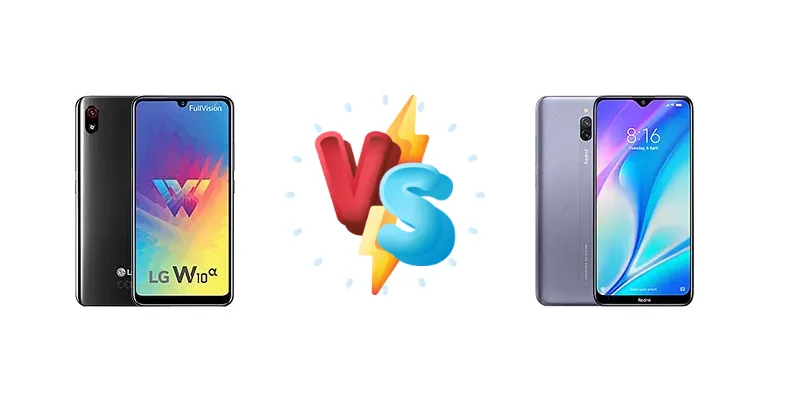
The LG W10 Alpha and Xiaomi Redmi 8A Pro represent two compelling options in the ultra-budget smartphone segment. While both aim to deliver essential smartphone functionality at a low price point, they take different approaches to achieving this. The W10 Alpha prioritizes a potentially more efficient chipset, while the Redmi 8A Pro focuses on faster charging and a slightly more powerful processor.
🏆 Quick Verdict
For the average user prioritizing quick top-ups and slightly smoother performance, the Xiaomi Redmi 8A Pro is the better choice. Its 18W charging capability and Snapdragon 439 chipset offer a tangible advantage over the LG W10 Alpha's Unisoc SC9863A, despite the latter's potentially better efficiency.
| Network |
|---|
| 2G bands | GSM 850 / 900 / 1800 / 1900 | GSM 850 / 900 / 1800 / 1900 |
| 3G bands | HSDPA 850 / 900 / 2100 | HSDPA 850 / 900 / 1900 / 2100 |
| 4G bands | 1, 3, 5, 8, 40, 41 | 1, 3, 5, 8, 40, 41 |
| Speed | HSPA 42.2/5.76 Mbps, LTE (2CA) Cat13 600/150 Mbps | HSPA, LTE |
| Technology | GSM / HSPA / LTE | GSM / HSPA / LTE |
| Launch |
|---|
| Announced | 2020, February 19. Released 2020, February 19 | 2020, April 02. Released 2020, April 02 |
| Status | Discontinued | Discontinued |
| Body |
|---|
| Build | - | Glass front (Gorilla Glass 5), plastic back, plastic frame |
| Dimensions | 147.3 x 71 x 8.9 mm (5.80 x 2.80 x 0.35 in) | 156.5 x 75.4 x 9.4 mm (6.16 x 2.97 x 0.37 in) |
| SIM | Nano-SIM + Nano-SIM | Nano-SIM + Nano-SIM |
| Weight | 170 g (6.00 oz) | 188 g (6.63 oz) |
| | - | Water-repellent coating |
| Display |
|---|
| Protection | - | Corning Gorilla Glass 5 |
| Resolution | 720 x 1512 pixels, 19:9 ratio (~293 ppi density) | 720 x 1520 pixels, 19:9 ratio (~270 ppi density) |
| Size | 5.71 inches, 81.7 cm2 (~78.1% screen-to-body ratio) | 6.22 inches, 96.6 cm2 (~81.8% screen-to-body ratio) |
| Type | IPS LCD | IPS LCD, 400 nits (typ) |
| Platform |
|---|
| CPU | Octa-core (4x1.6 GHz Cortex-A55 & 4x1.2 GHz Cortex-A55) | Octa-core (4x1.95 GHz Cortex-A53 & 4x1.45 GHz Cortex A53) |
| Chipset | Unisoc SC9863A (28 nm) | Qualcomm SDM439 Snapdragon 439 (12 nm) |
| GPU | IMG8322 | Adreno 505 |
| OS | Android 9.0 (Pie) | Android 9.0 (Pie), planned upgrade to Android 10, MIUI 12 |
| Memory |
|---|
| Card slot | microSDXC (dedicated slot) | microSDXC (dedicated slot) |
| Internal | 32GB 3GB RAM | 32GB 2GB RAM, 32GB 3GB RAM |
| | eMMC 5.1 | eMMC 5.1 |
| Main Camera |
|---|
| Dual | - | 13 MP, f/2.2, (wide), 1/3.1", 1.12µm, PDAF
Auxiliary lens |
| Features | LED flash, panorama, HDR | LED flash, HDR, panorama |
| Single | 8 MP, AF | - |
| Video | 1080p@30fps | 1080p@30fps |
| Selfie camera |
|---|
| Features | - | HDR |
| Single | 8 MP | 8 MP, f/2.0, 1/4.0", 1.12µm |
| Video | 720p@30fps | 1080p@30fps |
| Sound |
|---|
| 3.5mm jack | Yes | Yes |
| 35mm jack | Yes | Yes |
| Loudspeaker | Yes | Yes |
| Comms |
|---|
| Bluetooth | 4.1, A2DP, LE | 4.2, A2DP, LE |
| NFC | No | No |
| Positioning | GPS | GPS, GLONASS, BDS |
| Radio | FM radio | FM Radio, built-in antenna |
| USB | microUSB 2.0, OTG | USB Type-C 2.0, OTG |
| WLAN | Wi-Fi 802.11 b/g/n, Wi-Fi Direct | Wi-Fi 802.11 b/g/n, Wi-Fi Direct |
| Features |
|---|
| Sensors | Accelerometer, proximity | Accelerometer, proximity, compass |
| Battery |
|---|
| Charging | - | 18W wired
2.5W reverse wired |
| Type | Li-Po 3450 mAh | Li-Po 5000 mAh |
| Misc |
|---|
| Colors | Black, Blue | Sky White, Sea Blue, Midnight Grey |
| Models | LMX210, LMX210LMW, LM-X210LMW | - |
| Price | About 130 EUR | About 90 EUR |
LG W10 Alpha
- Potentially better power efficiency due to Unisoc chipset.
- May offer longer battery life for basic usage.
- Simple and straightforward user experience.
- Slower processor compared to Snapdragon 439.
- Likely slower charging speeds.
- Limited performance for demanding apps.
Xiaomi Redmi 8A Pro
- Faster Snapdragon 439 processor for smoother performance.
- 18W fast charging for quicker top-ups.
- 2.5W reverse wired charging for accessory power.
- Potentially slightly lower battery life due to more powerful processor.
- May run slightly warmer under heavy load.
- Qualcomm chipsets can sometimes have more bloatware.
Display Comparison
Neither device is expected to boast a high-end display. Details on panel type, resolution, and brightness are missing, but given the price bracket, both likely utilize IPS LCD panels. The focus here isn't on visual fidelity, but rather basic usability. Bezels are likely comparable, prioritizing cost reduction over a premium aesthetic. Color accuracy will likely be standard for this segment, leaning towards acceptable rather than accurate.
Camera Comparison
Camera performance is likely to be similar, with both devices likely featuring a primary sensor paired with depth or macro sensors of limited utility. Without specific sensor size or aperture information, it's difficult to make a definitive judgment. However, Qualcomm’s image signal processor (ISP) within the Snapdragon 439 generally offers better image processing capabilities than those found in Unisoc chipsets, potentially resulting in slightly better image quality in various lighting conditions. The Redmi 8A Pro's ISP will likely handle noise reduction and dynamic range more effectively.
Performance
The core difference lies in the chipsets. The Xiaomi Redmi 8A Pro’s Qualcomm Snapdragon 439 (12nm) has a clear architectural advantage over the LG W10 Alpha’s Unisoc SC9863A (28nm). The 12nm process node of the Snapdragon 439 translates to improved power efficiency and thermal performance compared to the older 28nm node of the Unisoc chip. While both are octa-core, the Snapdragon 439 utilizes Cortex-A53 cores clocked at 1.95 GHz, offering a performance edge over the W10 Alpha’s mix of 1.6 GHz and 1.2 GHz Cortex-A55 cores. This means the Redmi 8A Pro will handle multitasking and moderately demanding apps more smoothly. The Unisoc chip will likely be sufficient for basic tasks, but may struggle with heavier workloads.
Battery Life
Battery capacity is not specified for either device, but both likely fall in the 4000-5000 mAh range, typical for this price point. The key differentiator is charging speed. The Redmi 8A Pro’s 18W wired charging is a significant advantage, allowing for a much faster 0-100% charge compared to the W10 Alpha, which likely supports standard 5W or 10W charging. The Redmi 8A Pro also includes 2.5W reverse wired charging, a feature absent on the W10 Alpha, adding to its versatility.
Buying Guide
Buy the LG W10 Alpha if you prioritize long-term battery life and are less concerned with quick charging or demanding applications. Its Unisoc chipset, built on a 28nm process, may offer better power efficiency for basic tasks. Buy the Xiaomi Redmi 8A Pro if you need faster charging, a slightly more responsive user experience, and the convenience of reverse wired charging – ideal for topping up accessories or a friend's phone in a pinch.
Frequently Asked Questions
❓ Will the Redmi 8A Pro's Snapdragon 439 handle popular games like PUBG Mobile?
The Snapdragon 439 can run PUBG Mobile, but expect to play at lower graphics settings (balanced or low) to maintain a stable frame rate. It's not a gaming powerhouse, but it's capable of providing a playable experience for casual gamers.
❓ How long will it take to fully charge the Redmi 8A Pro with the 18W charger?
With the included 18W charger, the Redmi 8A Pro should fully charge from 0% to 100% in approximately 2-2.5 hours, a significant improvement over standard 5W or 10W charging.
❓ Is the reverse charging feature on the Redmi 8A Pro useful for more than just emergencies?
While primarily intended for emergencies, the 2.5W reverse charging can be useful for slowly topping up Bluetooth headphones, smartwatches, or other small accessories. It's not a fast charging solution, but it provides a convenient way to share power.
❓ Does the Unisoc SC9863A in the LG W10 Alpha get hot during prolonged use?
The Unisoc SC9863A, being built on a 28nm process, is more prone to thermal throttling than the Snapdragon 439. Prolonged use of demanding apps may result in noticeable heat and a slight performance decrease.