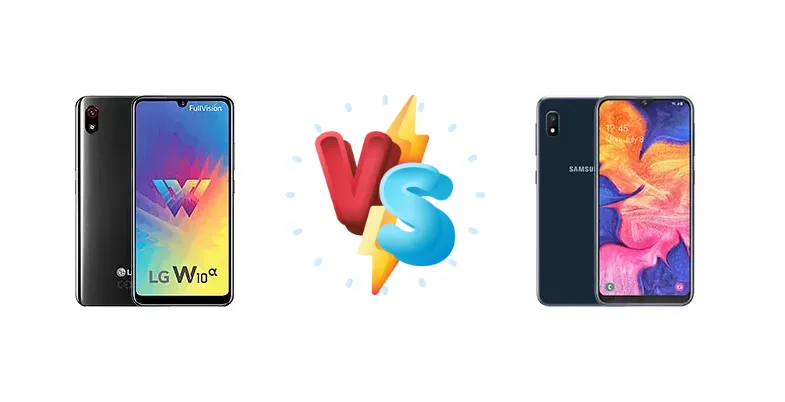
The LG W10 Alpha and Samsung Galaxy A10e represent a shrinking segment of the smartphone market: ultra-budget devices focused on essential functionality. Both phones aim to deliver a smartphone experience at the lowest possible price point, but they take different approaches to achieving this, primarily through their chipset choices. This comparison dissects those choices and reveals which phone offers the best value for your money.
🏆 Quick Verdict
For the average user prioritizing responsiveness and occasional multitasking, the Samsung Galaxy A10e is the better choice. Its Exynos 7884, built on a smaller 14nm process, delivers noticeably better CPU performance than the LG W10 Alpha’s Unisoc SC9863A. While the W10 Alpha may offer slightly better efficiency, the A10e’s performance advantage outweighs this.
| Network |
|---|
| 2G bands | GSM 850 / 900 / 1800 / 1900 | GSM 850 / 900 / 1800 / 1900 |
| 3G bands | HSDPA 850 / 900 / 2100 | HSDPA 850 / 1700(AWS) / 1900 / 2100 - AT&T |
| 4G bands | 1, 3, 5, 8, 40, 41 | 2, 3, 4, 5, 7, 12, 14, 29, 30, 66 - AT&T |
| Speed | HSPA 42.2/5.76 Mbps, LTE (2CA) Cat13 600/150 Mbps | HSPA 42.2/5.76 Mbps, LTE Cat4 150/50 Mbps |
| Technology | GSM / HSPA / LTE | GSM / CDMA / HSPA / LTE |
| | - | 1, 2, 3, 4, 5, 7, 8, 12, 13, 20, 25, 26, 28, 38, 39, 40, 41, 66, 71 - Metro PCS, T-Mobile |
| Launch |
|---|
| Announced | 2020, February 19. Released 2020, February 19 | 2019, July. Released 2019, August |
| Status | Discontinued | Discontinued |
| Body |
|---|
| Build | - | Glass front, plastic back, plastic frame |
| Dimensions | 147.3 x 71 x 8.9 mm (5.80 x 2.80 x 0.35 in) | 147.3 x 69.6 x 8.4 mm (5.80 x 2.74 x 0.33 in) |
| SIM | Nano-SIM + Nano-SIM | Nano-SIM |
| Weight | 170 g (6.00 oz) | 141 g (4.97 oz) |
| Display |
|---|
| Resolution | 720 x 1512 pixels, 19:9 ratio (~293 ppi density) | 720 x 1560 pixels, 19.5:9 ratio (~295 ppi density) |
| Size | 5.71 inches, 81.7 cm2 (~78.1% screen-to-body ratio) | 5.83 inches, 83.4 cm2 (~81.4% screen-to-body ratio) |
| Type | IPS LCD | PLS LCD |
| Platform |
|---|
| CPU | Octa-core (4x1.6 GHz Cortex-A55 & 4x1.2 GHz Cortex-A55) | Octa-core (2x1.6 GHz Cortex-A73 & 6x1.35 GHz Cortex-A53) |
| Chipset | Unisoc SC9863A (28 nm) | Exynos 7884 (14 nm) |
| GPU | IMG8322 | Mali-G71 MP2 |
| OS | Android 9.0 (Pie) | Android 9.0 (Pie), upgradable to Android 11, One UI 3.1 |
| Memory |
|---|
| Card slot | microSDXC (dedicated slot) | microSDXC (dedicated slot) |
| Internal | 32GB 3GB RAM | 32GB 2GB RAM, 32GB 3GB RAM |
| | eMMC 5.1 | eMMC 5.1 |
| Main Camera |
|---|
| Features | LED flash, panorama, HDR | LED flash, panorama, HDR |
| Single | 8 MP, AF | 8 MP, f/1.9, AF
or
5 MP, AF |
| Video | 1080p@30fps | 1080p@30fps |
| Selfie camera |
|---|
| Single | 8 MP | 5 MP, f/2.0
or
2 MP |
| Video | 720p@30fps | - |
| Sound |
|---|
| 3.5mm jack | Yes | Yes |
| 35mm jack | Yes | Yes |
| Loudspeaker | Yes | Yes |
| Comms |
|---|
| Bluetooth | 4.1, A2DP, LE | 5.0, A2DP, LE |
| NFC | No | No |
| Positioning | GPS | GPS, GLONASS, GALILEO |
| Radio | FM radio | No |
| USB | microUSB 2.0, OTG | USB Type-C 2.0 |
| WLAN | Wi-Fi 802.11 b/g/n, Wi-Fi Direct | Wi-Fi 802.11 a/b/g/n/ac, dual-band, Wi-Fi Direct |
| Features |
|---|
| Sensors | Accelerometer, proximity | Accelerometer, proximity |
| Battery |
|---|
| Type | Li-Po 3450 mAh | Li-Ion 3000 mAh, non-removable |
| Misc |
|---|
| Colors | Black, Blue | Black |
| Models | LMX210, LMX210LMW, LM-X210LMW | SM-A102U, SM-S102DL, SM-A102U1, SM-A102W, SM-A102N |
| Price | About 130 EUR | About 80 EUR |
| SAR | - | 0.47 W/kg (head) 0.54 W/kg (body) |
LG W10 Alpha
- Potentially better battery life in extremely light usage.
- Lowest possible price point.
- Simple and straightforward Android experience.
- Significantly slower CPU performance.
- Less responsive user interface.
- Limited multitasking capabilities.
Samsung Galaxy A10e
- Faster and more responsive CPU.
- Smoother multitasking experience.
- Samsung’s refined software and image processing.
- Potentially slightly shorter battery life under load.
- May be slightly more expensive than the W10 Alpha.
- Still a budget device with inherent limitations.
Display Comparison
Neither LG nor Samsung provided detailed display specs for these models. However, given their price points, it’s safe to assume both utilize IPS LCD panels with 720p+ resolutions. The lack of detailed specs makes a direct comparison difficult, but the A10e likely benefits from Samsung’s more refined display calibration, potentially offering slightly more accurate colors. Bezels are expected to be substantial on both devices, reflecting their budget nature.
Camera Comparison
Both phones likely feature basic camera setups. Details are scarce, but it’s reasonable to assume the A10e has a slight advantage due to Samsung’s image processing expertise. While both may include a primary sensor and depth sensor, the quality of these sensors is likely similar. The presence of a 2MP macro camera on either device is largely marketing fluff and offers minimal practical benefit. Image quality will be acceptable in good lighting conditions, but expect significant noise and softness in low light.
Performance
The core difference lies in the chipsets. The Samsung Galaxy A10e’s Exynos 7884, fabricated on a 14nm process, features a more powerful CPU configuration: two Cortex-A73 cores clocked at 1.6 GHz and six Cortex-A53 cores at 1.35 GHz. This contrasts with the LG W10 Alpha’s Unisoc SC9863A, which uses four Cortex-A55 cores at 1.6 GHz and four at 1.2 GHz. The A73 cores in the A10e are significantly more capable than the A55 cores in the W10 Alpha, resulting in faster app loading times and smoother multitasking. The 14nm process of the Exynos also allows for potentially better sustained performance under load, though thermal throttling remains a concern in this price bracket. The Unisoc’s 28nm process, while potentially more power-efficient at idle, is less efficient overall and limits its performance ceiling.
Battery Life
Battery capacity details are unavailable. However, the Unisoc SC9863A’s 28nm process *could* translate to slightly better battery life during very light usage, such as standby and minimal calling. However, the Exynos 7884’s more efficient CPU architecture when actively used may offset this advantage. Charging speeds are also unknown, but likely slow on both devices, relying on Micro-USB connectivity.
Buying Guide
Buy the LG W10 Alpha if you prioritize absolute minimal cost and are primarily using the phone for very basic tasks like calls, texts, and light social media. Its Unisoc chipset is designed for efficiency, potentially offering slightly longer battery life in extremely light usage scenarios. Buy the Samsung Galaxy A10e if you need a phone that can handle more demanding tasks, such as running multiple apps simultaneously, browsing with numerous tabs open, or playing less-intensive mobile games. The Exynos 7884 provides a smoother, more responsive experience.
Frequently Asked Questions
❓ Does the Exynos 7884 in the Galaxy A10e suffer from significant overheating during prolonged use?
While the Exynos 7884 isn't a high-end chip, its 14nm process and relatively modest performance targets mean overheating isn't a major concern. Expect some warmth during extended gaming sessions, but it's unlikely to cause significant throttling or performance degradation. The phone's plastic build also helps dissipate heat.
❓ Is the Unisoc SC9863A in the LG W10 Alpha capable of running popular games like PUBG Mobile?
PUBG Mobile is likely playable on the LG W10 Alpha, but only at the lowest graphics settings and frame rates. Expect significant lag and stuttering, even with reduced settings. The chipset simply lacks the processing power for a smooth gaming experience. The A10e will provide a far more playable experience, even if still requiring compromises.
❓ How does the software experience differ between the LG W10 Alpha and Samsung Galaxy A10e?
The Samsung Galaxy A10e will likely offer a more polished software experience with Samsung's One UI, which includes features like gesture navigation and a more refined user interface. LG's software on the W10 Alpha is likely to be a more basic, stock Android experience, potentially with fewer features and customizations.