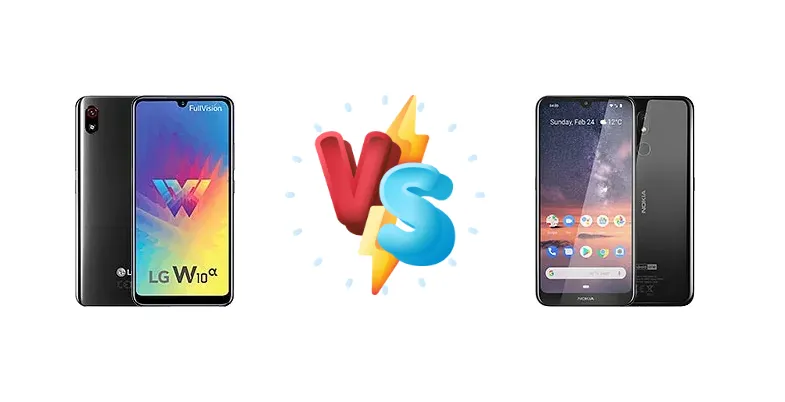
The LG W10 Alpha and Nokia 3.2 represent the lower end of the smartphone spectrum, targeting users prioritizing affordability. However, they take different approaches to achieving this price point, particularly in their chipset choices. This comparison dissects the key differences between the Unisoc SC9863A-powered LG W10 Alpha and the Qualcomm Snapdragon 429-equipped Nokia 3.2, revealing which device delivers a smoother experience for everyday tasks.
🏆 Quick Verdict
For the average user seeking a basic smartphone for calls, messaging, and light social media, the Nokia 3.2 emerges as the slightly better choice. Its more efficient Snapdragon 429, fabricated on a 12nm process, offers a better balance of performance and battery life compared to the LG W10 Alpha’s less refined Unisoc SC9863A.
| Network |
|---|
| 2G bands | GSM 850 / 900 / 1800 / 1900 | GSM 850 / 900 / 1800 / 1900 |
| 3G bands | HSDPA 850 / 900 / 2100 | HSDPA 850 / 900 / 2100 |
| 4G bands | 1, 3, 5, 8, 40, 41 | 1, 3, 5, 7, 8, 20, 28, 38, 40 - EMEA, APAC, MENA |
| Speed | HSPA 42.2/5.76 Mbps, LTE (2CA) Cat13 600/150 Mbps | HSPA 42.2/5.76 Mbps, LTE Cat4 150/50 Mbps |
| Technology | GSM / HSPA / LTE | GSM / HSPA / LTE |
| | - | 1, 3, 5, 8, 40, 41 - India |
| Launch |
|---|
| Announced | 2020, February 19. Released 2020, February 19 | 2019, February 24. Released 2019, May 22 |
| Status | Discontinued | Discontinued |
| Body |
|---|
| Build | - | Glass front, plastic back, plastic frame |
| Dimensions | 147.3 x 71 x 8.9 mm (5.80 x 2.80 x 0.35 in) | 159.4 x 76.2 x 8.6 mm (6.28 x 3.00 x 0.34 in) |
| SIM | Nano-SIM + Nano-SIM | Nano-SIM + Nano-SIM |
| Weight | 170 g (6.00 oz) | 181 g (6.38 oz) |
| Display |
|---|
| Resolution | 720 x 1512 pixels, 19:9 ratio (~293 ppi density) | 720 x 1520 pixels, 19:9 ratio (~269 ppi density) |
| Size | 5.71 inches, 81.7 cm2 (~78.1% screen-to-body ratio) | 6.26 inches, 97.8 cm2 (~80.5% screen-to-body ratio) |
| Type | IPS LCD | IPS LCD |
| Platform |
|---|
| CPU | Octa-core (4x1.6 GHz Cortex-A55 & 4x1.2 GHz Cortex-A55) | Quad-core 1.8 GHz Cortex-A53 |
| Chipset | Unisoc SC9863A (28 nm) | Qualcomm SDM429 Snapdragon 429 (12 nm) |
| GPU | IMG8322 | Adreno 504 |
| OS | Android 9.0 (Pie) | Android 9.0 (Pie), upgradable to Android 11, Android One |
| Memory |
|---|
| Card slot | microSDXC (dedicated slot) | microSDXC (dedicated slot) |
| Internal | 32GB 3GB RAM | 16GB 2GB RAM, 32GB 3GB RAM, 64GB 3GB RAM |
| | eMMC 5.1 | eMMC 5.1 |
| Main Camera |
|---|
| Features | LED flash, panorama, HDR | LED flash |
| Single | 8 MP, AF | 13 MP, f/2.2, 1/3.1", 1.12µm, AF |
| Video | 1080p@30fps | 1080p@30fps |
| Selfie camera |
|---|
| Single | 8 MP | 5 MP, f/2.2, 27mm (wide), 1/5.0", 1.12µm |
| Video | 720p@30fps | - |
| Sound |
|---|
| 3.5mm jack | Yes | Yes |
| 35mm jack | Yes | Yes |
| Loudspeaker | Yes | Yes |
| Comms |
|---|
| Bluetooth | 4.1, A2DP, LE | 4.2, A2DP, LE, aptX |
| NFC | No | No |
| Positioning | GPS | GPS, GLONASS, BDS |
| Radio | FM radio | FM radio |
| USB | microUSB 2.0, OTG | microUSB 2.0, OTG |
| WLAN | Wi-Fi 802.11 b/g/n, Wi-Fi Direct | Wi-Fi 802.11 b/g/n |
| Features |
|---|
| Sensors | Accelerometer, proximity | Fingerprint (rear-mounted, 32/3GB only), accelerometer, proximity |
| Battery |
|---|
| Charging | - | 10W wired |
| Type | Li-Po 3450 mAh | Li-Ion 4000 mAh, non-removable |
| Misc |
|---|
| Colors | Black, Blue | Black, Steel |
| Models | LMX210, LMX210LMW, LM-X210LMW | TA-1156, TA-1159, TA-1164 |
| Price | About 130 EUR | About 140 EUR |
| SAR EU | - | 0.24 W/kg (head) 1.63 W/kg (body) |
LG W10 Alpha
- Octa-core processor may handle multitasking slightly better.
- Potentially lower cost depending on market.
- Larger core count could benefit specific, optimized apps.
- Less efficient 28nm manufacturing process.
- Unisoc chipset generally less optimized than Qualcomm.
- Likely to experience more thermal throttling.
Nokia 3.2
- More efficient 12nm Snapdragon 429 chipset.
- Qualcomm’s optimized software and drivers.
- Android One provides a cleaner software experience.
- 10W charging offers a slight advantage.
- Quad-core processor may struggle with heavy multitasking.
- Potentially slightly higher price point.
- Limited gaming performance.
Display Comparison
Neither device boasts a standout display. Details regarding panel type, resolution, and brightness are unavailable, suggesting both utilize basic LCD panels common in this price bracket. However, the focus here is on internal components, and display differences are unlikely to be a deciding factor for most users. Bezels are likely to be substantial on both, reflecting their budget positioning.
Camera Comparison
Camera performance is likely to be similar on both devices, with both likely featuring basic sensors. Without specific sensor details, it’s safe to assume image quality will be adequate for casual snapshots in good lighting conditions. The presence of a 2MP macro lens on either device is largely a marketing gimmick, offering minimal practical benefit due to the low resolution and lack of optical image stabilization (OIS).
Performance
The core architectural difference lies in the chipsets. The LG W10 Alpha’s Unisoc SC9863A features an octa-core configuration, split between 1.6GHz and 1.2GHz Cortex-A55 cores. While the higher core count *suggests* multitasking potential, the Cortex-A55 architecture is less performant than the Cortex-A53 found in the Nokia 3.2. The Nokia 3.2’s Snapdragon 429, with its quad-core 1.8GHz Cortex-A53 setup, benefits from a more efficient 12nm manufacturing process compared to the LG’s 28nm process. This translates to lower power consumption and potentially less thermal throttling under sustained load. The Snapdragon 429’s architecture, while fewer in number, are more capable individual cores, making it better suited for single-threaded tasks.
Battery Life
Battery capacity details are missing for both devices. However, the Nokia 3.2’s 10W wired charging and the Snapdragon 429’s superior power efficiency give it an advantage. The 12nm process allows for more efficient power management, meaning the Nokia 3.2 is likely to achieve a longer screen-on time and potentially faster charging cycles, even with a similar battery capacity to the LG W10 Alpha.
Buying Guide
Buy the LG W10 Alpha if you prioritize a higher core count and anticipate needing to run multiple apps simultaneously, even if it comes at the cost of battery efficiency. Buy the Nokia 3.2 if you value a smoother, more consistent experience for everyday tasks, and prefer a chipset known for its power efficiency and stable performance, even with fewer cores. The Nokia 3.2 is also a better choice for users who appreciate the clean Android One experience.
Frequently Asked Questions
❓ Will the LG W10 Alpha struggle with popular apps like WhatsApp and Facebook?
While the LG W10 Alpha can likely run these apps, the Unisoc SC9863A’s less efficient architecture and 28nm process may result in noticeable lag or slowdowns when multitasking or using these apps for extended periods. The Nokia 3.2’s Snapdragon 429 is better optimized for these common tasks.
❓ Is the Nokia 3.2 a good choice for playing mobile games?
Neither the LG W10 Alpha nor the Nokia 3.2 are ideal for gaming. The Snapdragon 429 in the Nokia 3.2 will offer a slightly smoother experience for less demanding titles, but both devices will struggle with graphically intensive games. Expect low frame rates and the need to lower graphics settings significantly.
❓ Does the Nokia 3.2's Android One software offer any advantages?
Yes, Android One provides a clean, bloatware-free Android experience with guaranteed software updates for a certain period. This means fewer pre-installed apps consuming resources and faster access to security patches, enhancing the overall user experience and security of the Nokia 3.2.