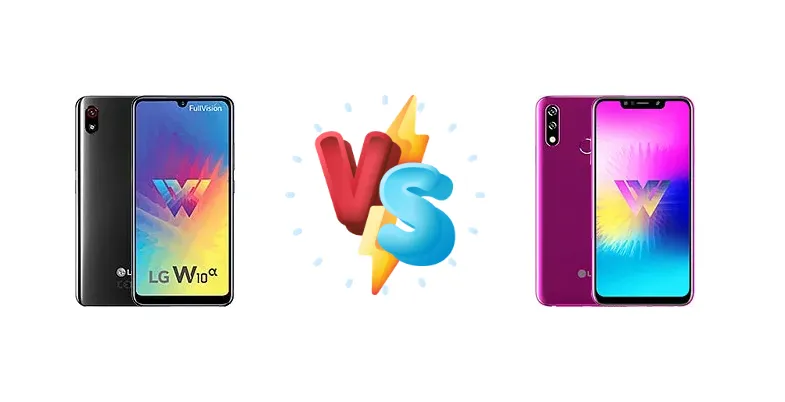
The LG W10 Alpha and W10 represent LG's foray into the ultra-budget smartphone market. While visually similar, a key difference lies under the hood: the W10 Alpha utilizes a Unisoc SC9863A chipset, while the W10 features the Mediatek Helio P22. This comparison dissects these chipset choices, analyzing their impact on performance, efficiency, and overall user experience.
🏆 Quick Verdict
For the average user prioritizing sustained performance and responsiveness, the LG W10 with its Mediatek Helio P22 is the better choice. The P22’s 12nm process and higher clock speeds translate to a smoother experience, particularly with multitasking and moderately demanding apps, despite the Alpha's octa-core configuration.
| Network |
|---|
| 2G bands | GSM 850 / 900 / 1800 / 1900 | GSM 850 / 900 / 1800 / 1900 |
| 3G bands | HSDPA 850 / 900 / 2100 | HSDPA 850 / 900 / 1900 / 2100 |
| 4G bands | 1, 3, 5, 8, 40, 41 | 1, 3, 5, 8, 40, 41 |
| Speed | HSPA 42.2/5.76 Mbps, LTE (2CA) Cat13 600/150 Mbps | HSPA, LTE |
| Technology | GSM / HSPA / LTE | GSM / HSPA / LTE |
| Launch |
|---|
| Announced | 2020, February 19. Released 2020, February 19 | 2019, June. Released 2019, July |
| Status | Discontinued | Discontinued |
| Body |
|---|
| Dimensions | 147.3 x 71 x 8.9 mm (5.80 x 2.80 x 0.35 in) | 156 x 76.2 x 8.5 mm (6.14 x 3.00 x 0.33 in) |
| SIM | Nano-SIM + Nano-SIM | · Nano-SIM· Nano-SIM + Nano-SIM |
| Weight | 170 g (6.00 oz) | 164 g (5.78 oz) |
| Display |
|---|
| Resolution | 720 x 1512 pixels, 19:9 ratio (~293 ppi density) | 720 x 1512 pixels, 19:9 ratio (~271 ppi density) |
| Size | 5.71 inches, 81.7 cm2 (~78.1% screen-to-body ratio) | 6.19 inches, 96.0 cm2 (~80.7% screen-to-body ratio) |
| Type | IPS LCD | IPS LCD |
| Platform |
|---|
| CPU | Octa-core (4x1.6 GHz Cortex-A55 & 4x1.2 GHz Cortex-A55) | Octa-core 2.0 GHz Cortex-A53 |
| Chipset | Unisoc SC9863A (28 nm) | Mediatek MT6762 Helio P22 (12 nm) |
| GPU | IMG8322 | PowerVR GE8320 |
| OS | Android 9.0 (Pie) | Android 9.0 (Pie) |
| Memory |
|---|
| Card slot | microSDXC (dedicated slot) | microSDXC (dedicated slot) |
| Internal | 32GB 3GB RAM | 32GB 3GB RAM |
| | eMMC 5.1 | eMMC 5.1 |
| Main Camera |
|---|
| Dual | - | 13 MP, PDAF
Auxiliary lens |
| Features | LED flash, panorama, HDR | LED flash, panorama, HDR |
| Single | 8 MP, AF | - |
| Video | 1080p@30fps | 1080p@30fps |
| Selfie camera |
|---|
| Features | - | LED flash |
| Single | 8 MP | 8 MP |
| Video | 720p@30fps | 1080p@30fps |
| Sound |
|---|
| 3.5mm jack | Yes | Yes |
| 35mm jack | Yes | Yes |
| Loudspeaker | Yes | Yes |
| Comms |
|---|
| Bluetooth | 4.1, A2DP, LE | 4.2, A2DP, LE |
| NFC | No | No |
| Positioning | GPS | GPS, GLONASS |
| Radio | FM radio | FM radio |
| USB | microUSB 2.0, OTG | microUSB 2.0, OTG |
| WLAN | Wi-Fi 802.11 b/g/n, Wi-Fi Direct | Wi-Fi 802.11 b/g/n, Wi-Fi Direct |
| Features |
|---|
| Sensors | Accelerometer, proximity | Fingerprint (rear-mounted), accelerometer, gyro, proximity |
| Battery |
|---|
| Type | Li-Po 3450 mAh | Li-Po 4000 mAh, non-removable |
| Misc |
|---|
| Colors | Black, Blue | Tulip Purple, Smokey Grey |
| Models | LMX210, LMX210LMW, LM-X210LMW | LMX130IM |
| Price | About 130 EUR | About 110 EUR |
LG W10 Alpha
- Potentially longer battery life due to the 28nm process.
- Octa-core CPU configuration.
- May be more affordable depending on market conditions.
- Slower CPU clock speeds compared to the W10.
- Older 28nm manufacturing process leads to lower efficiency.
- Likely less responsive user experience.
LG W10
- Faster CPU clock speeds (2.0 GHz).
- More efficient 12nm manufacturing process.
- Better overall performance for multitasking and apps.
- Potentially shorter battery life compared to the W10 Alpha.
- May be slightly more expensive.
- Cortex-A53 cores are older architecture than A55.
Display Comparison
Both devices likely feature similar LCD panels, given their market positioning. However, detailed display specs like brightness (nits) and color gamut coverage are unavailable. The focus here is on the chipset, which won't directly impact display quality but *will* affect how smoothly animations and scrolling appear. A faster processor can render frames more consistently, improving perceived visual fluidity.
Camera Comparison
Without detailed camera sensor information, a direct comparison is difficult. Both phones likely feature basic camera setups geared towards casual photography. The chipset’s image signal processor (ISP) plays a role in image processing speed and quality. The Helio P22’s ISP is generally considered more capable than the one found in the SC9863A, potentially resulting in slightly better image clarity and faster processing times. Any 2MP macro or depth sensors on either device should be considered supplementary features with limited real-world benefit.
Performance
The core difference lies in the chipsets. The LG W10’s Mediatek Helio P22 (12nm) boasts an octa-core CPU clocked at 2.0 GHz using Cortex-A53 cores. The W10 Alpha, conversely, uses the Unisoc SC9863A (28nm) with an octa-core CPU split between 1.6 GHz and 1.2 GHz Cortex-A55 cores. While both are octa-core, the Helio P22’s newer Cortex-A53 architecture and higher clock speed provide a significant performance advantage. The 12nm manufacturing process of the P22 also contributes to better power efficiency compared to the W10 Alpha’s older 28nm process. This means the W10 will likely experience less thermal throttling under sustained load. The A55 cores in the Alpha are more efficient *per clock cycle*, but the lower overall clock speed and older process node negate this advantage.
Battery Life
Battery capacity is not specified in the provided data. However, the Unisoc SC9863A’s 28nm process and lower clock speeds *suggest* potentially better battery life compared to the W10’s Helio P22. However, this advantage could be offset by less efficient power management or a smaller battery capacity in the W10 Alpha. The W10’s faster processor will consume more power under load, but the difference in real-world usage will depend on individual usage patterns. Charging wattage is also unknown, making it impossible to compare charging speeds.
Buying Guide
Buy the LG W10 Alpha if you prioritize potentially longer battery life due to the Unisoc chip's lower clock speeds and 28nm process, and your usage is primarily limited to basic tasks like calls, messaging, and light social media. Buy the LG W10 if you prefer a more responsive user experience, better app loading times, and the ability to handle slightly more demanding applications without significant slowdowns, even if it means slightly reduced battery endurance.
Frequently Asked Questions
❓ Will the Unisoc SC9863A in the W10 Alpha struggle with popular apps like Facebook or WhatsApp?
While the W10 Alpha can run these apps, the Unisoc SC9863A’s lower processing power may result in slower loading times and occasional lag, especially when multitasking. The W10’s Helio P22 will provide a smoother experience with these commonly used applications.
❓ Is the Helio P22 in the LG W10 capable of playing mobile games like PUBG Mobile or Call of Duty Mobile?
The Helio P22 can run PUBG Mobile and Call of Duty Mobile, but likely at lower graphics settings and frame rates to maintain playable performance. Expect noticeable frame drops and potential stuttering, especially in intense scenes. The W10 Alpha would likely perform even worse in these scenarios.
❓ Does the 28nm process of the Unisoc chip in the W10 Alpha mean it will get significantly hotter during use?
The 28nm process is less efficient than the 12nm process in the Helio P22, meaning the W10 Alpha is more likely to generate heat under load. While it won't likely overheat to the point of being unusable, it may experience more thermal throttling, reducing performance over extended periods.