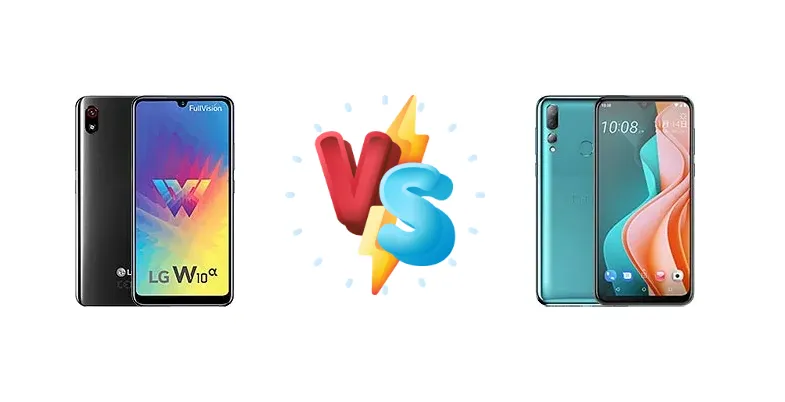
The LG W10 Alpha and HTC Desire 19s represent two approaches to the ultra-budget smartphone market. The LG prioritizes efficiency with its Unisoc chipset, while the HTC aims for a bit more raw performance with a MediaTek Helio P22. This comparison dissects their key differences to determine which device delivers the best value for users seeking an affordable Android experience.
🏆 Quick Verdict
For the average user prioritizing battery life and a smoother, less demanding experience, the LG W10 Alpha is the better choice. However, the HTC Desire 19s offers a noticeable performance boost for those willing to trade some battery longevity and potentially deal with more thermal throttling.
| Network |
|---|
| 2G bands | GSM 850 / 900 / 1800 / 1900 | GSM 850 / 900 / 1800 / 1900 |
| 3G bands | HSDPA 850 / 900 / 2100 | HSDPA 850 / 900 / 1900 / 2100 |
| 4G bands | 1, 3, 5, 8, 40, 41 | 1, 2, 3, 5, 7, 8, 20, 28, 38, 39, 40, 41 |
| Speed | HSPA 42.2/5.76 Mbps, LTE (2CA) Cat13 600/150 Mbps | HSPA 42.2/5.76 Mbps, LTE (2CA) Cat6 300/50 Mbps |
| Technology | GSM / HSPA / LTE | GSM / HSPA / LTE |
| Launch |
|---|
| Announced | 2020, February 19. Released 2020, February 19 | 2019, November 14. Released 2019, November 14 |
| Status | Discontinued | Discontinued |
| Body |
|---|
| Build | - | Glass front, plastic back, plastic frame |
| Dimensions | 147.3 x 71 x 8.9 mm (5.80 x 2.80 x 0.35 in) | 156.2 x 74.8 x 8.5 mm (6.15 x 2.94 x 0.33 in) |
| SIM | Nano-SIM + Nano-SIM | Nano-SIM + Nano-SIM |
| Weight | 170 g (6.00 oz) | 170 g (6.00 oz) |
| Display |
|---|
| Resolution | 720 x 1512 pixels, 19:9 ratio (~293 ppi density) | 720 x 1520 pixels, 19:9 ratio (~271 ppi density) |
| Size | 5.71 inches, 81.7 cm2 (~78.1% screen-to-body ratio) | 6.2 inches, 95.9 cm2 (~82.1% screen-to-body ratio) |
| Type | IPS LCD | IPS LCD |
| Platform |
|---|
| CPU | Octa-core (4x1.6 GHz Cortex-A55 & 4x1.2 GHz Cortex-A55) | Octa-core 2.0 GHz Cortex-A53 |
| Chipset | Unisoc SC9863A (28 nm) | Mediatek MT6762 Helio P22 (12 nm) |
| GPU | IMG8322 | PowerVR GE8320 |
| OS | Android 9.0 (Pie) | Android 9 (Pie) |
| Memory |
|---|
| Card slot | microSDXC (dedicated slot) | microSDXC (uses shared SIM slot) |
| Internal | 32GB 3GB RAM | 32GB 3GB RAM |
| | eMMC 5.1 | eMMC 5.1 |
| Main Camera |
|---|
| Features | LED flash, panorama, HDR | Dual-LED dual-tone flash, HDR, panorama |
| Single | 8 MP, AF | - |
| Triple | - | 13 MP, f/1.9, 26mm (wide), PDAF
5 MP, f/2.2, 13mm (ultrawide)
Auxiliary lens |
| Video | 1080p@30fps | 1080p@30fps |
| Selfie camera |
|---|
| Features | - | HDR |
| Single | 8 MP | 16 MP, f/2.0, 27mm (wide), 1/3.06", 1.0µm |
| Video | 720p@30fps | 1080p@30fps |
| Sound |
|---|
| 3.5mm jack | Yes | Yes |
| 35mm jack | Yes | Yes |
| Loudspeaker | Yes | Yes |
| Comms |
|---|
| Bluetooth | 4.1, A2DP, LE | 5.0, A2DP, LE |
| NFC | No | Yes |
| Positioning | GPS | GPS, GLONASS, BDS |
| Radio | FM radio | FM radio |
| USB | microUSB 2.0, OTG | USB Type-C 2.0, OTG |
| WLAN | Wi-Fi 802.11 b/g/n, Wi-Fi Direct | Wi-Fi 802.11 a/b/g/n/ac, dual-band, Wi-Fi Direct |
| Features |
|---|
| Sensors | Accelerometer, proximity | Fingerprint (rear-mounted), accelerometer, proximity, compass |
| Battery |
|---|
| Charging | - | 10W wired |
| Type | Li-Po 3450 mAh | Li-Ion 3850 mAh, non-removable |
| Misc |
|---|
| Colors | Black, Blue | Blue, Black |
| Models | LMX210, LMX210LMW, LM-X210LMW | - |
| Price | About 130 EUR | About 180 EUR |
LG W10 Alpha
- Potentially longer battery life due to efficient chipset.
- Lower thermal output, leading to more consistent performance.
- Likely more affordable price point.
- Slower processor, resulting in less responsive performance.
- May struggle with demanding apps and multitasking.
- Limited gaming capabilities.
HTC Desire 19s
- Faster processor for smoother multitasking and app launches.
- Better performance in casual games.
- 10W charging support.
- Shorter battery life due to more powerful chipset.
- Potential for thermal throttling under sustained load.
- May be slightly more expensive.
Display Comparison
Neither device boasts a standout display. Both likely feature LCD panels, typical for this price bracket. However, the lack of detailed display specs necessitates focusing on the chipset's impact on UI smoothness. The LG W10 Alpha's less powerful chipset may struggle to deliver a consistently fluid 60Hz experience, while the HTC Desire 19s, with its faster CPU, has a better chance of maintaining a smoother visual experience, even if the panel itself is basic.
Camera Comparison
Both phones are expected to feature basic camera setups. Without detailed sensor information, it's difficult to make a definitive judgment. However, the HTC Desire 19s’ more powerful chipset could potentially handle more complex image processing algorithms, leading to slightly better image quality in favorable lighting conditions. The presence of a 10W charging capability on the HTC suggests a slightly more robust power management system, which *could* translate to better camera performance, as image processing is power-intensive. It's safe to assume both phones will struggle in low-light scenarios.
Performance
The core difference lies in the chipsets. The HTC Desire 19s’ MediaTek Helio P22 (12nm) utilizes Cortex-A53 cores clocked at 2.0 GHz, offering a clear advantage in raw processing power over the LG W10 Alpha’s Unisoc SC9863A (28nm) with its split core configuration (1.6GHz & 1.2GHz Cortex-A55). The 12nm process node of the Helio P22 is significantly more efficient than the 28nm node of the SC9863A, but the higher clock speeds and more capable cores still mean the HTC will likely generate more heat under load. This translates to better app launch times and smoother multitasking on the HTC, but potentially more throttling during extended gaming sessions. The LG, while slower, will likely maintain consistent performance for longer due to its lower thermal output.
Battery Life
While battery capacities are unknown, the Unisoc SC9863A’s 28nm process inherently consumes less power than the MediaTek Helio P22’s 12nm process, despite the latter’s more efficient architecture. This suggests the LG W10 Alpha will likely offer longer battery life on a single charge. The HTC Desire 19s’ 10W wired charging is a modest feature, indicating a standard charging time of around 3-4 hours for a full charge. The LG’s charging speed is likely similar, but its lower power consumption means it may reach full charge slightly faster.
Buying Guide
Buy the LG W10 Alpha if you need a phone primarily for basic tasks like calling, texting, and light social media use, and value long battery life. It's ideal for first-time smartphone users or those seeking a reliable secondary device. Buy the HTC Desire 19s if you prefer a slightly more responsive experience for casual gaming or multitasking, and don't mind more frequent charging or potential performance dips under sustained load.
Frequently Asked Questions
❓ Will the HTC Desire 19s overheat during prolonged gaming sessions?
The MediaTek Helio P22, while offering better performance, is more prone to thermal throttling than the Unisoc SC9863A. Expect performance to decrease after 20-30 minutes of demanding games, and the phone may become noticeably warm to the touch.
❓ Is the LG W10 Alpha suitable for running multiple apps simultaneously?
The LG W10 Alpha's Unisoc SC9863A is designed for basic tasks. While it can handle a few apps, multitasking with more than 3-4 apps open simultaneously will likely result in noticeable slowdowns and lag.
❓ Does the HTC Desire 19s support fast charging beyond 10W?
No, the HTC Desire 19s only supports 10W wired charging. This is a standard charging speed for devices in this price range, and you shouldn't expect significantly faster charging times.
❓ Which phone is better for someone upgrading from a feature phone?
The LG W10 Alpha is the better choice for a first-time smartphone user. Its simpler chipset and focus on efficiency provide a more forgiving experience, and the longer battery life is a significant benefit for those unfamiliar with daily charging routines.