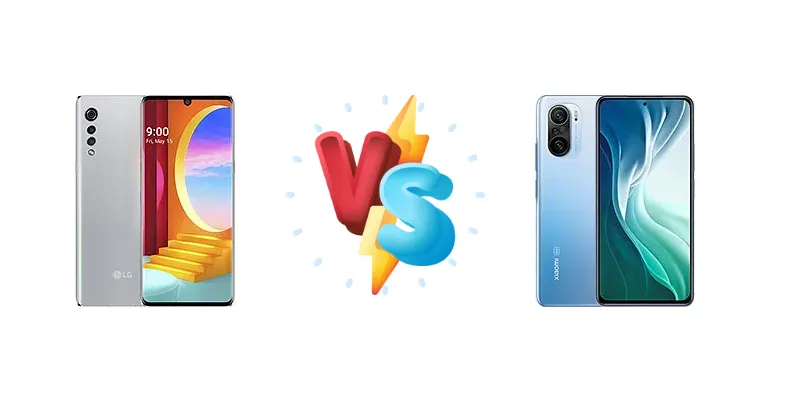
The LG Velvet and Xiaomi Mi 11i represent different approaches to the mid-range smartphone market. The Velvet, released with a focus on design and a more refined experience, now faces a strong contender in the Mi 11i, which prioritizes raw performance with a newer generation chipset. This comparison dissects their key differences to determine which device offers the best value in today's market.
🏆 Quick Verdict
For most users, the Xiaomi Mi 11i is the clear winner. Its Snapdragon 888 5G chipset delivers significantly faster performance and future-proofs the device for demanding applications and games. While the LG Velvet offers a unique aesthetic, the Mi 11i’s superior processing power and faster charging outweigh its advantages.
| Network |
|---|
| 2G bands | GSM 850 / 900 / 1800 / 1900 | GSM 850 / 900 / 1800 / 1900 |
| 3G bands | HSDPA 850 / 900 / 1900 / 2100 | HSDPA 850 / 900 / 1700(AWS) / 1900 / 2100 |
| 4G bands | 1, 3, 7, 8, 20, 28, 38, 40 | 1, 2, 3, 4, 5, 7, 8, 12, 17, 20, 28, 38, 40, 41, 66 |
| 5G bands | - | 1, 3, 5, 7, 8, 20, 28, 38, 41, 77, 78 SA/NSA |
| Speed | HSPA, LTE | HSPA, LTE, 5G |
| Technology | GSM / HSPA / LTE | GSM / HSPA / LTE / 5G |
| Launch |
|---|
| Announced | 2020, July 28. Released 2020, July 31 | 2021, March 29 |
| Status | Discontinued | Available. Released 2021, May 31 |
| Body |
|---|
| Build | Glass front, glass back, aluminum frame | - |
| Dimensions | 167.1 x 74.1 x 7.9 mm (6.58 x 2.92 x 0.31 in) | 163.7 x 76.4 x 7.8 mm (6.44 x 3.01 x 0.31 in) |
| SIM | Nano-SIM + Nano-SIM | Nano-SIM + Nano-SIM |
| Weight | 180 g (6.35 oz) | 196 g (6.91 oz) |
| | IP68 dust/water resistant (up to 1.5m for 30 min)
MIL-STD-810G compliant*
*does not guarantee ruggedness or use in extreme conditions | IP53, dust and splash resistant |
| Display |
|---|
| Protection | - | Corning Gorilla Glass 5 |
| Resolution | 1080 x 2460 pixels (~395 ppi density) | 1080 x 2400 pixels, 20:9 ratio (~395 ppi density) |
| Size | 6.8 inches, 109.8 cm2 (~88.7% screen-to-body ratio) | 6.67 inches, 107.4 cm2 (~85.9% screen-to-body ratio) |
| Type | P-OLED | Super AMOLED, 120Hz, HDR10+, 900 nits (HBM), 1300 nits (peak) |
| Platform |
|---|
| CPU | Octa-core (4x2.8 GHz Kryo 385 Gold & 4x1.8 GHz Kryo 385 Silver) | Octa-core (1x2.84 GHz Cortex-X1 & 3x2.42 GHz Cortex-A78 & 4x1.80 GHz Cortex-A55) |
| Chipset | Qualcomm SDM845 Snapdragon 845 (10 nm) | Qualcomm SM8350 Snapdragon 888 5G (5 nm) |
| GPU | Adreno 630 | Adreno 660 |
| OS | Android 10, upgradable to Android 12 | Android 11, MIUI 12 |
| Memory |
|---|
| Card slot | microSDXC (uses shared SIM slot) | No |
| Internal | 128GB 6GB RAM | 128GB 8GB RAM, 256GB 8GB RAM |
| | UFS 2.1 | UFS 3.1 |
| Main Camera |
|---|
| Features | LED flash, panorama, HDR | Color spectrum sensor, LED flash, HDR, panorama |
| Single | - | 20 MP, f/2.5, (wide), 1/3.4", 0.8µm |
| Triple | 48 MP, f/1.8, 26mm (wide), 1/2.0", 0.8µm, PDAF
8 MP, f/2.2, 120˚, 15mm (ultrawide), 1/4.0", 1.12µm
Auxiliary lens | 108 MP, f/1.8, 26mm (wide), 1/1.52", 0.7µm, PDAF
8 MP, f/2.2, 119˚ (ultrawide)
5 MP, f/2.4, 50mm (telephoto macro), 1/5.0", 1.12µm, AF |
| Video | 4K@30fps, 1080p@30/60fps, gyro-EIS | 8K@30fps, 4K@30/60fps, 1080p@30/60/120/240/960fps, gyro-EIS, HDR10+ |
| Selfie camera |
|---|
| Features | HDR | HDR |
| Single | 16 MP, f/1.9, 29mm (standard), 1/3.06, 1.0µm | 20 MP, f/2.5, (wide), 1/3.4", 0.8µm |
| Video | 4K@30fps, 1080p@30fps | 1080p@30fps, 720p@120fps |
| Sound |
|---|
| 3.5mm jack | Yes | No |
| 35mm jack | Yes | No |
| Loudspeaker | Yes, with stereo speakers | Yes, with stereo speakers |
| | - | 24-bit/192kHz audio |
| Comms |
|---|
| Bluetooth | 5.1, A2DP, LE | 5.2, A2DP, LE |
| Infrared port | - | Yes |
| NFC | Yes | Yes (market/region dependent) |
| Positioning | GPS | GPS (L1+L5), GLONASS (L1), BDS (B1I+B1c+B2a), GALILEO (E1+E5a), QZSS (L1+L5), NavIC (L5) |
| Radio | FM radio | No |
| USB | USB Type-C, OTG | USB Type-C 2.0, OTG |
| WLAN | Wi-Fi 802.11 a/b/g/n/ac, dual-band, Wi-Fi Direct | Wi-Fi 802.11 a/b/g/n/ac/6, dual-band, Wi-Fi Direct |
| Features |
|---|
| Sensors | Fingerprint (under display, optical), accelerometer, gyro, proximity, compass, barometer | Fingerprint (side-mounted), accelerometer, gyro, proximity, compass, barometer |
| Battery |
|---|
| Charging | 15W wired, QC3
9W wireless | 33W wired, PD3.0, QC3, 100% in 52 min |
| Type | Li-Po 4300 mAh | Li-Po 4520 mAh |
| Misc |
|---|
| Colors | Black, Aurora Silver | Celestial Silver, Frosty White, Cosmic Black |
| Models | LMG910EMW, LM-G910EMW | M2012K11G |
| Price | About 360 EUR | About 230 EUR |
| SAR | - | 0.95 W/kg (head) 0.74 W/kg (body) |
| SAR EU | - | 0.57 W/kg (head) 0.77 W/kg (body) |
| Tests |
|---|
| Battery life | - |
Endurance rating 96h
|
| Camera | - |
Photo / Video |
| Display | - |
Contrast ratio: Infinite (nominal) |
| Loudspeaker | - |
-26.0 LUFS (Very good)
|
| Performance | - |
AnTuTu: 690021 (v8)
GeekBench: 3641 (v5.1) |
LG Velvet
- Unique and stylish design
- Potentially more refined software experience (LG UX)
- Wireless charging support
- Outdated Snapdragon 845 chipset
- Slow charging speeds (15W wired)
- Limited display information
Xiaomi Mi 11i
- Powerful Snapdragon 888 5G chipset
- Fast 33W wired charging
- Bright and vibrant display (939 nits)
- Potentially less refined software experience (MIUI)
- May experience thermal throttling under sustained load
- Design may be less distinctive
Display Comparison
The Xiaomi Mi 11i boasts a significantly brighter display, reaching a measured 939 nits, compared to the LG Velvet’s unspecified peak brightness. This translates to better visibility outdoors under direct sunlight. While both displays likely utilize AMOLED technology (based on brand trends), the Mi 11i’s higher brightness and infinite contrast ratio provide a more vibrant and immersive viewing experience. The Velvet’s display details are less defined, making it difficult to assess color accuracy or refresh rate without further testing.
Camera Comparison
Both phones offer photo and video capabilities, but detailed camera specs are limited for the LG Velvet. The Mi 11i likely benefits from the Snapdragon 888’s improved image signal processor (ISP), enabling faster image processing and better low-light performance. Without knowing the Velvet’s sensor size or aperture, it’s difficult to make a direct comparison. However, the Mi 11i’s ISP and potentially larger sensor (typical for flagship-tier phones) likely provide superior image quality and dynamic range. The absence of detailed camera information for the Velvet suggests it isn’t a primary selling point.
Performance
The core difference lies in the chipsets. The LG Velvet’s Snapdragon 845 (10nm) is a capable performer, but the Xiaomi Mi 11i’s Snapdragon 888 5G (5nm) represents a substantial leap forward. The 5nm process node allows for greater transistor density and improved thermal efficiency, meaning the Mi 11i can sustain peak performance for longer periods without significant throttling. The Mi 11i’s CPU configuration, featuring a Cortex-X1 prime core, further enhances its single-core performance, crucial for responsive app loading and smooth multitasking. The Velvet’s Kryo 385 cores, while efficient, simply cannot compete with the newer architecture.
Battery Life
Both devices achieve an endurance rating of 96 hours, suggesting similar real-world battery life despite the Mi 11i’s more powerful chipset. This is likely due to optimizations in the Mi 11i’s software and the efficiency gains from the 5nm process. However, the Mi 11i significantly outperforms the Velvet in charging speed, offering 33W wired charging with PD3.0 and QC3, achieving 100% charge in just 52 minutes. The Velvet’s 15W wired charging (QC3) and 9W wireless charging are considerably slower, requiring significantly more time to fully replenish the battery.
Buying Guide
Buy the LG Velvet if you prioritize a distinctive design and a more mature software experience, and are willing to compromise on raw processing power. It’s a good choice for users who primarily use their phones for everyday tasks and don’t require the latest gaming performance. Buy the Xiaomi Mi 11i if you demand the best possible performance for the price, enjoy mobile gaming, and value faster charging speeds. It’s ideal for power users and those who want a phone that will remain responsive for years to come.
Frequently Asked Questions
❓ Will the Snapdragon 888 in the Mi 11i get noticeably hot during extended gaming sessions?
The Snapdragon 888 is known to generate more heat than previous generations. While the Mi 11i incorporates cooling solutions, some thermal throttling is possible during prolonged, demanding gaming. However, the 5nm process and optimizations in MIUI should mitigate this to a reasonable extent, providing a better sustained performance than the Snapdragon 845 in the Velvet.
❓ Does the LG Velvet still receive software updates and security patches?
LG has exited the smartphone market, meaning the LG Velvet is unlikely to receive major Android version updates or long-term security support. This is a significant consideration, as a lack of security updates can leave your device vulnerable to exploits. The Mi 11i, being a Xiaomi device, will continue to receive updates for a longer period.
❓ Is the difference in charging speed between the two phones really that significant in everyday use?
Yes. The Mi 11i’s 33W charging can top up the battery from 0-100% in approximately 52 minutes, while the Velvet’s 15W charging will take considerably longer – likely over two hours. This difference is noticeable for users who frequently need to quickly recharge their phones.