
LG Velvet vs Sony Xperia 5 III: A Detailed Comparison of Two Android Flagships
| Phones Images | |||||
|---|---|---|---|---|---|
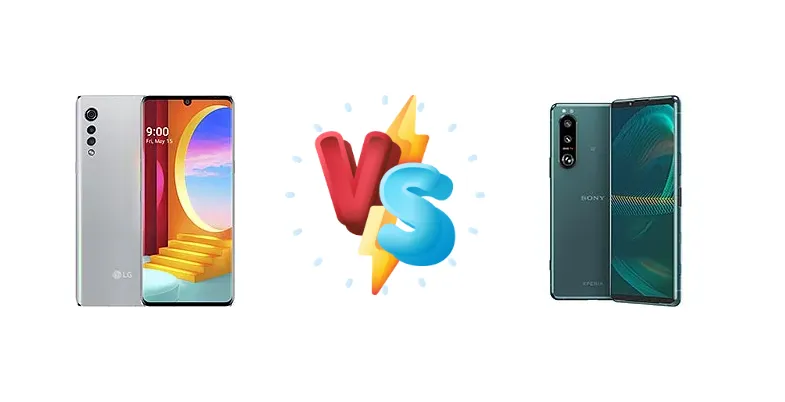
|
🏆 Quick Verdict
For most users, the Sony Xperia 5 III is the superior choice. Its Snapdragon 888 5G chipset delivers significantly faster performance and improved efficiency compared to the LG Velvet’s Snapdragon 845. While both phones boast a 100-hour endurance rating, the Xperia 5 III’s faster charging and more modern features make it the better long-term investment.
| PHONES | ||
|---|---|---|
| Phone Names | LG Velvet | Sony Xperia 5 III |
| Network | ||
|---|---|---|
| 2G bands | GSM 850 / 900 / 1800 / 1900 | GSM 850 / 900 / 1800 / 1900 |
| 3G bands | HSDPA 850 / 900 / 1900 / 2100 | HSDPA 800 / 850 / 900 / 1700(AWS) / 1900 / 2100 |
| 4G bands | 1, 3, 7, 8, 20, 28, 38, 40 | 1, 2, 3, 4, 5, 7, 8, 12, 13, 17, 19, 20, 25, 26, 28, 29, 32, 34, 38, 39, 40, 41, 46, 48, 66, 71 - USA |
| 5G bands | - | 1, 2, 3, 5, 7, 8, 20, 28, 38, 40, 41, 66, 71, 77, 78 SA/NSA/Sub6 - USA |
| Speed | HSPA, LTE | HSPA, LTE, 5G |
| Technology | GSM / HSPA / LTE | GSM / HSPA / LTE / 5G |
| - | 1, 3, 5, 7, 8, 28, 38, 40, 41, 77, 78, 79 SA/NSA/Sub6 - Asia | |
| Launch | ||
|---|---|---|
| Announced | 2020, July 28. Released 2020, July 31 | 2021, April 14 |
| Status | Discontinued | Available. Released 2021, October 08 |
| Body | ||
|---|---|---|
| Build | Glass front, glass back, aluminum frame | Glass front (Gorilla Glass 6), glass back (Gorilla Glass 6), aluminum frame |
| Dimensions | 167.1 x 74.1 x 7.9 mm (6.58 x 2.92 x 0.31 in) | 157 x 68 x 8.2 mm (6.18 x 2.68 x 0.32 in) |
| SIM | Nano-SIM + Nano-SIM | · Nano-SIM· Nano-SIM + Nano-SIM |
| Weight | 180 g (6.35 oz) | 168 g (5.93 oz) |
| IP68 dust/water resistant (up to 1.5m for 30 min) MIL-STD-810G compliant* *does not guarantee ruggedness or use in extreme conditions | IP65/IP68 dust/water resistant (up to 1.5m for 30 min) | |
| Display | ||
|---|---|---|
| Protection | - | Corning Gorilla Glass 6 |
| Resolution | 1080 x 2460 pixels (~395 ppi density) | 1080 x 2520 pixels, 21:9 ratio (~449 ppi density) |
| Size | 6.8 inches, 109.8 cm2 (~88.7% screen-to-body ratio) | 6.1 inches, 86.9 cm2 (~81.4% screen-to-body ratio) |
| Type | P-OLED | OLED, 1B colors, 120Hz, HDR BT.2020 |
| Platform | ||
|---|---|---|
| CPU | Octa-core (4x2.8 GHz Kryo 385 Gold & 4x1.8 GHz Kryo 385 Silver) | Octa-core (1x2.84 GHz Cortex-X1 & 3x2.42 GHz Cortex-A78 & 4x1.80 GHz Cortex-A55) |
| Chipset | Qualcomm SDM845 Snapdragon 845 (10 nm) | Qualcomm SM8350 Snapdragon 888 5G (5 nm) |
| GPU | Adreno 630 | Adreno 660 |
| OS | Android 10, upgradable to Android 12 | Android 11, upgradable to Android 13 |
| Memory | ||
|---|---|---|
| Card slot | microSDXC (uses shared SIM slot) | microSDXC (uses shared SIM slot) |
| Internal | 128GB 6GB RAM | 128GB 8GB RAM, 256GB 8GB RAM |
| UFS 2.1 | UFS 3.X | |
| Main Camera | ||
|---|---|---|
| Features | LED flash, panorama, HDR | Zeiss optics, Zeiss T* lens coating, color spectrum sensor, LED flash, panorama, HDR, eye tracking |
| Single | - | 8 MP, f/2.0, 24mm (wide), 1/4", 1.12µm |
| Triple | 48 MP, f/1.8, 26mm (wide), 1/2.0", 0.8µm, PDAF 8 MP, f/2.2, 120˚, 15mm (ultrawide), 1/4.0", 1.12µm Auxiliary lens | 12 MP, f/1.7, 24mm (wide), 1/1.7", 1.8µm, dual pixel PDAF, OIS 12 MP, f/2.3, 70mm (telephoto), f/2.8, 105mm (telephoto), 1/2.9", dual pixel PDAF, 3x/4.4x optical zoom, OIS 12 MP, f/2.2, 124˚, 16mm (ultrawide), 1/2.6", dual pixel PDAF |
| Video | 4K@30fps, 1080p@30/60fps, gyro-EIS | 4K@24/25/30/60/120fps HDR, 1080p@30/60/120fps; 5-axis gyro-EIS, OIS |
| Selfie camera | ||
|---|---|---|
| Features | HDR | HDR |
| Single | 16 MP, f/1.9, 29mm (standard), 1/3.06, 1.0µm | 8 MP, f/2.0, 24mm (wide), 1/4.0", 1.12µm |
| Video | 4K@30fps, 1080p@30fps | 1080p@30fps, 5-axis gyro-EIS |
| Sound | ||
|---|---|---|
| 3.5mm jack | Yes | Yes |
| 35mm jack | Yes | Yes |
| Loudspeaker | Yes, with stereo speakers | Yes, with stereo speakers |
| - | 24-bit/192kHz audio Dynamic vibration system | |
| Comms | ||
|---|---|---|
| Bluetooth | 5.1, A2DP, LE | 5.2, A2DP, LE, aptX HD, aptX Adaptive |
| NFC | Yes | Yes |
| Positioning | GPS | GPS, GLONASS, BDS, GALILEO, QZSS |
| Radio | FM radio | No |
| USB | USB Type-C, OTG | USB Type-C 3.1, OTG, video output |
| WLAN | Wi-Fi 802.11 a/b/g/n/ac, dual-band, Wi-Fi Direct | Wi-Fi 802.11 a/b/g/n/ac/6, dual-band, Wi-Fi Direct, DLNA |
| Features | ||
|---|---|---|
| Sensors | Fingerprint (under display, optical), accelerometer, gyro, proximity, compass, barometer | Fingerprint (side-mounted), accelerometer, gyro, proximity, barometer, compass |
| - | Native Sony Alpha camera support | |
| Battery | ||
|---|---|---|
| Charging | 15W wired, QC3 9W wireless | Wired, PD, 50% in 30 min |
| Type | Li-Po 4300 mAh | Li-Po 4500 mAh |
| Misc | ||
|---|---|---|
| Colors | Black, Aurora Silver | Black, Green, Pink |
| Models | LMG910EMW, LM-G910EMW | XQBQ62/G, XQBQ52G.UKCX, XQBQ52B.UKCX, XQ-BQ52, XQ-BQ72, XQ-BQ42, XQ-BQ62, SO-53B |
| Price | About 360 EUR | € 431.90 / £ 199.99 |
| Tests | ||
|---|---|---|
| Battery life | - | Endurance rating 100h |
| Camera | - | Photo / Video |
| Display | - | Contrast ratio: Infinite (nominal) |
| Loudspeaker | - | -26.7 LUFS (Good) |
| Performance | - | AnTuTu: 708394 (v9) GeekBench: 3549 (v5.1) GFXBench: 53fps (ES 3.1 onscreen) |
LG Velvet
- More affordable price point (now)
- Unique and flowing design aesthetic
- Wireless charging support
- Significantly slower processor
- Less efficient chipset leading to potential throttling
- Likely inferior camera performance
Sony Xperia 5 III
- Much faster Snapdragon 888 5G processor
- Faster charging with Power Delivery (PD)
- Compact form factor ideal for one-handed use
- Higher initial purchase price
- May lack the unique design appeal of the Velvet
- No wireless charging
Display Comparison
The Sony Xperia 5 III features a 590 nit max brightness display, offering a noticeably brighter viewing experience than what the LG Velvet likely achieves (brightness data unavailable for Velvet). While both displays have an infinite (nominal) contrast ratio, the Xperia 5 III’s smaller 6.1-inch screen size contributes to a higher pixel density, resulting in a sharper image. The Xperia 5 III’s display is optimized for content consumption, while the Velvet’s display, though likely good, lacks the brightness and pixel density for optimal outdoor visibility.
Camera Comparison
Both devices offer photo and video capabilities, but the Xperia 5 III likely has a more advanced camera system. While specific sensor details are missing for both, Sony’s expertise in camera technology suggests superior image processing and potentially larger sensor sizes in the Xperia 5 III. The Xperia 5 III benefits from Sony’s Real-time Tracking and Eye AF, features absent on the Velvet. The Velvet’s camera system, while capable, is likely limited by the older image signal processor (ISP) within the Snapdragon 845. The Xperia 5 III’s video recording capabilities are likely more robust, offering features like 4K HDR recording and cinematic video modes.
Performance
The core difference lies in the chipsets. The Sony Xperia 5 III’s Snapdragon 888 5G (5nm) represents a substantial upgrade over the LG Velvet’s Snapdragon 845 (10nm). The 888’s Cortex-X1 prime core, coupled with its more efficient 5nm process, delivers significantly faster CPU and GPU performance. The Velvet’s octa-core CPU (4x2.8 GHz Kryo 385 Gold & 4x1.8 GHz Kryo 385 Silver) is outmatched by the Xperia 5 III’s (1x2.84 GHz Cortex-X1 & 3x2.42 GHz Cortex-A78 & 4x1.80 GHz Cortex-A55). This translates to faster app loading times, smoother multitasking, and a better gaming experience on the Xperia 5 III. The 5nm process also contributes to better thermal management, reducing the likelihood of performance throttling during sustained workloads.
Battery Life
Both phones share a 100-hour endurance rating, suggesting comparable battery life under similar usage scenarios. However, the Xperia 5 III’s faster charging capabilities (50% in 30 minutes with PD) provide a significant convenience advantage over the LG Velvet’s 15W wired charging with QC3 and 9W wireless charging. While the Velvet’s wireless charging is a plus, the Xperia 5 III’s faster wired charging minimizes downtime. The Snapdragon 888’s improved efficiency also contributes to better battery life during demanding tasks.
Buying Guide
Buy the LG Velvet if you prioritize a lower price point and a unique, flowing design, and your primary use case doesn't demand intensive gaming or demanding applications. Buy the Sony Xperia 5 III if you value raw performance, a more compact form factor for one-handed use, and features geared towards content creators, such as advanced video recording capabilities. The Xperia 5 III is the clear choice for power users and mobile gamers.