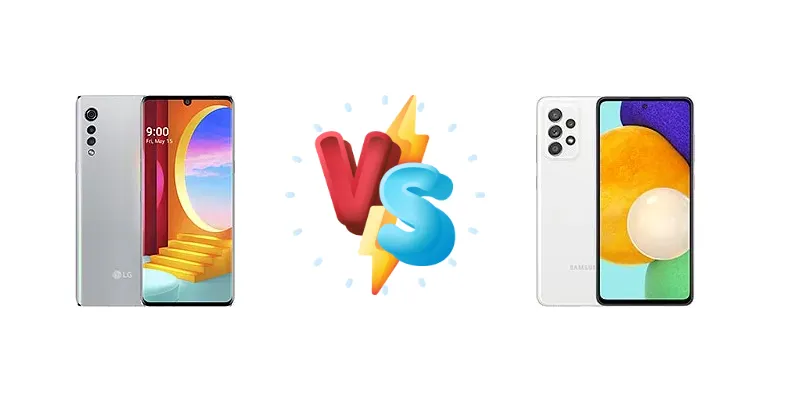
The LG Velvet and Samsung Galaxy A52 5G represent interesting points in the mid-range smartphone landscape. The Velvet, released with a flagship Snapdragon 845, now faces competition from newer, more efficient chips like the Snapdragon 750G in the A52 5G. This comparison dissects the trade-offs between raw power and modern features, helping you determine which device best suits your needs.
🏆 Quick Verdict
For the average user prioritizing battery life and 5G connectivity, the Samsung Galaxy A52 5G is the better choice. Its 25W charging and endurance rating of 111h outweigh the LG Velvet’s older, but still capable, Snapdragon 845. However, users seeking maximum performance for demanding apps will find the Velvet’s chipset more responsive.
| Network |
|---|
| 2G bands | GSM 850 / 900 / 1800 / 1900 | GSM 850 / 900 / 1800 / 1900 |
| 3G bands | HSDPA 850 / 900 / 1900 / 2100 | HSDPA 850 / 900 / 1700(AWS) / 1900 / 2100 |
| 4G bands | 1, 3, 7, 8, 20, 28, 38, 40 | 1, 2, 3, 4, 5, 7, 8, 12, 17, 20, 26, 28, 32, 38, 40, 41, 66 |
| 5G bands | - | 1, 3, 5, 7, 8, 20, 28, 38, 40, 41, 66, 78 SA/NSA/Sub6 |
| Speed | HSPA, LTE | HSPA, LTE, 5G |
| Technology | GSM / HSPA / LTE | GSM / HSPA / LTE / 5G |
| Launch |
|---|
| Announced | 2020, July 28. Released 2020, July 31 | 2021, March 17 |
| Status | Discontinued | Available. Released 2021, March 19 |
| Body |
|---|
| Build | Glass front, glass back, aluminum frame | Glass front (Gorilla Glass 5), plastic back |
| Dimensions | 167.1 x 74.1 x 7.9 mm (6.58 x 2.92 x 0.31 in) | 159.9 x 75.1 x 8.4 mm (6.30 x 2.96 x 0.33 in) |
| SIM | Nano-SIM + Nano-SIM | · Nano-SIM· Nano-SIM + Nano-SIM |
| Weight | 180 g (6.35 oz) | 189 g (6.67 oz) |
| | IP68 dust/water resistant (up to 1.5m for 30 min)
MIL-STD-810G compliant*
*does not guarantee ruggedness or use in extreme conditions | IP67 dust/water resistant (up to 1m for 30 min) |
| Display |
|---|
| Protection | - | Corning Gorilla Glass 5 |
| Resolution | 1080 x 2460 pixels (~395 ppi density) | 1080 x 2400 pixels, 20:9 ratio (~407 ppi density) |
| Size | 6.8 inches, 109.8 cm2 (~88.7% screen-to-body ratio) | 6.5 inches, 101.0 cm2 (~84.1% screen-to-body ratio) |
| Type | P-OLED | Super AMOLED, 120Hz, HDR10+, 800 nits (HBM) |
| | - | Always-on display |
| Platform |
|---|
| CPU | Octa-core (4x2.8 GHz Kryo 385 Gold & 4x1.8 GHz Kryo 385 Silver) | Octa-core (2x2.2 GHz Kryo 570 & 6x1.8 GHz Kryo 570) |
| Chipset | Qualcomm SDM845 Snapdragon 845 (10 nm) | Qualcomm SM7225 Snapdragon 750G 5G (8 nm) |
| GPU | Adreno 630 | Adreno 619 |
| OS | Android 10, upgradable to Android 12 | Android 11, upgradable to Android 14, One UI 6.1 |
| Memory |
|---|
| Card slot | microSDXC (uses shared SIM slot) | microSDXC (uses shared SIM slot) |
| Internal | 128GB 6GB RAM | 128GB 4GB RAM, 128GB 6GB RAM, 128GB 8GB RAM, 256GB 4GB RAM, 256GB 8GB RAM |
| | UFS 2.1 | - |
| Main Camera |
|---|
| Features | LED flash, panorama, HDR | LED flash, panorama, HDR |
| Quad | - | 64 MP, f/1.8, 26mm (wide), 1/1.7X", 0.8µm, PDAF, OIS
12 MP, f/2.2, 123˚ (ultrawide), 1.12µm
5 MP (macro)
Auxiliary lens |
| Triple | 48 MP, f/1.8, 26mm (wide), 1/2.0", 0.8µm, PDAF
8 MP, f/2.2, 120˚, 15mm (ultrawide), 1/4.0", 1.12µm
Auxiliary lens | - |
| Video | 4K@30fps, 1080p@30/60fps, gyro-EIS | 4K@30fps, 1080p@30/60fps; gyro-EIS |
| Selfie camera |
|---|
| Features | HDR | HDR |
| Single | 16 MP, f/1.9, 29mm (standard), 1/3.06, 1.0µm | 32 MP, f/2.2, 26mm (wide), 1/2.8", 0.8µm |
| Video | 4K@30fps, 1080p@30fps | 4K@30fps, 1080p@30fps |
| Sound |
|---|
| 3.5mm jack | Yes | Yes |
| 35mm jack | Yes | Yes |
| Loudspeaker | Yes, with stereo speakers | Yes, with stereo speakers |
| Comms |
|---|
| Bluetooth | 5.1, A2DP, LE | 5.0, A2DP, LE |
| NFC | Yes | Yes (market/region dependent) |
| Positioning | GPS | GPS, GLONASS, GALILEO, BDS |
| Radio | FM radio | FM radio (market/region dependent) |
| USB | USB Type-C, OTG | USB Type-C 2.0, OTG |
| WLAN | Wi-Fi 802.11 a/b/g/n/ac, dual-band, Wi-Fi Direct | Wi-Fi 802.11 a/b/g/n/ac, dual-band, Wi-Fi Direct |
| Features |
|---|
| Sensors | Fingerprint (under display, optical), accelerometer, gyro, proximity, compass, barometer | Fingerprint (under display, optical), accelerometer, gyro, compass |
| | - | Virtual proximity sensing |
| Battery |
|---|
| Charging | 15W wired, QC3
9W wireless | 25W wired, 50% in 30 min |
| Type | Li-Po 4300 mAh | Li-Po 4500 mAh |
| Misc |
|---|
| Colors | Black, Aurora Silver | Awesome Black, Awesome White, Awesome Violet, Awesome Blue |
| Models | LMG910EMW, LM-G910EMW | SM-A526B, SM-A526B/DS, SM-A5260, SM-A526W, SM-A526U, SM-A526U1 |
| Price | About 360 EUR | $ 137.39 / £ 280.00 / € 115.49 |
| SAR | - | 0.74 W/kg (head) 0.53 W/kg (body) |
| SAR EU | - | 1.05 W/kg (head) 1.42 W/kg (body) |
| Tests |
|---|
| Battery life | - |
Endurance rating 111h
|
| Camera | - |
Photo / Video |
| Display | - |
Contrast ratio: Infinite (nominal) |
| Loudspeaker | - |
-27.5 LUFS (Good)
|
| Performance | - |
AnTuTu: 334981 (v8), 386474 (v9)
GeekBench: 1820 (v5.1)
GFXBench: 16fps (ES 3.1 onscreen) |
LG Velvet
- More powerful processor for demanding tasks
- Potentially lower price due to age
- Snapdragon 845 offers a robust platform for older apps
- Slower charging speeds (15W)
- Likely shorter battery life
- Older chipset may exhibit thermal throttling
Samsung Galaxy A52 5G
- Excellent battery life (111h endurance)
- Faster 25W charging
- Brighter display for outdoor use
- Less powerful processor compared to the Snapdragon 845
- May struggle with extremely demanding games at max settings
- Potentially less responsive in heavy multitasking
Display Comparison
The Samsung Galaxy A52 5G boasts a significantly brighter display, reaching a measured 787 nits, compared to the LG Velvet’s unspecified peak brightness. This makes the A52 5G far more usable in direct sunlight. While the A52 5G’s contrast ratio is listed as ‘Infinite’ (typical for AMOLED), the Velvet’s panel type isn’t specified, suggesting it’s likely an LCD. This impacts color vibrancy and black levels. The A52 5G’s larger display size (assumed, based on market positioning) also contributes to a more immersive viewing experience.
Camera Comparison
Both devices offer photo and video capabilities, but specifics are limited. The LG Velvet’s camera system likely leverages the image signal processor (ISP) within the Snapdragon 845, while the A52 5G utilizes the ISP within the Snapdragon 750G. Without sensor size or aperture details, it’s difficult to definitively assess image quality. However, the A52 5G’s newer image processing algorithms likely provide better dynamic range and low-light performance. The presence of OIS (Optical Image Stabilization) on either device is unknown, but would be a significant advantage for video recording.
Performance
The LG Velvet’s Snapdragon 845, built on a 10nm process, was a flagship processor in its time, featuring an octa-core configuration with Kryo 385 cores clocked up to 2.8 GHz. However, the Samsung Galaxy A52 5G’s Snapdragon 750G (8nm) benefits from architectural improvements and a more efficient manufacturing process. While the 845 has a theoretical clock speed advantage, the 750G’s newer core design and 5G modem integration offer a more balanced experience. The Velvet may show its age in sustained workloads due to potential thermal throttling, while the 750G is designed for efficiency. The A52 5G’s CPU configuration (2x2.2 GHz Kryo 570 & 6x1.8 GHz Kryo 570) is optimized for multi-tasking.
Battery Life
The Samsung Galaxy A52 5G clearly wins in battery and charging. Its endurance rating of 111 hours indicates excellent battery life, likely due to the efficient Snapdragon 750G and optimized software. The 25W wired charging, capable of reaching 50% charge in 30 minutes, is significantly faster than the LG Velvet’s 15W wired charging with QC3 and 9W wireless charging. While the Velvet’s battery capacity is unknown, the A52 5G’s combination of efficiency and faster charging provides a superior user experience.
Buying Guide
Buy the LG Velvet if you prioritize raw processing power for applications like video editing or older, graphically intensive games, and don't mind potentially shorter battery life. Buy the Samsung Galaxy A52 5G if you value all-day battery life, 5G connectivity, faster charging, and a brighter display for outdoor visibility. The A52 5G is the more practical choice for everyday use.
Frequently Asked Questions
❓ Will the Snapdragon 845 in the LG Velvet struggle with newer, graphically intensive games like Genshin Impact?
While the Snapdragon 845 is still a capable chip, it may struggle to maintain consistent frame rates at maximum settings in demanding games like Genshin Impact. You may need to lower graphics settings to achieve a smooth gaming experience. The Snapdragon 750G in the A52 5G is optimized for efficiency, but may also require settings adjustments for optimal performance.
❓ How much faster is the 25W charging on the Galaxy A52 5G compared to the 15W charging on the LG Velvet in real-world use?
The A52 5G’s 25W charging can reach 50% charge in approximately 30 minutes, while the Velvet’s 15W charging will take considerably longer – likely over an hour to reach the same level. This difference is significant for users who need a quick power boost.
❓ Does the Snapdragon 750G in the A52 5G support carrier aggregation for faster 5G speeds?
Yes, the Snapdragon 750G includes 5G modem with support for carrier aggregation, allowing it to combine multiple 5G channels for faster download and upload speeds, provided your carrier supports it. This is a key advantage over older 5G modems.
❓ Is the LG Velvet still a good option for someone who primarily uses their phone for basic tasks like calling, texting, and browsing?
Yes, the LG Velvet is perfectly capable of handling basic tasks. The Snapdragon 845 provides more than enough power for everyday use. However, the A52 5G offers a better overall experience with its superior battery life and brighter display, even for basic usage.