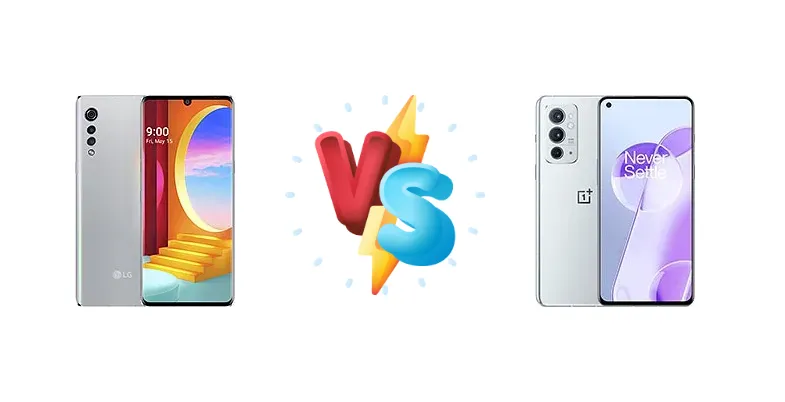
The LG Velvet, despite its age, remains a compelling option in the budget-to-midrange space, particularly as prices have fallen. However, the OnePlus 9RT 5G represents a more recent generation of flagship-adjacent hardware. This comparison dissects the core differences between the Snapdragon 845-powered Velvet and the Snapdragon 888-equipped 9RT, focusing on performance, charging, and overall user experience.
🏆 Quick Verdict
For most users, the OnePlus 9RT 5G is the superior choice. Its Snapdragon 888 chipset delivers significantly faster performance and smoother multitasking, while the 65W charging is a game-changer. However, the LG Velvet offers a compelling value proposition if budget is the primary concern and raw power isn't essential.
| Network |
|---|
| 2G bands | GSM 850 / 900 / 1800 / 1900 | GSM 850 / 900 / 1800 / 1900 |
| 3G bands | HSDPA 850 / 900 / 1900 / 2100 | HSDPA 800 / 850 / 900 / 1700(AWS) / 1800 / 1900 / 2100 |
| 4G bands | 1, 3, 7, 8, 20, 28, 38, 40 | 1, 2, 3, 4, 5, 7, 8, 12, 17, 18, 19, 20, 26, 28, 34, 38, 39, 40, 41 - Global |
| 5G bands | - | 1, 3, 5, 8, 28, 40, 41, 78 SA/NSA - Global |
| Speed | HSPA, LTE | HSPA 42.2/5.76 Mbps, LTE Cat18 1200/200 Mbps, 5G |
| Technology | GSM / HSPA / LTE | GSM / CDMA / HSPA / EVDO / LTE / 5G |
| | - | CDMA2000 1xEV-DO |
| Launch |
|---|
| Announced | 2020, July 28. Released 2020, July 31 | 2021, October 13 |
| Status | Discontinued | Available. Released 2021, October 19 |
| Body |
|---|
| Build | Glass front, glass back, aluminum frame | Glass front (Gorilla Glass 5), glass back (Gorilla Glass 5), aluminum frame |
| Dimensions | 167.1 x 74.1 x 7.9 mm (6.58 x 2.92 x 0.31 in) | 162.2 x 74.6 x 8.3 mm (6.39 x 2.94 x 0.33 in) |
| SIM | Nano-SIM + Nano-SIM | Nano-SIM + Nano-SIM |
| Weight | 180 g (6.35 oz) | 198.5 g (7.02 oz) |
| | IP68 dust/water resistant (up to 1.5m for 30 min)
MIL-STD-810G compliant*
*does not guarantee ruggedness or use in extreme conditions | - |
| Display |
|---|
| Protection | - | Corning Gorilla Glass 5 |
| Resolution | 1080 x 2460 pixels (~395 ppi density) | 1080 x 2400 pixels, 20:9 ratio (~397 ppi density) |
| Size | 6.8 inches, 109.8 cm2 (~88.7% screen-to-body ratio) | 6.62 inches, 106.3 cm2 (~87.9% screen-to-body ratio) |
| Type | P-OLED | AMOLED, 120Hz, HDR10+ |
| | - | Always-on display |
| Platform |
|---|
| CPU | Octa-core (4x2.8 GHz Kryo 385 Gold & 4x1.8 GHz Kryo 385 Silver) | Octa-core (1x2.84 GHz Cortex-X1 & 3x2.42 GHz Cortex-A78 & 4x1.80 GHz Cortex-A55) |
| Chipset | Qualcomm SDM845 Snapdragon 845 (10 nm) | Qualcomm SM8350 Snapdragon 888 5G (5 nm) |
| GPU | Adreno 630 | Adreno 660 |
| OS | Android 10, upgradable to Android 12 | Android 11, upgradable to Android 13, OxygenOS 13 |
| Memory |
|---|
| Card slot | microSDXC (uses shared SIM slot) | No |
| Internal | 128GB 6GB RAM | 128GB 8GB RAM, 256GB 8GB RAM, 256GB 12GB RAM |
| | UFS 2.1 | UFS 3.1 |
| Main Camera |
|---|
| Features | LED flash, panorama, HDR | Dual-LED flash, HDR, panorama |
| Quad | - | 50 MP, f/1.8, 24mm (wide), 1/1.56”, 1.0µm, PDAF, OIS
16 MP, f/2.2, 14mm, 123˚ (ultrawide), 1/3.6", 1.0µm
2 MP (macro) |
| Single | - | 16 MP, f/2.4, (wide), 1/3.06", 1.0µm |
| Triple | 48 MP, f/1.8, 26mm (wide), 1/2.0", 0.8µm, PDAF
8 MP, f/2.2, 120˚, 15mm (ultrawide), 1/4.0", 1.12µm
Auxiliary lens | - |
| Video | 4K@30fps, 1080p@30/60fps, gyro-EIS | 4K@30/60fps, 1080p@30/60/240fps, Auto HDR, gyro-EIS |
| Selfie camera |
|---|
| Features | HDR | HDR |
| Single | 16 MP, f/1.9, 29mm (standard), 1/3.06, 1.0µm | 16 MP, f/2.4, (wide), 1/3.06", 1.0µm |
| Video | 4K@30fps, 1080p@30fps | 1080p@30fps, gyro-EIS |
| Sound |
|---|
| 3.5mm jack | Yes | No |
| 35mm jack | Yes | No |
| Loudspeaker | Yes, with stereo speakers | Yes, with stereo speakers |
| Comms |
|---|
| Bluetooth | 5.1, A2DP, LE | 5.2, A2DP, LE |
| NFC | Yes | Yes |
| Positioning | GPS | GPS (L1+L5), GLONASS (G1), BDS (B1), GALILEO (E1+E5a) |
| Radio | FM radio | No |
| USB | USB Type-C, OTG | USB Type-C 2.0, OTG |
| WLAN | Wi-Fi 802.11 a/b/g/n/ac, dual-band, Wi-Fi Direct | Wi-Fi 802.11 a/b/g/n/ac/6, dual-band, Wi-Fi Direct |
| Features |
|---|
| Sensors | Fingerprint (under display, optical), accelerometer, gyro, proximity, compass, barometer | Fingerprint (under display, optical), accelerometer, gyro, proximity, compass |
| Battery |
|---|
| Charging | 15W wired, QC3
9W wireless | 65W wired, 100% in 29 min |
| Type | Li-Po 4300 mAh | Li-Po 4500 mAh |
| Misc |
|---|
| Colors | Black, Aurora Silver | Hacker Black, Nano Silver, Blue |
| Models | LMG910EMW, LM-G910EMW | MT2110, MT2111 |
| Price | About 360 EUR | About 590 EUR |
LG Velvet
- Potentially lower price point
- Compact and lightweight design (likely)
- Wireless charging support
- Significantly slower processor
- Slow 15W charging
- Older chipset may struggle with demanding apps
OnePlus 9RT 5G
- Much faster Snapdragon 888 processor
- Blazing-fast 65W charging
- Superior image processing capabilities
- No wireless charging
- Potentially higher price
- Snapdragon 888 can run warmer under sustained load
Display Comparison
While specific display specs for the LG Velvet aren't provided, its OLED panel was well-regarded for its color accuracy. The OnePlus 9RT 5G, though lacking details here, benefits from a newer panel generation. The key difference lies in processing power; the Snapdragon 888 can drive higher refresh rates and more complex display features. The Velvet's older chipset may struggle with consistently smooth performance at higher refresh rates if supported. Bezels are likely slimmer on the 9RT due to its more recent design.
Camera Comparison
Without detailed camera specs for both devices, a direct comparison is limited. However, the Snapdragon 888 in the 9RT offers a more advanced Image Signal Processor (ISP), enabling superior image processing capabilities – better noise reduction, dynamic range, and faster autofocus. The Velvet’s ISP, while competent for its time, lacks the sophistication of the 888’s. We can assume the 9RT will deliver better low-light performance and more detailed images. The presence of OIS (Optical Image Stabilization) on the 9RT is highly probable, further enhancing image quality.
Performance
The core of this comparison is the chipset. The OnePlus 9RT 5G’s Snapdragon 888 (5nm) is a substantial upgrade over the LG Velvet’s Snapdragon 845 (10nm). The 5nm process node allows for greater transistor density and improved thermal efficiency, meaning the 888 can sustain peak performance for longer periods. The 888’s Cortex-X1 prime core provides a significant single-core performance boost, crucial for responsive app launches and UI navigation. The Velvet’s Kryo 385 cores, while capable, are simply outmatched. This translates to faster gaming, smoother multitasking, and quicker processing of demanding tasks on the 9RT.
Battery Life
The LG Velvet’s 15W charging is painfully slow compared to the OnePlus 9RT 5G’s 65W charging, which promises a full charge in just 29 minutes. This is a massive convenience factor for the 9RT. While the Velvet offers 9W wireless charging, the 9RT lacks this feature. The difference in charging speed alone is a compelling reason to choose the 9RT, even if the Velvet has a slightly larger battery capacity (not specified). The 888's improved efficiency may also offset any battery capacity differences.
Buying Guide
Buy the LG Velvet if you prioritize a more compact form factor, a potentially lower price point, and are comfortable with a less demanding user experience. It's ideal for everyday tasks and light media consumption. Buy the OnePlus 9RT 5G if you demand faster performance for gaming and demanding apps, require incredibly fast charging, and want a phone that feels more future-proof.
Frequently Asked Questions
❓ Will the Snapdragon 845 in the LG Velvet struggle with modern games like Genshin Impact or Call of Duty Mobile?
Yes, the Snapdragon 845 will likely struggle with demanding games at high settings. You'll likely need to lower graphics settings and resolution to achieve playable frame rates. The Snapdragon 888 in the OnePlus 9RT 5G offers a much smoother gaming experience with higher graphical fidelity.
❓ Is the 65W charging on the OnePlus 9RT 5G safe for the battery's long-term health?
OnePlus employs charging algorithms designed to protect the battery from overcharging and overheating. While fast charging generates more heat, the 9RT's thermal management system and charging circuitry are designed to mitigate these effects. However, consistently using the fastest charging speeds *may* contribute to slightly faster battery degradation over several years compared to slower charging.
❓ Does the LG Velvet still receive software updates?
LG has largely ceased software support for the Velvet. While it may have received updates to Android 12, it's unlikely to receive further major Android version updates or security patches. The OnePlus 9RT 5G, being a newer device, will continue to receive updates for a longer period.