
LG Velvet vs. Motorola Edge+ (2023): A Generational Leap in Performance
| Phones Images | |||||
|---|---|---|---|---|---|
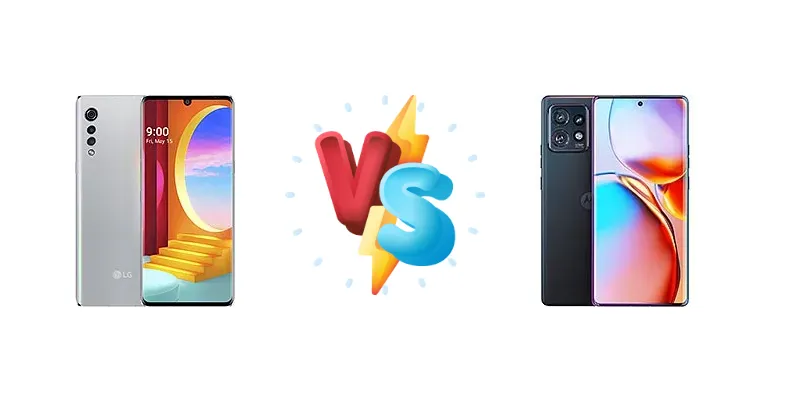
|
🏆 Quick Verdict
For the vast majority of users, the Motorola Edge+ (2023) is the clear winner. Its Snapdragon 8 Gen 2 offers a massive performance uplift, significantly faster charging, and a more modern feature set. While the LG Velvet remains a capable device, the generational gap is too wide to ignore.
| PHONES | ||
|---|---|---|
| Phone Names | LG Velvet | Motorola Edge+ (2023) |
| Network | ||
|---|---|---|
| 2G bands | GSM 850 / 900 / 1800 / 1900 | GSM 850 / 900 / 1800 / 1900 |
| 3G bands | HSDPA 850 / 900 / 1900 / 2100 | HSDPA 850 / 900 / 1700(AWS) / 1900 / 2100 |
| 4G bands | 1, 3, 7, 8, 20, 28, 38, 40 | 1, 2, 3, 4, 5, 7, 8, 12, 13, 14, 17, 18, 20, 25, 26, 28, 29, 30, 38, 39, 40, 41, 41, 46, 48, 66, 71 |
| 5G bands | - | 1, 2, 3, 5, 7, 12, 14, 20, 25, 26, 28, 29, 30, 38, 41, 41, 48, 66, 70, 71, 77, 78 SA/NSA/Sub6/mmWave |
| Speed | HSPA, LTE | HSPA, LTE, 5G |
| Technology | GSM / HSPA / LTE | GSM / HSPA / LTE / 5G |
| Launch | ||
|---|---|---|
| Announced | 2020, July 28. Released 2020, July 31 | 2023, May 02 |
| Status | Discontinued | Available. Released 2023, May 19 |
| Body | ||
|---|---|---|
| Build | Glass front, glass back, aluminum frame | Glass front (Gorilla Glass Victus), glass back (Gorilla Glass Victus), aluminum frame |
| Dimensions | 167.1 x 74.1 x 7.9 mm (6.58 x 2.92 x 0.31 in) | 161.2 x 74 x 8.6 mm (6.35 x 2.91 x 0.34 in) |
| SIM | Nano-SIM + Nano-SIM | Nano-SIM + eSIM |
| Weight | 180 g (6.35 oz) | 203 g (7.16 oz) |
| IP68 dust/water resistant (up to 1.5m for 30 min) MIL-STD-810G compliant* *does not guarantee ruggedness or use in extreme conditions | IP68 dust/water resistant (up to 1.5m for 30 min) | |
| Display | ||
|---|---|---|
| Protection | - | Corning Gorilla Glass Victus |
| Resolution | 1080 x 2460 pixels (~395 ppi density) | 1080 x 2400 pixels, 20:9 ratio (~395 ppi density) |
| Size | 6.8 inches, 109.8 cm2 (~88.7% screen-to-body ratio) | 6.67 inches, 107.4 cm2 (~90.0% screen-to-body ratio) |
| Type | P-OLED | OLED, 1B colors, 165Hz, HDR10+, Dolby Vision, 1300 nits (peak) |
| Platform | ||
|---|---|---|
| CPU | Octa-core (4x2.8 GHz Kryo 385 Gold & 4x1.8 GHz Kryo 385 Silver) | Octa-core (1x3.2 GHz Cortex-X3 & 2x2.8 GHz Cortex-A715 & 2x2.8 GHz Cortex-A710 & 3x2.0 GHz Cortex-A510) |
| Chipset | Qualcomm SDM845 Snapdragon 845 (10 nm) | Qualcomm SM8550-AB Snapdragon 8 Gen 2 (4 nm) |
| GPU | Adreno 630 | Adreno 740 |
| OS | Android 10, upgradable to Android 12 | Android 13, upgradable to Android 14 |
| Memory | ||
|---|---|---|
| Card slot | microSDXC (uses shared SIM slot) | No |
| Internal | 128GB 6GB RAM | 512GB 8GB RAM |
| UFS 2.1 | UFS 4.0 | |
| Main Camera | ||
|---|---|---|
| Features | LED flash, panorama, HDR | Dual-LED flash, panorama, HDR |
| Triple | 48 MP, f/1.8, 26mm (wide), 1/2.0", 0.8µm, PDAF 8 MP, f/2.2, 120˚, 15mm (ultrawide), 1/4.0", 1.12µm Auxiliary lens | 50 MP, f/1.8, (wide), 1/1.55", 1.0µm, multi-directional PDAF, OIS 12 MP, f/1.6, (telephoto), 1/2.93", 1.22µm, PDAF, 2x optical zoom 50 MP, f/2.2, 114˚ (ultrawide), 1/2.76", 0.64µm, AF |
| Video | 4K@30fps, 1080p@30/60fps, gyro-EIS | 8K@30fps, 4K@30/60fps, 1080p@30/60/120/240/960fps, 10-bit HDR10+, gyro-EIS |
| Selfie camera | ||
|---|---|---|
| Features | HDR | HDR |
| Single | 16 MP, f/1.9, 29mm (standard), 1/3.06, 1.0µm | 60 MP, f/2.2, (wide), 1/2.8", 0.61µm |
| Video | 4K@30fps, 1080p@30fps | 4K@30/60fps, 1080p@30/60/120/240fps |
| Sound | ||
|---|---|---|
| 3.5mm jack | Yes | No |
| 35mm jack | Yes | No |
| Loudspeaker | Yes, with stereo speakers | Yes, with stereo speakers |
| Comms | ||
|---|---|---|
| Bluetooth | 5.1, A2DP, LE | 5.3, A2DP, LE, aptX HD, aptX Adaptive |
| NFC | Yes | Yes |
| Positioning | GPS | GPS, GLONASS, GALILEO, BDS |
| Radio | FM radio | No |
| USB | USB Type-C, OTG | USB Type-C 3.2, OTG, DisplayPort 1.4 |
| WLAN | Wi-Fi 802.11 a/b/g/n/ac, dual-band, Wi-Fi Direct | Wi-Fi 802.11 a/b/g/n/ac/6e/7, tri-band, Wi-Fi Direct |
| Features | ||
|---|---|---|
| Sensors | Fingerprint (under display, optical), accelerometer, gyro, proximity, compass, barometer | Fingerprint (under display, optical), accelerometer, gyro, proximity, compass, barometer |
| - | Ready For 3.5 support | |
| Battery | ||
|---|---|---|
| Charging | 15W wired, QC3 9W wireless | 68W wired 15W wireless 5W reverse wired 5W reverse wireless |
| Type | Li-Po 4300 mAh | Li-Po 5100 mAh |
| Misc | ||
|---|---|---|
| Colors | Black, Aurora Silver | Interstellar Black |
| Models | LMG910EMW, LM-G910EMW | - |
| Price | About 360 EUR | $ 298.99 |
LG Velvet
- Potentially lower price point
- More compact design (likely)
- Headphone jack (likely, based on LG's history)
- Significantly slower performance
- Outdated chipset and software support
- Slow charging speeds
Motorola Edge+ (2023)
- Exceptional performance with Snapdragon 8 Gen 2
- Fast 68W wired charging
- Reverse wireless charging
- Higher price tag
- Potentially larger size
- May lack a headphone jack (check specific model)
Display Comparison
The context data lacks display specifics for both devices, but given the Velvet's 2020 release, it likely features an OLED panel with a 60Hz refresh rate. The Edge+ (2023), being a modern flagship, almost certainly boasts a 120Hz or higher OLED display, potentially with LTPO technology for variable refresh rate and improved efficiency. This difference in refresh rate alone translates to a significantly smoother visual experience on the Motorola. Bezels are also likely slimmer on the newer device, contributing to a more immersive viewing experience.
Camera Comparison
Without detailed camera specs, a direct comparison is limited. However, the Motorola Edge+ (2023), as a newer flagship, likely features a larger main sensor with more advanced image processing capabilities. The Snapdragon 8 Gen 2’s ISP (Image Signal Processor) is significantly more sophisticated than the 845’s, enabling better dynamic range, noise reduction, and low-light performance. While the Velvet may offer acceptable image quality in good lighting, the Edge+ (2023) will likely excel in challenging conditions. The presence of Optical Image Stabilization (OIS) is almost guaranteed on the Motorola, further enhancing image clarity.
Performance
The core difference lies in the chipsets. The LG Velvet's Snapdragon 845, built on a 10nm process, is a capable performer but is dwarfed by the Motorola Edge+ (2023)'s Snapdragon 8 Gen 2, fabricated on a 4nm node. This process shrink delivers substantial gains in both performance and power efficiency. The 8 Gen 2’s CPU architecture – featuring a Cortex-X3 prime core alongside Cortex-A715 and A710 performance cores – provides a significant advantage in multi-threaded tasks and single-core responsiveness compared to the 845’s Kryo 385 cores. Gamers and power users will see a dramatic difference in frame rates and loading times. The 8 Gen 2 also benefits from a more advanced Adreno GPU, further widening the performance gap.
Battery Life
The LG Velvet’s 15W wired charging and 9W wireless charging are slow by today’s standards. The Motorola Edge+ (2023) with its 68W wired charging can replenish the battery much faster – likely achieving a full charge in under 40 minutes. The 15W wireless charging on the Motorola is a modest improvement, but the addition of 5W reverse wired and wireless charging is a unique feature absent on the Velvet, allowing it to charge accessories like earbuds. While battery capacity isn't specified, the Snapdragon 8 Gen 2’s superior efficiency means the Edge+ (2023) will likely offer comparable or better real-world battery life despite potentially having a similar or smaller battery capacity.
Buying Guide
Buy the LG Velvet if you prioritize a potentially lower price point and a more compact form factor, and your usage is limited to everyday tasks like browsing, social media, and light media consumption. Buy the Motorola Edge+ (2023) if you demand top-tier performance for gaming, demanding applications, and future-proofing, and value fast charging and a more refined user experience.