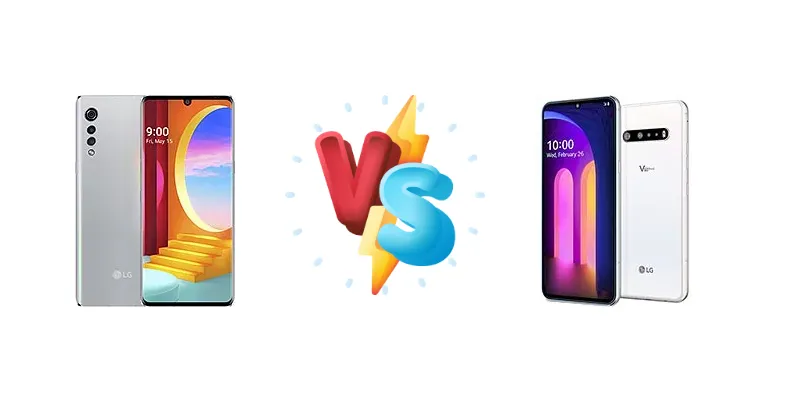
The LG Velvet and V60 ThinQ 5G represent distinct approaches to the flagship smartphone experience. The V60, released as LG’s 2020 powerhouse, aimed for top-tier performance with the Snapdragon 865. The Velvet, arriving later, prioritized a more refined design and a lower price point, utilizing the Snapdragon 845. This comparison dissects the key differences to determine which device remains the better choice in today’s market.
🏆 Quick Verdict
For most users in 2024, the LG V60 ThinQ 5G is the superior choice. While both phones offer a 103-hour endurance rating, the V60’s Snapdragon 865 provides a significant performance uplift, crucial for demanding tasks and future-proofing, justifying its initial higher price.
| Network |
|---|
| 2G bands | GSM 850 / 900 / 1800 / 1900 | GSM 850 / 900 / 1800 / 1900 |
| 3G bands | HSDPA 850 / 900 / 1900 / 2100 | HSDPA 850 / 900 / 1700(AWS) / 1900 / 2100 |
| 4G bands | 1, 3, 7, 8, 20, 28, 38, 40 | 2, 4, 5, 12, 25, 26, 41, 46, 48, 66, 71 - USA |
| 5G bands | - | 2, 25, 41, 66, 71 SA/NSA/Sub6 |
| Speed | HSPA, LTE | HSPA 42.2/5.76 Mbps, LTE (7CA) Cat22, 5G |
| Technology | GSM / HSPA / LTE | GSM / CDMA / HSPA / EVDO / LTE / 5G |
| | - | CDMA2000 1xEV-DO |
| Launch |
|---|
| Announced | 2020, July 28. Released 2020, July 31 | 2020, February 26. Released 2020, March 20 |
| Status | Discontinued | Discontinued |
| Body |
|---|
| Build | Glass front, glass back, aluminum frame | Glass front (Gorilla Glass 5), glass back (Gorilla Glass 6), aluminum frame |
| Dimensions | 167.1 x 74.1 x 7.9 mm (6.58 x 2.92 x 0.31 in) | 169.3 x 77.6 x 8.9 mm (6.67 x 3.06 x 0.35 in) |
| SIM | Nano-SIM + Nano-SIM | · Nano-SIM· Nano-SIM + Nano-SIM |
| Weight | 180 g (6.35 oz) | 213 g (Global)/ 218 g (Verizon) (7.51 oz) |
| | IP68 dust/water resistant (up to 1.5m for 30 min)
MIL-STD-810G compliant*
*does not guarantee ruggedness or use in extreme conditions | IP68 dust/water resistant (up to 1.5m for 30 min)
MIL-STD-810G compliant*
Method 516.6, Procedure IV "Transit Drop"
*does not guarantee ruggedness or use in extreme conditions |
| Display |
|---|
| Protection | - | Corning Gorilla Glass 5 |
| Resolution | 1080 x 2460 pixels (~395 ppi density) | 1080 x 2460 pixels (~395 ppi density) |
| Size | 6.8 inches, 109.8 cm2 (~88.7% screen-to-body ratio) | 6.8 inches, 109.8 cm2 (~83.6% screen-to-body ratio) |
| Type | P-OLED | P-OLED, HDR10+ |
| | - | Always-on display |
| Platform |
|---|
| CPU | Octa-core (4x2.8 GHz Kryo 385 Gold & 4x1.8 GHz Kryo 385 Silver) | Octa-core (1x2.84 GHz Cortex-A77 & 3x2.42 GHz Cortex-A77 & 4x1.80 GHz Cortex-A55) |
| Chipset | Qualcomm SDM845 Snapdragon 845 (10 nm) | Qualcomm SM8250 Snapdragon 865 5G (7 nm+) |
| GPU | Adreno 630 | Adreno 650 |
| OS | Android 10, upgradable to Android 12 | Android 10, upgradable to Android 13 |
| Memory |
|---|
| Card slot | microSDXC (uses shared SIM slot) | microSDXC (uses shared SIM slot) - dual-SIM model |
| Internal | 128GB 6GB RAM | 128GB 8GB RAM, 256GB 8GB RAM |
| | UFS 2.1 | UFS 2.1 |
| Main Camera |
|---|
| Dual | - | 64 MP, f/1.8, 27mm (standard), 1/1.72", 0.8µm, dual pixel PDAF, OIS
13 MP, f/1.9, 12mm (ultrawide), 1/3.4", 1.0µm
0.3 MP, TOF 3D, f/1.4, (depth) |
| Features | LED flash, panorama, HDR | Dual-LED dual-tone flash, HDR, panorama |
| Triple | 48 MP, f/1.8, 26mm (wide), 1/2.0", 0.8µm, PDAF
8 MP, f/2.2, 120˚, 15mm (ultrawide), 1/4.0", 1.12µm
Auxiliary lens | - |
| Video | 4K@30fps, 1080p@30/60fps, gyro-EIS | 8K@30fps, 4K@30/60fps, 1080p, HDR10+, 24-bit/192kHz stereo sound rec., gyro-EIS |
| Selfie camera |
|---|
| Features | HDR | HDR |
| Single | 16 MP, f/1.9, 29mm (standard), 1/3.06, 1.0µm | 10 MP, f/1.9, 30mm (standard), 1/3.1", 1.22µm |
| Video | 4K@30fps, 1080p@30fps | 4K@30fps, gyro-EIS |
| Sound |
|---|
| 3.5mm jack | Yes | Yes |
| 35mm jack | Yes | Yes |
| Loudspeaker | Yes, with stereo speakers | Yes, with stereo speakers |
| | - | 32-bit/192kHz audio
24-bit/192kHz audio recording |
| Comms |
|---|
| Bluetooth | 5.1, A2DP, LE | 5.1, A2DP, LE, aptX HD |
| NFC | Yes | Yes |
| Positioning | GPS | GPS, GLONASS, GALILEO, BDS |
| Radio | FM radio | FM radio (USA model only) |
| USB | USB Type-C, OTG | USB Type-C 3.1, OTG |
| WLAN | Wi-Fi 802.11 a/b/g/n/ac, dual-band, Wi-Fi Direct | Wi-Fi 802.11 a/b/g/n/ac/6, dual-band, Wi-Fi Direct, DLNA |
| Features |
|---|
| Sensors | Fingerprint (under display, optical), accelerometer, gyro, proximity, compass, barometer | Fingerprint (under display, optical), accelerometer, gyro, proximity, compass, barometer |
| Battery |
|---|
| Charging | 15W wired, QC3
9W wireless | Wired, PD2.0, QC4
Wireless |
| Type | Li-Po 4300 mAh | Li-Po 5000 mAh |
| Misc |
|---|
| Colors | Black, Aurora Silver | Classy Blue, Classy White |
| Models | LMG910EMW, LM-G910EMW | LM-V600, A001LG |
| Price | About 360 EUR | About 700 EUR |
| Tests |
|---|
| Battery life | - |
Endurance rating 103h
|
LG Velvet
- More affordable price point
- Sleek and comfortable design
- Good overall performance for everyday tasks
- Older Snapdragon 845 chipset
- Slower charging speeds
- Less future-proof
LG V60 ThinQ 5G
- Powerful Snapdragon 865 chipset
- Faster charging support (PD2.0, QC4)
- Superior image processing capabilities
- Higher initial price
- Potentially larger and heavier design
- May experience more heat under heavy load
Display Comparison
While specific display specs like resolution and panel type aren't provided, both phones likely feature OLED displays typical of LG flagships. The V60 benefits from the more modern Snapdragon 865 ISP, potentially enabling slightly better image processing for display output. However, without detailed data on peak brightness or color gamut coverage, a definitive display winner is difficult to declare. Both likely offer excellent viewing experiences, but the V60’s chipset could provide a marginal advantage in dynamic range and color accuracy.
Camera Comparison
Without detailed camera sensor information, it’s challenging to make a precise comparison. However, the Snapdragon 865 in the V60 offers a more advanced Image Signal Processor (ISP), enabling faster image processing, improved noise reduction, and better dynamic range. This is particularly noticeable in low-light conditions and when recording video. While both phones likely feature similar lens configurations, the V60’s ISP gives it an edge in image quality and video capabilities. The Velvet’s camera will still produce good results, but the V60 will consistently deliver superior photos and videos.
Performance
The core difference lies in the chipsets. The LG V60’s Snapdragon 865 (7nm+) is a substantial upgrade over the Velvet’s Snapdragon 845 (10nm). The 865 utilizes newer Cortex-A77 cores, offering improved single-core and multi-core performance. The 7nm+ manufacturing process also contributes to better thermal efficiency, reducing throttling during sustained workloads. This translates to smoother gaming, faster app loading times, and a more responsive overall experience on the V60. The Velvet’s 845 is still capable, but will struggle with demanding modern applications and games compared to the V60.
Battery Life
Interestingly, both phones share an endurance rating of 103 hours, suggesting similar real-world battery life despite the V60’s more powerful processor. This indicates efficient power management on both devices. However, the V60 supports faster charging standards – PD2.0 and QC4 – compared to the Velvet’s QC3, meaning quicker top-ups. While both can charge wirelessly, the V60’s faster wired charging provides a more convenient and efficient charging experience.
Buying Guide
Buy the LG Velvet if you prioritize a sleek, comfortable design and are primarily focused on everyday tasks like browsing, social media, and light photography. It’s an excellent option for users on a tighter budget who don’t require cutting-edge performance. Buy the LG V60 ThinQ 5G if you demand faster processing speeds for gaming, video editing, or multitasking, and value 5G connectivity for faster data speeds. It’s the better choice for power users and those who want a phone that will remain capable for longer.
Frequently Asked Questions
❓ Does the Snapdragon 865 in the V60 offer a noticeable gaming improvement over the 845 in the Velvet?
Yes, the Snapdragon 865 provides a substantial gaming performance boost. The newer CPU and GPU architecture, combined with faster memory speeds, result in higher frame rates, smoother gameplay, and better graphics fidelity in demanding mobile games. The V60 is significantly better suited for gamers.
❓ Given both phones have similar battery endurance ratings, is the V60’s faster charging really that important?
While the endurance is similar, the V60’s support for PD2.0 and QC4 allows for significantly faster charging times. This means you can quickly top up the battery when needed, minimizing downtime and ensuring you’re always ready to go. It’s a convenience factor that adds real-world value.
❓ Are software updates still available for either the LG Velvet or the LG V60 ThinQ 5G?
LG has exited the smartphone market, so official software updates are no longer being released for either device. However, the Android open-source nature allows for custom ROM development, potentially extending the lifespan of both phones with community support.
❓ Which phone is better for taking photos of fast-moving subjects?
The LG V60 ThinQ 5G is better suited for capturing fast-moving subjects. The Snapdragon 865’s ISP allows for faster autofocus and image processing, reducing motion blur and ensuring sharper results.