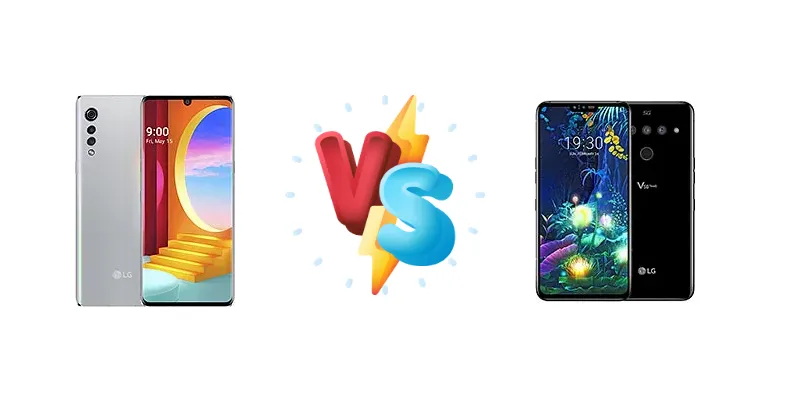
The LG Velvet and V50 ThinQ 5G represent different eras in LG’s smartphone strategy. The V50, released in 2019, was a full-fledged flagship aiming for premium features, including 5G connectivity. The Velvet, launched in 2020, took a more mainstream approach, focusing on design and a competitive price point. This comparison dissects their core differences to determine which device offers the best value today.
🏆 Quick Verdict
For most users, the LG V50 ThinQ 5G is the better choice. While both phones offer a 96-hour endurance rating, the V50’s Snapdragon 855, built on a 7nm process, provides a performance edge over the Velvet’s Snapdragon 845, and its faster 18W charging with PD2.0 support is a significant convenience.
| Network |
|---|
| 2G bands | GSM 850 / 900 / 1800 / 1900 | GSM 850 / 900 / 1800 / 1900 |
| 3G bands | HSDPA 850 / 900 / 1900 / 2100 | HSDPA 850 / 900 / 1700(AWS) / 1900 / 2100 - USA |
| 4G bands | 1, 3, 7, 8, 20, 28, 38, 40 | 1, 2, 3, 4, 5, 7, 8, 12, 13, 17, 20, 25, 26, 28, 40, 41, 46, 66, 71 - USA |
| 5G bands | - | 41, 260, 261 NSA |
| Speed | HSPA, LTE | HSPA 42.2/5.76 Mbps, LTE (6CA) Cat18 1200/75 Mbps, 5G (2+ Gbps DL) |
| Technology | GSM / HSPA / LTE | GSM / CDMA / HSPA / EVDO / LTE / 5G |
| | - | CDMA2000 1xEV-DO |
| Launch |
|---|
| Announced | 2020, July 28. Released 2020, July 31 | 2019, February 24. Released 2019, April 19 |
| Status | Discontinued | Discontinued |
| Body |
|---|
| Build | Glass front, glass back, aluminum frame | Glass front (Gorilla Glass 5), glass back (Gorilla Glass 6), aluminum frame |
| Dimensions | 167.1 x 74.1 x 7.9 mm (6.58 x 2.92 x 0.31 in) | 159.2 x 76.1 x 8.3 mm (6.27 x 3.00 x 0.33 in) |
| SIM | Nano-SIM + Nano-SIM | · Nano-SIM· Nano-SIM + Nano-SIM |
| Weight | 180 g (6.35 oz) | 183 g (6.46 oz) |
| | IP68 dust/water resistant (up to 1.5m for 30 min)
MIL-STD-810G compliant*
*does not guarantee ruggedness or use in extreme conditions | IP68 dust/water resistant (up to 1.5m for 30 min)
MIL-STD-810G compliant*
*does not guarantee ruggedness or use in extreme conditions |
| Display |
|---|
| Protection | - | Corning Gorilla Glass 5 |
| Resolution | 1080 x 2460 pixels (~395 ppi density) | 1440 x 3120 pixels, 19.5:9 ratio (~538 ppi density) |
| Size | 6.8 inches, 109.8 cm2 (~88.7% screen-to-body ratio) | 6.4 inches, 100.2 cm2 (~82.7% screen-to-body ratio) |
| Type | P-OLED | P-OLED, HDR10 |
| | - | Always-on display |
| Platform |
|---|
| CPU | Octa-core (4x2.8 GHz Kryo 385 Gold & 4x1.8 GHz Kryo 385 Silver) | Octa-core (1x2.84 GHz Kryo 485 & 3x2.42 GHz Kryo 485 & 4x1.78 GHz Kryo 485) |
| Chipset | Qualcomm SDM845 Snapdragon 845 (10 nm) | Qualcomm SM8150 Snapdragon 855 (7 nm) |
| GPU | Adreno 630 | Adreno 640 |
| OS | Android 10, upgradable to Android 12 | Android 9.0 (Pie), upgradable to Android 11 |
| Memory |
|---|
| Card slot | microSDXC (uses shared SIM slot) | microSDXC (dedicated slot) |
| Internal | 128GB 6GB RAM | 128GB 6GB RAM |
| | UFS 2.1 | UFS 2.1 |
| Main Camera |
|---|
| Features | LED flash, panorama, HDR | LED flash, HDR, panorama |
| Triple | 48 MP, f/1.8, 26mm (wide), 1/2.0", 0.8µm, PDAF
8 MP, f/2.2, 120˚, 15mm (ultrawide), 1/4.0", 1.12µm
Auxiliary lens | 12 MP, 27mm (wide), f/1.5, 1/2.55", 1.4µm, dual pixel PDAF, 3-axis OIS
12 MP, 52mm (telephoto), f/2.4, 1/3.4", 1.0µm, 2x optical zoom, PDAF, OIS
16 MP, 16mm (ultrawide), f/1.9, 1/3.1", 1.0µm, no AF |
| Video | 4K@30fps, 1080p@30/60fps, gyro-EIS | 4K@30/60fps, 1080p@30/60/240fps, 24-bit/192kHz stereo sound rec., HDR10 video, gyro-EIS |
| Selfie camera |
|---|
| Dual | - | 8 MP, f/1.9, 26mm (wide), 1/4.0", 1.12µm
5 MP, 21mm (wide), f/2.2, 1/5.0", 1.12µm |
| Features | HDR | HDR |
| Single | 16 MP, f/1.9, 29mm (standard), 1/3.06, 1.0µm | - |
| Video | 4K@30fps, 1080p@30fps | 1080p@60fps |
| Sound |
|---|
| 3.5mm jack | Yes | Yes |
| 35mm jack | Yes | Yes |
| Loudspeaker | Yes, with stereo speakers | Yes, with stereo speakers |
| | - | 32-bit/192kHz audio
24-bit/192kHz audio recording
Tuned with Meridian Audio |
| Comms |
|---|
| Bluetooth | 5.1, A2DP, LE | 5.0, A2DP, LE, aptX HD |
| NFC | Yes | Yes |
| Positioning | GPS | GPS, GLONASS, GALILEO |
| Radio | FM radio | FM radio |
| USB | USB Type-C, OTG | USB Type-C 3.1 |
| WLAN | Wi-Fi 802.11 a/b/g/n/ac, dual-band, Wi-Fi Direct | Wi-Fi 802.11 a/b/g/n/ac, dual-band, Wi-Fi Direct, DLNA |
| Features |
|---|
| Sensors | Fingerprint (under display, optical), accelerometer, gyro, proximity, compass, barometer | Fingerprint (rear-mounted), accelerometer, gyro, proximity, compass, barometer |
| Battery |
|---|
| Charging | 15W wired, QC3
9W wireless | 18W wired, PD2.0, QC3, 50% in 36 min
10W wireless (Qi) |
| Type | Li-Po 4300 mAh | Li-Po 4000 mAh, non-removable |
| Misc |
|---|
| Colors | Black, Aurora Silver | New Aurora Black |
| Models | LMG910EMW, LM-G910EMW | LM-V500, LM-V500N, LM-V500EM, LM-V500XM, LM-V450PM, LM-V450 |
| Price | About 360 EUR | About 550 EUR |
| Tests |
|---|
| Audio quality | - |
Noise -92.5dB / Crosstalk -92.6dB |
| Battery life | - |
Endurance rating 96h
|
| Camera | - |
Photo / Video |
| Display | - |
Contrast ratio: 194000:1 (nominal) |
| Loudspeaker | - |
-25.2 LUFS (Very good)
|
| Performance | - |
AnTuTu: 343758 (v7), 421934 (v8)
GeekBench: 10928 (v4.4), 2672 (v5.1)
GFXBench: 22fps (ES 3.1 onscreen) |
LG Velvet
- More modern design aesthetic
- Potentially lower price point
- Competent performance for everyday tasks
- Older Snapdragon 845 chipset
- Slower 15W charging
- Less detailed display specifications
LG V50 ThinQ 5G
- Faster Snapdragon 855 chipset (7nm)
- Faster 18W charging with PD2.0
- Higher display contrast ratio
- Older design
- Potentially higher price
- Larger and heavier build
Display Comparison
The LG V50 ThinQ 5G boasts a display capable of reaching 533 nits of peak brightness, offering better visibility in direct sunlight compared to the Velvet (brightness data unavailable). While both likely utilize OLED technology given LG’s display expertise, the V50’s reported contrast ratio of 194000:1 suggests deeper blacks and a more vibrant image. The Velvet’s display specs are less detailed, making a direct comparison challenging, but it likely prioritizes color accuracy over peak brightness.
Camera Comparison
Both phones feature capable photo and video capabilities, but detailed sensor information is lacking. Without specific details on sensor size and aperture, it’s difficult to definitively declare a winner. However, given the V50’s flagship positioning, it likely incorporates a more advanced image signal processor (ISP) and potentially larger sensors for improved low-light performance. The Velvet’s camera system likely focuses on software enhancements to compensate for potentially less advanced hardware. The absence of details on OIS (Optical Image Stabilization) for either device makes a precise comparison impossible.
Performance
The core difference lies in the chipsets. The LG V50 ThinQ 5G’s Snapdragon 855 (7nm) offers a clear advantage over the Velvet’s Snapdragon 845 (10nm). The 7nm process allows for greater transistor density and improved thermal efficiency, meaning the V50 is less prone to throttling under sustained load. The V50’s CPU configuration – 1x2.84 GHz Kryo 485, 3x2.42 GHz Kryo 485, and 4x1.78 GHz Kryo 485 – is optimized for both performance and power efficiency, while the Velvet’s 4x2.8 GHz Kryo 385 Gold & 4x1.8 GHz Kryo 385 Silver configuration, while fast, is less refined. This translates to smoother multitasking and faster app loading times on the V50.
Battery Life
Both the LG Velvet and V50 ThinQ 5G achieve an impressive endurance rating of 96 hours, suggesting similar real-world battery life despite potential differences in battery capacity (data unavailable for Velvet). However, the V50’s 18W charging with PD2.0 and QC3 support is significantly faster than the Velvet’s 15W QC3 charging, reaching 50% charge in just 36 minutes. The V50 also offers 10W wireless charging (Qi), while the Velvet’s wireless charging is slower at 9W. This faster charging capability provides a substantial convenience advantage for the V50.
Buying Guide
Buy the LG Velvet if you prioritize a more modern aesthetic and are comfortable with slightly older processing power for basic to moderate tasks. It’s a good option for users who don’t heavily game or require the absolute fastest performance. Buy the LG V50 ThinQ 5G if you value performance, faster charging, and 5G connectivity, making it ideal for power users, mobile gamers, and those who want a phone that will handle demanding applications with ease.
Frequently Asked Questions
❓ Does the Snapdragon 855 in the V50 ThinQ 5G experience significant thermal throttling during extended gaming sessions?
While the Snapdragon 855 is capable, it's known to generate heat under sustained load. However, the V50 ThinQ 5G’s thermal design, combined with the 7nm process, mitigates throttling better than the Snapdragon 845 in the Velvet. Expect some performance reduction after prolonged gaming, but it should be less severe than on the Velvet.
❓ Is the 5G connectivity on the V50 ThinQ 5G still relevant and useful in 2024?
Yes, 5G networks have expanded significantly since the V50’s release. If you live in an area with 5G coverage, the V50 can provide significantly faster download and upload speeds compared to 4G LTE. However, the specific 5G bands supported by the V50 may not be compatible with all carriers or future 5G technologies.
❓ How does the charging speed difference between 15W and 18W impact daily use?
While 3W may seem minor, the V50’s support for PD2.0 alongside QC3 allows for more efficient power delivery. This translates to a noticeably faster charging experience, especially from 0-50%. The V50’s 36-minute 50% charge time is a significant convenience over the Velvet’s slower charging.