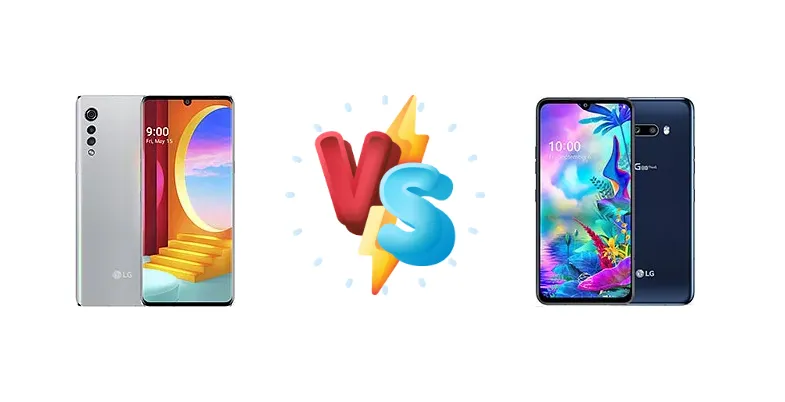
The LG Velvet and G8X ThinQ represent different approaches from LG during their smartphone heyday. The G8X, released in 2019, aimed for a premium experience with its unique Dual Screen accessory, while the Velvet, launched in 2020, prioritized a more refined design and accessible price point. Now, with both devices available at significantly reduced prices, the question arises: which offers the better value in 2024?
🏆 Quick Verdict
For the average user seeking a balance of performance and affordability, the LG G8X ThinQ emerges as the stronger choice. Its Snapdragon 855 chipset, built on a 7nm process, provides a noticeable performance edge over the Velvet’s Snapdragon 845, and its 21W fast charging capability offers quicker top-ups despite similar wireless charging speeds.
| Network |
|---|
| 2G bands | GSM 850 / 900 / 1800 / 1900 | GSM 850 / 900 / 1800 / 1900 |
| 3G bands | HSDPA 850 / 900 / 1900 / 2100 | HSDPA 850 / 900 / 1900 / 2100 |
| 4G bands | 1, 3, 7, 8, 20, 28, 38, 40 | 1, 2, 3, 4, 5, 7, 8, 12, 13, 17, 20, 28, 32, 38, 39, 40, 41 |
| Speed | HSPA, LTE | HSPA 42.2/5.76 Mbps, LTE Cat20 1960/75 Mbps |
| Technology | GSM / HSPA / LTE | GSM / CDMA / HSPA / EVDO / LTE |
| | - | 1, 2, 3, 4, 5, 7, 12, 14, 20, 29, 30, 38, 39, 40, 41, 46, 66 - USA |
| Launch |
|---|
| Announced | 2020, July 28. Released 2020, July 31 | 2019, September 06. Released 2019, November 01 |
| Status | Discontinued | Discontinued |
| Body |
|---|
| Build | Glass front, glass back, aluminum frame | Glass front (Gorilla Glass 6), glass back (Gorilla Glass 5), aluminum frame |
| Dimensions | 167.1 x 74.1 x 7.9 mm (6.58 x 2.92 x 0.31 in) | 159.3 x 75.8 x 8.4 mm (6.27 x 2.98 x 0.33 in) |
| SIM | Nano-SIM + Nano-SIM | · Nano-SIM· Nano-SIM + Nano-SIM |
| Weight | 180 g (6.35 oz) | 192 g (6.77 oz) |
| | IP68 dust/water resistant (up to 1.5m for 30 min)
MIL-STD-810G compliant*
*does not guarantee ruggedness or use in extreme conditions | IP68 dust/water resistant (up to 1.5m for 30 min)
MIL-STD-810G compliant*
*does not guarantee ruggedness or use in extreme conditions |
| Display |
|---|
| Protection | - | Corning Gorilla Glass 6 |
| Resolution | 1080 x 2460 pixels (~395 ppi density) | 1080 x 2340 pixels, 19.5:9 ratio (~403 ppi density) |
| Size | 6.8 inches, 109.8 cm2 (~88.7% screen-to-body ratio) | 6.4 inches, 100.5 cm2 (~83.3% screen-to-body ratio) |
| Type | P-OLED | OLED, HDR10 |
| | - | Always-on display |
| Platform |
|---|
| CPU | Octa-core (4x2.8 GHz Kryo 385 Gold & 4x1.8 GHz Kryo 385 Silver) | Octa-core (1x2.84 GHz Kryo 485 & 3x2.42 GHz Kryo 485 & 4x1.78 GHz Kryo 485) |
| Chipset | Qualcomm SDM845 Snapdragon 845 (10 nm) | Qualcomm SM8150 Snapdragon 855 (7 nm) |
| GPU | Adreno 630 | Adreno 640 |
| OS | Android 10, upgradable to Android 12 | Android 9.0 (Pie), upgradable to Android 12 |
| Memory |
|---|
| Card slot | microSDXC (uses shared SIM slot) | microSDXC (uses shared SIM slot) - dual-SIM model |
| Internal | 128GB 6GB RAM | 128GB 6GB RAM |
| | UFS 2.1 | UFS 2.1 |
| Main Camera |
|---|
| Dual | - | 12 MP, f/1.8, 27mm (wide), 1/2.55", 1.4µm, dual pixel PDAF, OIS
13 MP, f/2.4, 9mm (ultrawide), 1.0µm |
| Features | LED flash, panorama, HDR | Dual-LED dual-tone flash, HDR, panorama |
| Single | - | 3.15 MP, AF |
| Triple | 48 MP, f/1.8, 26mm (wide), 1/2.0", 0.8µm, PDAF
8 MP, f/2.2, 120˚, 15mm (ultrawide), 1/4.0", 1.12µm
Auxiliary lens | - |
| Video | 4K@30fps, 1080p@30/60fps, gyro-EIS | 4K@30/60fps, 1080p@30/60/240fps, 24-bit/192kHz stereo sound rec., gyro-EIS |
| Selfie camera |
|---|
| Features | HDR | HDR |
| Single | 16 MP, f/1.9, 29mm (standard), 1/3.06, 1.0µm | 32 MP, f/1.9, 26mm (wide), 1/2.8", 0.8µm |
| Video | 4K@30fps, 1080p@30fps | 4K@30fps, gyro-EIS |
| Sound |
|---|
| 3.5mm jack | Yes | Yes |
| 35mm jack | Yes | Yes |
| Loudspeaker | Yes, with stereo speakers | Yes, with stereo speakers |
| | - | 32-bit/192kHz audio
24-bit/192kHz audio recording
Tuned by Meridian Audio |
| Comms |
|---|
| Bluetooth | 5.1, A2DP, LE | 5.0, A2DP, LE, aptX HD |
| NFC | Yes | Yes |
| Positioning | GPS | GPS, GLONASS, GALILEO, BDS |
| Radio | FM radio | FM radio |
| USB | USB Type-C, OTG | USB Type-C 3.1, OTG |
| WLAN | Wi-Fi 802.11 a/b/g/n/ac, dual-band, Wi-Fi Direct | Wi-Fi 802.11 a/b/g/n/ac, dual-band, Wi-Fi Direct, DLNA |
| Features |
|---|
| Browser | - | HTML, Adobe Flash |
| Sensors | Fingerprint (under display, optical), accelerometer, gyro, proximity, compass, barometer | Fingerprint (under display, optical), accelerometer, gyro, proximity, compass, barometer |
| Battery |
|---|
| Charging | 15W wired, QC3
9W wireless | 21W wired, PD, QC3
9W wireless |
| Talk time | - | Up to 12 h (multimedia) |
| Type | Li-Po 4300 mAh | Li-Po 4000 mAh, non-removable |
| Misc |
|---|
| Colors | Black, Aurora Silver | New Aurora Black |
| Models | LMG910EMW, LM-G910EMW | LMG850EMW, LM-G850, 901LG, LM-G850N |
| Price | About 360 EUR | About 560 EUR |
| SAR | - | 1.12 W/kg (body) |
| SAR EU | - | 0.90 W/kg (head) |
| Tests |
|---|
| Audio quality | - |
Noise -93.2dB / Crosstalk -93.4dB |
| Battery life | - |
Endurance rating 111h
|
| Camera | - |
Photo / Video |
| Display | - |
Contrast ratio: Infinite (nominal) |
| Loudspeaker | - |
-24.9 LUFS (Very good)
|
| Performance | - |
AnTuTu: 339726 (v7), 411980 (v8)
GeekBench: 11251 (v4.4), 2870 (v5.1)
GFXBench: 38fps (ES 3.1 onscreen) |
LG Velvet
- Sleek and modern design
- More affordable price point
- Competent performance for everyday tasks
- Snapdragon 845 is less powerful than the 855
- Slower wired charging (15W)
- Display likely lacks the brightness of the G8X
LG G8X ThinQ
- More powerful Snapdragon 855 chipset
- Faster 21W wired charging with PD and QC3
- Brighter display for better outdoor visibility
- Potentially larger and heavier design
- May be harder to find in pristine condition
- Original price was significantly higher
Display Comparison
The LG G8X ThinQ boasts a brighter display, reaching a measured 603 nits, compared to an unspecified brightness for the Velvet. While both feature 'infinite' contrast ratios (typical for OLED panels), the G8X’s higher peak brightness translates to better visibility in direct sunlight. The Velvet’s display technology isn’t specified, but given its launch timeframe, it likely utilizes a standard OLED panel, while the G8X’s panel benefits from LG’s display expertise. Bezels are comparable, but the G8X’s overall display experience is superior due to its brightness.
Camera Comparison
Both devices offer photo and video capabilities, but detailed camera specs are limited. Without specific sensor size or aperture information, it’s difficult to make a definitive judgment. However, the G8X’s higher processing power allows for more sophisticated image processing algorithms, potentially resulting in better dynamic range and low-light performance. The inclusion of OIS (Optical Image Stabilization) on the G8X, if present (not specified in data), would further enhance image quality. We can safely assume both phones feature a standard array of lenses, but the G8X’s chipset provides a computational advantage.
Performance
The core difference lies in the chipsets. The LG G8X ThinQ’s Snapdragon 855 (7nm) offers a clear advantage over the Velvet’s Snapdragon 845 (10nm). The 855 features a more efficient architecture with a single high-performance Kryo 485 core clocked at 2.84 GHz, alongside three additional Kryo 485 cores at 2.42 GHz, and four efficiency cores at 1.78 GHz. This contrasts with the 845’s quad 2.8 GHz Kryo 385 Gold and quad 1.8 GHz Kryo 385 Silver configuration. The 7nm process node of the 855 also results in better thermal efficiency, reducing the likelihood of throttling during sustained workloads. While both phones likely feature similar RAM configurations, the 855’s superior processing power will be noticeable in demanding applications and games.
Battery Life
Interestingly, both the LG Velvet and G8X ThinQ share an endurance rating of 111 hours, suggesting comparable real-world battery life despite unspecified mAh capacities. However, the G8X ThinQ’s 21W wired charging with Power Delivery (PD) and Quick Charge 3.0 (QC3) provides a significant advantage over the Velvet’s 15W wired charging with QC3. This means the G8X can be charged from 0-100% much faster, mitigating any potential battery life differences. Both support 9W wireless charging, offering a convenient but slower charging option.
Buying Guide
Buy the LG Velvet if you prioritize a sleek, modern design and are comfortable with slightly less processing power for everyday tasks. It’s ideal for users who primarily browse, stream media, and take casual photos. Buy the LG G8X ThinQ if you demand more from your smartphone – faster app loading, smoother multitasking, and quicker charging are all benefits. This phone is better suited for gamers and power users who push their devices to the limit.
Frequently Asked Questions
❓ Will the Snapdragon 855 in the G8X ThinQ struggle with demanding games like Genshin Impact?
While the Snapdragon 855 isn't the latest and greatest, it's still capable of running Genshin Impact at medium settings with stable frame rates. The 7nm process and improved thermal management compared to the 845 in the Velvet will help prevent significant throttling during extended gaming sessions.
❓ Is the difference in charging speed between 15W and 21W really noticeable in everyday use?
Yes, the 21W charging on the G8X ThinQ provides a substantial difference. You can expect to gain several percentage points of battery life in a shorter amount of time, making it more convenient to quickly top up your phone when needed. The Velvet's 15W charging is adequate, but noticeably slower.
❓ Given both phones have the same endurance rating, does that mean battery life is identical?
The 111-hour endurance rating suggests similar overall battery life under typical usage. However, the G8X ThinQ’s faster charging allows you to replenish the battery more quickly, effectively mitigating any minor differences in battery drain. The faster charging also means less downtime.