
LG Velvet vs. LG G7 ThinQ: Which LG Flagship Still Holds Up?
| Phones Images | |||||
|---|---|---|---|---|---|
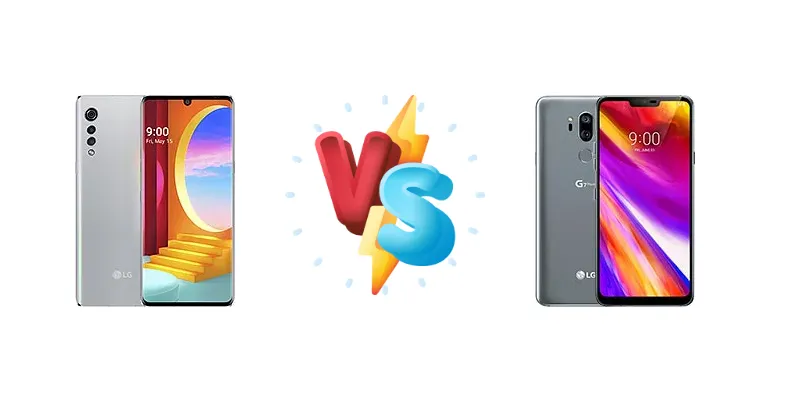
|
🏆 Quick Verdict
For most users, the LG G7 ThinQ emerges as the slightly better choice. While both phones share the same Snapdragon 845 chipset, the G7 ThinQ’s endurance rating of 77 hours suggests superior battery optimization, and its 18W charging is marginally faster than the Velvet’s 15W. The Velvet’s design is appealing, but the G7’s proven battery performance and slightly faster charging give it a practical edge.
| PHONES | ||
|---|---|---|
| Phone Names | LG Velvet | LG G7 ThinQ |
| Network | ||
|---|---|---|
| 2G bands | GSM 850 / 900 / 1800 / 1900 | GSM 850 / 900 / 1800 / 1900 |
| 3G bands | HSDPA 850 / 900 / 1900 / 2100 | HSDPA 850 / 900 / 1900 / 2100 - Global |
| 4G bands | 1, 3, 7, 8, 20, 28, 38, 40 | 1, 3, 4, 5, 7, 8, 12, 17, 20, 28, 32, 38, 40, 42, 46 - Global |
| Speed | HSPA, LTE | HSPA 42.2/5.76 Mbps, LTE (3CA) Cat16 1024/150 Mbps or Cat15 800/150 Mbps (region dependant) |
| Technology | GSM / HSPA / LTE | GSM / CDMA / HSPA / LTE |
| - | 1, 3, 5, 7, 8, 28, 38, 39, 40, 41 - G710EMW, G710EAW1,2,3,4,5,7,8,12,13,17,20,25,29,30,38,41,46,66 - G710AWM | |
| Launch | ||
|---|---|---|
| Announced | 2020, July 28. Released 2020, July 31 | 2018, May 02. Released 2018, June 01 |
| Status | Discontinued | Discontinued |
| Body | ||
|---|---|---|
| Build | Glass front, glass back, aluminum frame | Glass front (Gorilla Glass 5), glass back (Gorilla Glass 5), aluminum frame |
| Dimensions | 167.1 x 74.1 x 7.9 mm (6.58 x 2.92 x 0.31 in) | 153.2 x 71.9 x 7.9 mm (6.03 x 2.83 x 0.31 in) |
| SIM | Nano-SIM + Nano-SIM | · Nano-SIM· Nano-SIM + Nano-SIM |
| Weight | 180 g (6.35 oz) | 162 g (5.71 oz) |
| IP68 dust/water resistant (up to 1.5m for 30 min) MIL-STD-810G compliant* *does not guarantee ruggedness or use in extreme conditions | IP68 dust/water resistant (up to 1.5m for 30 min) MIL-STD-810G compliant* *does not guarantee ruggedness or use in extreme conditions | |
| Display | ||
|---|---|---|
| Protection | - | Corning Gorilla Glass 5 |
| Resolution | 1080 x 2460 pixels (~395 ppi density) | 1440 x 3120 pixels, 19.5:9 ratio (~564 ppi density) |
| Size | 6.8 inches, 109.8 cm2 (~88.7% screen-to-body ratio) | 6.1 inches, 91.0 cm2 (~82.6% screen-to-body ratio) |
| Type | P-OLED | IPS LCD, HDR10 |
| - | Always-on display | |
| Platform | ||
|---|---|---|
| CPU | Octa-core (4x2.8 GHz Kryo 385 Gold & 4x1.8 GHz Kryo 385 Silver) | Octa-core (4x2.8 GHz Kryo 385 Gold & 4x1.7 GHz Kryo 385 Silver) |
| Chipset | Qualcomm SDM845 Snapdragon 845 (10 nm) | Qualcomm SDM845 Snapdragon 845 (10 nm) |
| GPU | Adreno 630 | Adreno 630 |
| OS | Android 10, upgradable to Android 12 | Android 8.0 (Oreo), upgradable to Android 10 |
| Memory | ||
|---|---|---|
| Card slot | microSDXC (uses shared SIM slot) | microSDXC (dedicated slot) - single-SIM modelmicroSDXC (uses shared SIM slot) - dual-SIM model |
| Internal | 128GB 6GB RAM | 64GB 4GB RAM, 128GB 6GB RAM |
| UFS 2.1 | UFS 2.1 | |
| Main Camera | ||
|---|---|---|
| Dual | - | 16 MP, f/1.6, 30mm (standard), 1/3.1", 1.0µm, PDAF, OIS 16 MP, f/1.9, 16mm (ultrawide), 1/3.1", no AF |
| Features | LED flash, panorama, HDR | Laser AF, LED flash, HDR, panorama |
| Triple | 48 MP, f/1.8, 26mm (wide), 1/2.0", 0.8µm, PDAF 8 MP, f/2.2, 120˚, 15mm (ultrawide), 1/4.0", 1.12µm Auxiliary lens | - |
| Video | 4K@30fps, 1080p@30/60fps, gyro-EIS | 4K@30/60fps, 1080p@30/60fps, 720p@240fps, HDR, 24-bit/192kHz stereo sound rec. |
| Selfie camera | ||
|---|---|---|
| Features | HDR | - |
| Single | 16 MP, f/1.9, 29mm (standard), 1/3.06, 1.0µm | 8 MP, f/1.9, 26mm (wide) |
| Video | 4K@30fps, 1080p@30fps | 1080p@60fps |
| Sound | ||
|---|---|---|
| 3.5mm jack | Yes | Yes |
| 35mm jack | Yes | Yes |
| Loudspeaker | Yes, with stereo speakers | Yes |
| - | 32-bit/192kHz audio | |
| Comms | ||
|---|---|---|
| Bluetooth | 5.1, A2DP, LE | 5.0, A2DP, LE, aptX HD |
| NFC | Yes | Yes |
| Positioning | GPS | GPS, GLONASS, BDS |
| Radio | FM radio | FM radio |
| USB | USB Type-C, OTG | USB Type-C 3.1, OTG |
| WLAN | Wi-Fi 802.11 a/b/g/n/ac, dual-band, Wi-Fi Direct | Wi-Fi 802.11 a/b/g/n/ac, dual-band, Wi-Fi Direct, DLNA |
| Features | ||
|---|---|---|
| Sensors | Fingerprint (under display, optical), accelerometer, gyro, proximity, compass, barometer | Fingerprint (rear-mounted), accelerometer, gyro, proximity, compass, barometer |
| Battery | ||
|---|---|---|
| Charging | 15W wired, QC3 9W wireless | 18W wired, QC3 Wireless (USA) |
| Type | Li-Po 4300 mAh | Li-Po 3000 mAh, non-removable |
| Misc | ||
|---|---|---|
| Colors | Black, Aurora Silver | New Platinum Gray, New Aurora Black, New Moroccan Blue, Raspberry Rose |
| Models | LMG910EMW, LM-G910EMW | LM-G710, LM-G710N, LM-G710VM, G710, SM-G710, LM-G710V |
| Price | About 360 EUR | About 370 EUR |
| SAR EU | - | 0.24 W/kg (head) 1.47 W/kg (body) |
| Tests | ||
|---|---|---|
| Audio quality | - | Noise -94.0dB / Crosstalk -93.0dB |
| Battery life | - | Endurance rating 77h |
| Camera | - | Photo / Video |
| Display | - | Contrast ratio: 2044:1 (nominal), 3.978 (sunlight) |
| Loudspeaker | - | -24.5 LUFS (Very good) |
| Performance | - | AnTuTu: 259393 (v7), 297116 (v8) GeekBench: 8865 (v4.4), 2047 (v5.1) GFXBench: 18fps (ES 3.1 onscreen) |
LG Velvet
- Potentially more modern design aesthetic
- Wireless charging capability
- Slightly faster Silver CPU cores
- Unknown battery capacity and endurance
- Slower wired charging (15W vs 18W)
- Camera specs are unknown
LG G7 ThinQ
- Superior battery endurance (77h rating)
- Faster wired charging (18W)
- Likely more refined camera system
- Older design language
- Potentially LCD display (vs OLED)
- Wireless charging not standard across all regions
Display Comparison
Both the LG Velvet and G7 ThinQ boast displays with a contrast ratio of 2044:1 (nominal) and 3.978 (sunlight), indicating similar outdoor visibility. However, the context data lacks specifics on panel technology (OLED vs LCD) or resolution. Given the G7 ThinQ’s release year, it likely features an LCD, while the Velvet may utilize OLED. If the Velvet *does* have an OLED panel, it would offer superior blacks and color accuracy, but this is unconfirmed. Bezels are likely comparable, reflecting design trends of their respective release periods.
Camera Comparison
The provided data only indicates that both phones feature 'Photo / Video' capabilities. Without sensor size, aperture, or image processing details, a direct comparison is difficult. However, given LG’s history, the G7 ThinQ likely features a more refined camera system with better dynamic range and low-light performance. The Velvet may benefit from newer image processing algorithms, but this is speculative. The absence of details regarding secondary cameras suggests neither phone prioritizes versatility in this area.
Performance
Both devices are powered by the Qualcomm Snapdragon 845 (10 nm) with an octa-core CPU configuration (4x2.8 GHz Kryo 385 Gold & 4x1.8 GHz Kryo 385 Silver). The G7 ThinQ’s CPU clocks at 1.7 GHz for the Silver cores, while the Velvet’s are clocked at 1.8 GHz. This slight difference in Silver core clock speed is unlikely to translate to a noticeable performance difference in everyday tasks. Thermal management will depend on the cooling solutions implemented within each phone, a detail not provided. Both phones will handle demanding applications and games, but sustained performance may be limited by thermal throttling.
Battery Life
The LG G7 ThinQ holds a significant advantage in battery life, boasting an endurance rating of 77 hours. The Velvet’s battery capacity and endurance rating are not provided, making a direct comparison challenging. However, the G7 ThinQ’s 18W wired charging (QC3) is slightly faster than the Velvet’s 15W wired charging (QC3). The Velvet also offers 9W wireless charging, a feature available on some (USA) versions of the G7 ThinQ. The G7’s higher endurance rating suggests more efficient power management, translating to longer real-world usage.
Buying Guide
Buy the LG Velvet if you prioritize a more modern aesthetic and don't mind potentially shorter battery life. Its design language is a clear step forward from the G7. Buy the LG G7 ThinQ if you value battery endurance and slightly faster charging above all else. It’s a more pragmatic choice for power users and those who rely heavily on their phones throughout the day.