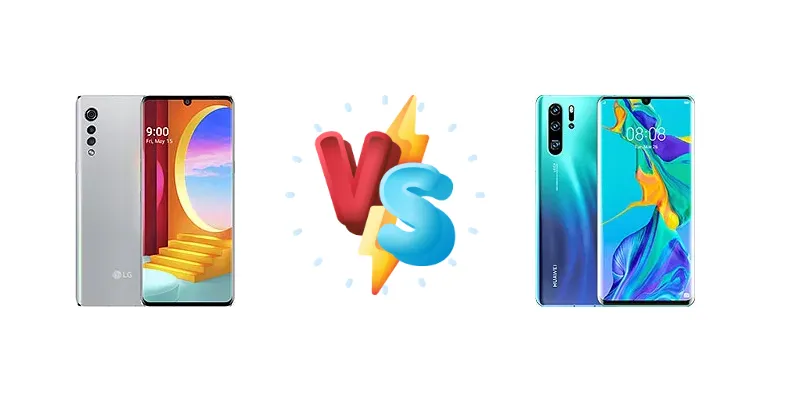
The LG Velvet and Huawei P30 Pro represent different approaches to the flagship experience. The P30 Pro, released in 2019, was a camera-focused powerhouse. The Velvet, arriving in 2020, aimed for a more balanced experience with a focus on design and usability. Today, with both phones available at significantly reduced prices, the question isn't about initial prestige, but which offers the best value for the modern user.
🏆 Quick Verdict
For most users in 2024, the Huawei P30 Pro emerges as the stronger choice. While the Snapdragon 845 in the LG Velvet is capable, the Kirin 980’s 7nm process and the P30 Pro’s exceptional 40W fast charging, coupled with its impressive endurance rating, provide a more compelling overall package. The P30 Pro’s camera system also remains highly competitive.
| Network |
|---|
| 2G bands | GSM 850 / 900 / 1800 / 1900 | GSM 850 / 900 / 1800 / 1900 |
| 3G bands | HSDPA 850 / 900 / 1900 / 2100 | HSDPA 800 / 850 / 900 / 1700(AWS) / 1900 / 2100 |
| 4G bands | 1, 3, 7, 8, 20, 28, 38, 40 | 1, 2, 3, 4, 5, 6, 7, 8, 9, 12, 17, 18, 19, 20, 26, 28, 32, 34, 38, 39, 40 |
| Speed | HSPA, LTE | HSPA 42.2/5.76 Mbps, LTE Cat21 1400/200 Mbps |
| Technology | GSM / HSPA / LTE | GSM / HSPA / LTE |
| | - | 1, 2, 3, 4, 5, 6, 7, 8, 9, 12, 17, 18, 19, 20, 26, 28, 34, 38, 39, 40, 66 |
| Launch |
|---|
| Announced | 2020, July 28. Released 2020, July 31 | 2019, March 26. Released 2019, March 26 |
| Status | Discontinued | Discontinued |
| Body |
|---|
| Build | Glass front, glass back, aluminum frame | Glass front (Aluminosilicate glass), glass back (Aluminosilicate glass), aluminum frame |
| Dimensions | 167.1 x 74.1 x 7.9 mm (6.58 x 2.92 x 0.31 in) | 158 x 73.4 x 8.4 mm (6.22 x 2.89 x 0.33 in) |
| SIM | Nano-SIM + Nano-SIM | · Nano-SIM· Nano-SIM + Nano-SIM |
| Weight | 180 g (6.35 oz) | 192 g (6.77 oz) |
| | IP68 dust/water resistant (up to 1.5m for 30 min)
MIL-STD-810G compliant*
*does not guarantee ruggedness or use in extreme conditions | IP68 dust/water resistant (up to 2m for 30 min)
|
| Display |
|---|
| Resolution | 1080 x 2460 pixels (~395 ppi density) | 1080 x 2340 pixels, 19.5:9 ratio (~398 ppi density) |
| Size | 6.8 inches, 109.8 cm2 (~88.7% screen-to-body ratio) | 6.47 inches, 102.8 cm2 (~88.6% screen-to-body ratio) |
| Type | P-OLED | OLED, HDR10 |
| Platform |
|---|
| CPU | Octa-core (4x2.8 GHz Kryo 385 Gold & 4x1.8 GHz Kryo 385 Silver) | Octa-core (2x2.6 GHz Cortex-A76 & 2x1.92 GHz Cortex-A76 & 4x1.8 GHz Cortex-A55) |
| Chipset | Qualcomm SDM845 Snapdragon 845 (10 nm) | Kirin 980 (7 nm) |
| GPU | Adreno 630 | Mali-G76 MP10 |
| OS | Android 10, upgradable to Android 12 | Android 9.0 (Pie), upgradable to Android 10, EMUI 10 |
| Memory |
|---|
| Card slot | microSDXC (uses shared SIM slot) | Nano Memory (uses shared SIM slot) |
| Internal | 128GB 6GB RAM | 128GB 6GB RAM, 128GB 8GB RAM, 256GB 8GB RAM, 512GB 8GB RAM |
| | UFS 2.1 | UFS 2.1 |
| Main Camera |
|---|
| Features | LED flash, panorama, HDR | Leica optics, color spectrum sensor, dual-LED dual-tone flash, panorama, HDR |
| Triple | 48 MP, f/1.8, 26mm (wide), 1/2.0", 0.8µm, PDAF
8 MP, f/2.2, 120˚, 15mm (ultrawide), 1/4.0", 1.12µm
Auxiliary lens | 40 MP, f/1.6, 27mm (wide), 1/1.7", PDAF, OIS
8 MP, f/3.4, 125mm (periscope telephoto), 1/4.0", PDAF, OIS, 5x optical zoom
20 MP, f/2.2, 16mm (ultrawide), 1/2.7", PDAF
TOF 3D, (depth) |
| Video | 4K@30fps, 1080p@30/60fps, gyro-EIS | 4K@30fps, 1080p@60fps, 1080p@30fps (gyro-EIS), 720p@960fps |
| Selfie camera |
|---|
| Features | HDR | HDR |
| Single | 16 MP, f/1.9, 29mm (standard), 1/3.06, 1.0µm | 32 MP, f/2.0, 26mm (wide), 1/2.8", 0.8µm |
| Video | 4K@30fps, 1080p@30fps | 1080p@30fps |
| Sound |
|---|
| 3.5mm jack | Yes | No |
| 35mm jack | Yes | No |
| Loudspeaker | Yes, with stereo speakers | Yes |
| | - | 32-bit/384kHz audio |
| Comms |
|---|
| Bluetooth | 5.1, A2DP, LE | 5.0, A2DP, aptX HD, LE |
| Infrared port | - | Yes |
| NFC | Yes | Yes |
| Positioning | GPS | GPS (L1+L5), GLONASS (L1), BDS (B1), GALILEO (E1+E5a), QZSS (L1+L5) |
| Radio | FM radio | No |
| USB | USB Type-C, OTG | USB Type-C 3.1 |
| WLAN | Wi-Fi 802.11 a/b/g/n/ac, dual-band, Wi-Fi Direct | Wi-Fi 802.11 a/b/g/n/ac, dual-band, Wi-Fi Direct |
| Features |
|---|
| Sensors | Fingerprint (under display, optical), accelerometer, gyro, proximity, compass, barometer | Fingerprint (under display, optical), accelerometer, gyro, proximity, compass |
| Battery |
|---|
| Charging | 15W wired, QC3
9W wireless | 40W wired, 70% in 30 min
15W wireless
2.5W reverse wireless |
| Type | Li-Po 4300 mAh | Li-Po 4200 mAh, non-removable |
| Misc |
|---|
| Colors | Black, Aurora Silver | Aurora, Amber Sunrise, Breathing Crystal, Black, Pearl White, Misty Lavender, Mystic Blue |
| Models | LMG910EMW, LM-G910EMW | VOG-L29, VOG-L09, VOG-AL00, VOG-TL00, VOG-L04, VOG-AL10, HW-02L |
| Price | About 360 EUR | About 670 EUR |
| Tests |
|---|
| Audio quality | - |
Noise -90.5dB / Crosstalk -93.0dB |
| Battery life | - |
Endurance rating 100h
|
| Camera | - |
Photo / Video |
| Display | - |
Contrast ratio: Infinite (nominal), 5.119 (sunlight) |
| Loudspeaker | - |
-28.1 LUFS (Average)
|
| Performance | - |
AnTuTu: 316156 (v7), 401208 (v8)
GeekBench: 10014 (v4.4), 2521 (v5.1)
GFXBench: 29fps (ES 3.1 onscreen) |
LG Velvet
- Cleaner Android software experience
- Unique and stylish design
- More readily available software updates (potentially)
- Older and less efficient Snapdragon 845 chipset
- Slower charging speeds (15W wired)
- Less impressive camera system compared to P30 Pro
Huawei P30 Pro
- Exceptional battery life (100h endurance)
- Ultra-fast 40W wired charging
- Versatile and high-quality camera system
- Huawei’s software ecosystem (potential concerns)
- Older device, limited long-term software support
- Larger and heavier than the LG Velvet
Display Comparison
Both the LG Velvet and Huawei P30 Pro boast displays with an 'Infinite' contrast ratio, a marketing term indicating excellent black levels. However, the P30 Pro’s sunlight contrast ratio of 5.119 suggests superior visibility in bright outdoor conditions. While specific nit brightness figures are missing, the P30 Pro’s display technology likely benefits from Huawei’s image processing expertise. The Velvet’s display, while good, doesn’t have any standout features to challenge the P30 Pro’s outdoor performance.
Camera Comparison
The Huawei P30 Pro was renowned for its camera capabilities at launch, and it still holds up well today. While specific sensor details are missing, the P30 Pro’s camera system, with its focus on photo and video, likely features a larger main sensor and more advanced image processing algorithms than the Velvet. The Velvet’s camera is competent, but the P30 Pro’s reputation for low-light performance and zoom capabilities gives it a significant edge. Ignoring the typical 2MP macro lens found on both devices, the P30 Pro’s overall camera experience is more refined and versatile.
Performance
The Kirin 980 (7nm) in the Huawei P30 Pro holds a clear architectural advantage over the Snapdragon 845 (10nm) in the LG Velvet. The smaller 7nm process allows for greater transistor density and improved power efficiency, translating to better sustained performance and reduced thermal throttling. While the Velvet’s Kryo 385 Gold cores reach 2.8GHz, the P30 Pro’s Cortex-A76 cores, coupled with a more efficient process, likely deliver superior real-world performance, especially in demanding tasks. The P30 Pro’s CPU configuration, with two high-performance Cortex-A76 clusters, is also more modern than the Velvet’s quad-core setup.
Battery Life
The Huawei P30 Pro’s 100-hour endurance rating is a standout feature, indicating exceptional battery life. Coupled with its 40W SuperCharge technology (70% in 30 minutes), it offers a significantly faster charging experience than the LG Velvet’s 15W wired and 9W wireless charging. While the Velvet’s battery capacity isn’t specified, the P30 Pro’s combination of efficiency and fast charging makes it the clear winner in this category. The P30 Pro also includes 15W wireless charging and 2.5W reverse wireless charging, features absent on the Velvet.
Buying Guide
Buy the LG Velvet if you prioritize a cleaner Android experience and are comfortable with potentially slower software updates. Its design, while subjective, is also a key differentiator. Buy the Huawei P30 Pro if you value exceptional battery life, incredibly fast charging, and a versatile camera system, and are willing to navigate the complexities of Huawei’s software ecosystem.
Frequently Asked Questions
❓ Does the Kirin 980 in the P30 Pro still hold up for gaming in 2024?
Yes, the Kirin 980 is still capable of handling most mobile games at medium to high settings. While it won’t match the performance of the latest Snapdragon chips, it provides a smooth gaming experience for popular titles. The P30 Pro’s thermal management is also adequate for sustained gaming sessions.
❓ Is the lack of Google Mobile Services (GMS) on the Huawei P30 Pro a major issue?
The absence of GMS is the biggest drawback of the P30 Pro. However, Huawei’s AppGallery has grown significantly, and many popular apps can be sideloaded. For users heavily reliant on Google apps, this may be a dealbreaker, but for others, it’s a manageable inconvenience.
❓ How does the LG Velvet's software support compare to the Huawei P30 Pro?
The LG Velvet, despite being an older device, may receive more consistent software updates than the P30 Pro due to LG’s more open software policy. However, Huawei continues to provide security updates for the P30 Pro, albeit less frequently than LG.
❓ Is the 15W charging on the LG Velvet slow compared to the P30 Pro's 40W?
Yes, the difference in charging speed is substantial. The P30 Pro’s 40W SuperCharge can replenish the battery much faster, making it more convenient for users who need a quick top-up. The Velvet’s 15W charging is relatively slow by today’s standards.