
Xiaomi Mi 11 Lite 5G vs LG Velvet 5G: A Detailed Comparison
| Phones Images | |||||
|---|---|---|---|---|---|
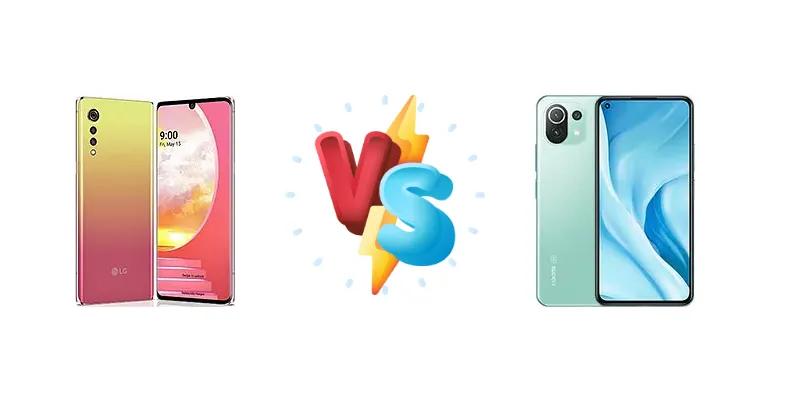
|
🏆 Quick Verdict
For most users, the Xiaomi Mi 11 Lite 5G emerges as the stronger choice. Its significantly superior battery life (106h vs 79h) and more efficient Snapdragon 780G chipset translate to a smoother, longer-lasting experience. While the LG Velvet 5G has a distinct aesthetic, the Mi 11 Lite 5G’s performance and endurance are more impactful.
| PHONES | ||
|---|---|---|
| Phone Names | LG Velvet 5G | Xiaomi Mi 11 Lite 5G |
| Network | ||
|---|---|---|
| 2G bands | GSM 850 / 900 / 1800 / 1900 | GSM 850 / 900 / 1800 / 1900 |
| 3G bands | HSDPA 850 / 900 / 1900 / 2100 | HSDPA 850 / 900 / 1700(AWS) / 1900 / 2100 |
| 4G bands | 1, 2, 3, 4, 5, 7, 8, 12, 17, 20, 28, 32, 38, 39, 40, 41 | 1, 2, 3, 4, 5, 6, 7, 8, 12, 13, 17, 20, 28, 32, 38, 40, 41, 66 - International |
| 5G bands | 1, 3, 28, 78 SA/NSA | 1, 3, 5, 7, 8, 20, 28, 38, 40, 41, 66, 77, 78 SA/NSA - International |
| Speed | HSPA 42.2/5.76 Mbps, LTE (5CA) Cat16 1000/75 Mbps, 5G 2Gbps | HSPA, LTE, 5G |
| Technology | GSM / HSPA / LTE / 5G | GSM / CDMA / HSPA / EVDO / LTE / 5G |
| - | 1, 3, 41, 77, 78 SA/NSA - China | |
| Launch | ||
|---|---|---|
| Announced | 2020, May 07. Released 2020, May 15 | 2021, March 29 |
| Status | Discontinued | Available. Released 2021, April 16 |
| Body | ||
|---|---|---|
| Build | Glass front, glass back, aluminum frame | Glass front (Gorilla Glass 6), glass back |
| Dimensions | 167.2 x 74.1 x 7.9 mm (6.58 x 2.92 x 0.31 in) | 160.5 x 75.7 x 6.8 mm (6.32 x 2.98 x 0.27 in) |
| SIM | Nano-SIM + Nano-SIM | Nano-SIM + Nano-SIM |
| Weight | 180 g (6.35 oz) | 159 g (5.61 oz) |
| IP68 dust/water resistant (up to 1.5m for 30 mins) MIL-STD-810G compliant* *does not guarantee ruggedness or use in extreme conditions | IP53, dust and splash resistant | |
| Display | ||
|---|---|---|
| Protection | - | Corning Gorilla Glass 6 |
| Resolution | 1080 x 2460 pixels (~395 ppi density) | 1080 x 2400 pixels, 20:9 ratio (~402 ppi density) |
| Size | 6.8 inches, 109.8 cm2 (~88.6% screen-to-body ratio) | 6.55 inches, 103.6 cm2 (~85.3% screen-to-body ratio) |
| Type | P-OLED | AMOLED, 1B colors, HDR10+, 90Hz, 500 nits (typ), 800 nits |
| Platform | ||
|---|---|---|
| CPU | Octa-core (1x2.4 GHz Kryo 475 Prime & 1x2.2 GHz Kryo 475 Gold & 6x1.8 GHz Kryo 475 Silver) | Octa-core (1x2.4 GHz Kryo 670 & 3x2.2 GHz Kryo 670 & 4x1.90 GHz Kryo 670) |
| Chipset | Qualcomm SM7250 Snapdragon 765G 5G (7 nm) | Qualcomm SM7350-AB Snapdragon 780G (5 nm) |
| GPU | Adreno 620 | Adreno 642 |
| OS | Android 10, upgradable to Android 13, LG UX | Android 11, upgradable to Android 13, MIUI 14 |
| Memory | ||
|---|---|---|
| Card slot | microSDXC (uses shared SIM slot) | microSDXC (uses shared SIM slot) |
| Internal | 128GB 6GB RAM, 128GB 8GB RAM | 64GB 6GB RAM, 128GB 6GB RAM, 128GB 8GB RAM, 256GB 8GB RAM |
| UFS 2.1 | UFS 2.2 | |
| Main Camera | ||
|---|---|---|
| Features | LED flash, panorama, HDR | Dual-LED dual-tone flash, HDR, panorama |
| Single | - | 20 MP, f/2.2, 27mm (wide), 1/3.4", 0.8µm |
| Triple | 48 MP, f/1.8, 26mm (wide), 1/2.0", 0.8µm, PDAF 8 MP, f/2.2, 120˚, 15mm (ultrawide), 1/4.0", 1.12µm Auxiliary lens | 64 MP, f/1.8, 26mm (wide), 1/1.97", 0.7µm, PDAF 8 MP, f/2.2, 119˚ (ultrawide), 1/4.0", 1.12µm 5 MP (macro), AF |
| Video | 4K@30fps, 1080p@30/60fps, gyro-EIS | 4K@30fps, 1080p@30/60/120fps; gyro-EIS |
| Selfie camera | ||
|---|---|---|
| Features | HDR | HDR, panorama |
| Single | 16 MP, f/1.9, 29mm (standard), 1/3.06, 1.0µm | 20 MP, f/2.2, 27mm (wide), 1/3.4", 0.8µm |
| Video | 1080p@30fps | 1080p@30/60fps, 720p@120fps |
| Sound | ||
|---|---|---|
| 3.5mm jack | Yes | No |
| 35mm jack | Yes | No |
| Loudspeaker | Yes, with stereo speakers | Yes, with dual speakers |
| - | 24-bit/192kHz audio | |
| Comms | ||
|---|---|---|
| Bluetooth | 5.1, A2DP, LE, aptX HD | 5.2, A2DP, LE |
| Infrared port | - | Yes |
| NFC | Yes | Yes (market/region dependent) |
| Positioning | GPS (L1+L5), GLONASS, BDS, GALILEO, QZSS | GPS (L1+L5), GLONASS (G1), BDS (B1I+B1c+B2a), GALILEO (E1+E5a), QZSS (L1+L5), NavIC (L5) |
| Radio | FM radio (market/region dependent) | No |
| USB | USB Type-C, OTG | USB Type-C 2.0, OTG |
| WLAN | Wi-Fi 802.11 a/b/g/n/ac, dual-band, Wi-Fi Direct, DLNA | Wi-Fi 802.11 a/b/g/n/ac/6, dual-band, Wi-Fi Direct |
| Features | ||
|---|---|---|
| Sensors | Fingerprint (under display, optical), accelerometer, gyro, proximity, compass, barometer | Fingerprint (side-mounted), accelerometer, gyro, compass |
| - | Virtual proximity sensing | |
| Battery | ||
|---|---|---|
| Charging | 25W wired, PD3.0, QC4 9W wireless | 33W wired, PD3.0, QC4 |
| Type | Li-Po 4300 mAh | Li-Po 4250 mAh |
| Misc | ||
|---|---|---|
| Colors | Aurora White, Aurora Green, Aurora Gray, Illusion Sunset, Red, Pink | Truffle Black, Mint Green, Citrus Yellow |
| Models | LM-G900N, LM-G900EM, LM-G900, LM-G900TM | M2101K9G, M2101K9C, M2101K9R |
| Price | About 470 EUR | About 120 EUR |
| SAR | 0.23 W/kg (head) 1.02 W/kg (body) | 1.03 W/kg (head) 1.06 W/kg (body) |
| SAR EU | - | 0.56 W/kg (head) 0.89 W/kg (body) |
| Tests | ||
|---|---|---|
| Battery life | Endurance rating 79h | Endurance rating 106h |
| Camera | Photo / Video | Photo / Video |
| Display | Contrast ratio: Infinite (nominal) | Contrast ratio: Infinite (nominal) |
| Loudspeaker | -23.5 LUFS (Very good) | -23.6 LUFS (Very good) |
| Performance | AnTuTu: 297372 (v8) GeekBench: 1905 (v5.1) GFXBench: 16fps (ES 3.1 onscreen) | AnTuTu: 465534 (v8) | 522490 (v9) GeekBench: 2909 (v5.1) GFXBench: 35fps (ES 3.1 onscreen) |
LG Velvet 5G
- Unique and stylish design
- Supports 25W fast charging with PD3.0 and QC4
- Wireless charging support (9W)
- Significantly shorter battery life (79h)
- Less powerful Snapdragon 765G chipset
Xiaomi Mi 11 Lite 5G
- Excellent battery life (106h)
- More powerful and efficient Snapdragon 780G chipset
- Brighter display for better outdoor visibility
- Faster 33W wired charging
- Design may be less distinctive than the LG Velvet 5G
- No wireless charging support
Display Comparison
The Xiaomi Mi 11 Lite 5G boasts a significantly brighter display, reaching 846 nits compared to the LG Velvet 5G’s 617 nits. This translates to better visibility outdoors under direct sunlight. Both displays share an 'Infinite' (nominal) contrast ratio, suggesting similar black levels, but the brightness difference is a key differentiator. While both are likely OLED panels, the Mi 11 Lite’s higher peak brightness provides a more vibrant and usable experience in various lighting conditions.
Camera Comparison
Both phones feature capable camera systems, but detailed sensor information is lacking in the provided data. However, the market positioning suggests the Mi 11 Lite 5G likely benefits from more advanced image processing algorithms. Without specific sensor size or aperture details, it’s difficult to definitively declare a winner, but Xiaomi’s generally strong camera performance in this price bracket gives it an edge. The presence of a dedicated night mode and AI scene detection on the Mi 11 Lite 5G would further enhance its photographic capabilities.
Performance
The Xiaomi Mi 11 Lite 5G’s Snapdragon 780G (5nm) represents a clear upgrade over the LG Velvet 5G’s Snapdragon 765G (7nm). The 5nm process node allows for greater transistor density and improved power efficiency. The Mi 11 Lite’s CPU configuration (1x2.4 GHz Kryo 670, 3x2.2 GHz Kryo 670, 4x1.90 GHz Kryo 670) is optimized for sustained performance, while the Velvet’s (1x2.4 GHz Kryo 475 Prime, 1x2.2 GHz Kryo 475 Gold, 6x1.8 GHz Kryo 475 Silver) is slightly less efficient. This difference will be noticeable in demanding tasks like gaming and video editing.
Battery Life
The Xiaomi Mi 11 Lite 5G’s endurance rating of 106 hours significantly surpasses the LG Velvet 5G’s 79 hours. This is a substantial difference, indicating the Mi 11 Lite 5G can comfortably last a full day of moderate to heavy use, while the Velvet 5G may require a top-up. The Mi 11 Lite 5G also offers faster 33W wired charging compared to the Velvet 5G’s 25W, reducing charging times. While both support PD3.0 and QC4, the wattage difference is crucial for convenience.
Buying Guide
Buy the LG Velvet 5G if you prioritize a unique, flowing design and are willing to trade some battery life and processing power for it. It’s a good fit for users who value aesthetics and don’t heavily rely on demanding applications. Buy the Xiaomi Mi 11 Lite 5G if you prioritize battery life, performance, and a lightweight build. This phone is ideal for users who stream videos, play mobile games, or simply need a phone that can last all day on a single charge.