
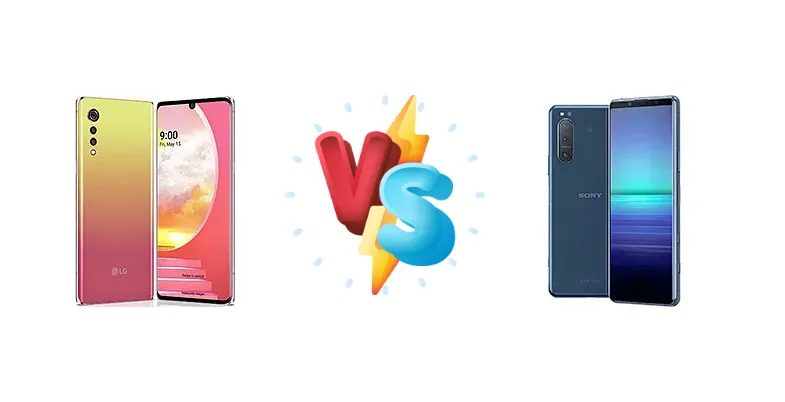
LG Velvet 5G vs Sony Xperia 5 II: A Detailed Comparison for Power Users and Value Seekers
| Phones Images | |||||
|---|---|---|---|---|---|
|
🏆 Quick Verdict
For the average user prioritizing battery life and a smoother experience, the Sony Xperia 5 II is the clear winner. Its Snapdragon 865 chipset and larger battery endurance rating of 102h significantly outperform the LG Velvet 5G’s Snapdragon 765G and 79h rating, justifying its higher price for demanding users.
| PHONES | ||
|---|---|---|
| Phone Names | LG Velvet 5G | Sony Xperia 5 II |
| Network | ||
|---|---|---|
| 2G bands | GSM 850 / 900 / 1800 / 1900 | GSM 850 / 900 / 1800 / 1900 |
| 3G bands | HSDPA 850 / 900 / 1900 / 2100 | HSDPA 800 / 850 / 900 / 1700(AWS) / 1900 / 2100 |
| 4G bands | 1, 2, 3, 4, 5, 7, 8, 12, 17, 20, 28, 32, 38, 39, 40, 41 | 1, 2, 3, 4, 5, 7, 8, 12, 13, 17, 19, 20, 25, 26, 28, 29, 32, 34, 38, 39, 40, 41, 46, 48, 66 |
| 5G bands | 1, 3, 28, 78 SA/NSA | 1, 3, 8, 28, 77, 78 SA/NSA |
| Speed | HSPA 42.2/5.76 Mbps, LTE (5CA) Cat16 1000/75 Mbps, 5G 2Gbps | HSPA 42.2/5.76 Mbps, LTE Cat18 1200/150 Mbps, 5G |
| Technology | GSM / HSPA / LTE / 5G | GSM / HSPA / LTE / 5G |
| Launch | ||
|---|---|---|
| Announced | 2020, May 07. Released 2020, May 15 | 2020, September 17 |
| Status | Discontinued | Available. Released 2020, October 12 |
| Body | ||
|---|---|---|
| Build | Glass front, glass back, aluminum frame | Glass front (Gorilla Glass 6), glass back (Gorilla Glass 6), aluminum frame |
| Dimensions | 167.2 x 74.1 x 7.9 mm (6.58 x 2.92 x 0.31 in) | 158 x 68 x 8 mm (6.22 x 2.68 x 0.31 in) |
| SIM | Nano-SIM + Nano-SIM | · Nano-SIM· Nano-SIM + Nano-SIM |
| Weight | 180 g (6.35 oz) | 163 g (5.75 oz) |
| IP68 dust/water resistant (up to 1.5m for 30 mins) MIL-STD-810G compliant* *does not guarantee ruggedness or use in extreme conditions | IP65/IP68 dust/water resistant (up to 1.5m for 30 mins) | |
| Display | ||
|---|---|---|
| Protection | - | Corning Gorilla Glass 6 |
| Resolution | 1080 x 2460 pixels (~395 ppi density) | 1080 x 2520 pixels, 21:9 ratio (~449 ppi density) |
| Size | 6.8 inches, 109.8 cm2 (~88.6% screen-to-body ratio) | 6.1 inches, 86.9 cm2 (~80.9% screen-to-body ratio) |
| Type | P-OLED | OLED, 120Hz, HDR BT.2020 |
| - | Triluminos display X-Reality Engine | |
| Platform | ||
|---|---|---|
| CPU | Octa-core (1x2.4 GHz Kryo 475 Prime & 1x2.2 GHz Kryo 475 Gold & 6x1.8 GHz Kryo 475 Silver) | Octa-core (1x2.84 GHz Cortex-A77 & 3x2.42 GHz Cortex-A77 & 4x1.80 GHz Cortex-A55) |
| Chipset | Qualcomm SM7250 Snapdragon 765G 5G (7 nm) | Qualcomm SM8250 Snapdragon 865 5G (7 nm+) |
| GPU | Adreno 620 | Adreno 650 |
| OS | Android 10, upgradable to Android 13, LG UX | Android 10, upgradable to Android 12 |
| Memory | ||
|---|---|---|
| Card slot | microSDXC (uses shared SIM slot) | microSDXC (uses shared SIM slot) |
| Internal | 128GB 6GB RAM, 128GB 8GB RAM | 128GB 8GB RAM, 256GB 8GB RAM |
| UFS 2.1 | UFS 3.0 | |
| Main Camera | ||
|---|---|---|
| Features | LED flash, panorama, HDR | Zeiss optics, color spectrum sensor, LED flash, panorama, HDR, eye tracking |
| Triple | 48 MP, f/1.8, 26mm (wide), 1/2.0", 0.8µm, PDAF 8 MP, f/2.2, 120˚, 15mm (ultrawide), 1/4.0", 1.12µm Auxiliary lens | 12 MP, f/1.7, 24mm (wide), 1/1.7", 1.8µm, dual pixel PDAF, OIS 12 MP, f/2.4, 70mm (telephoto), 1/3.4", 1.0µm, PDAF, 3x optical zoom, OIS 12 MP, f/2.2, 124˚, 16mm (ultrawide), 1/2.55", dual pixel PDAF |
| Video | 4K@30fps, 1080p@30/60fps, gyro-EIS | 4K@24/30/60/120fps HDR, 1080p, 5-axis gyro-EIS, OIS |
| Selfie camera | ||
|---|---|---|
| Features | HDR | HDR |
| Single | 16 MP, f/1.9, 29mm (standard), 1/3.06, 1.0µm | 8 MP, f/2.0, 24mm (wide), 1/4.0", 1.12µm |
| Video | 1080p@30fps | 1080p@30fps, 5-axis gyro-EIS |
| Sound | ||
|---|---|---|
| 3.5mm jack | Yes | Yes |
| 35mm jack | Yes | Yes |
| Loudspeaker | Yes, with stereo speakers | Yes, with stereo speakers |
| - | 24-bit/192kHz audio Dynamic vibration system | |
| Comms | ||
|---|---|---|
| Bluetooth | 5.1, A2DP, LE, aptX HD | 5.1, A2DP, aptX HD, LE |
| NFC | Yes | Yes |
| Positioning | GPS (L1+L5), GLONASS, BDS, GALILEO, QZSS | GPS, GLONASS, BDS, GALILEO, QZSS |
| Radio | FM radio (market/region dependent) | No |
| USB | USB Type-C, OTG | USB Type-C 3.1, OTG |
| WLAN | Wi-Fi 802.11 a/b/g/n/ac, dual-band, Wi-Fi Direct, DLNA | Wi-Fi 802.11 a/b/g/n/ac/6, dual-band, Wi-Fi Direct, DLNA |
| Features | ||
|---|---|---|
| Sensors | Fingerprint (under display, optical), accelerometer, gyro, proximity, compass, barometer | Fingerprint (side-mounted), accelerometer, gyro, proximity, barometer, compass |
| Battery | ||
|---|---|---|
| Charging | 25W wired, PD3.0, QC4 9W wireless | 21W wired, PD3.0, 50% in 30 min |
| Type | Li-Po 4300 mAh | Li-Ion 4000 mAh |
| Misc | ||
|---|---|---|
| Colors | Aurora White, Aurora Green, Aurora Gray, Illusion Sunset, Red, Pink | Black, Grey, Blue, Pink |
| Models | LM-G900N, LM-G900EM, LM-G900, LM-G900TM | SO-52A, XQ-AS52, XQ-AS62, XQ-AS72, A002SO, SOG02 |
| Price | About 470 EUR | About 650 EUR |
| SAR | 0.23 W/kg (head) 1.02 W/kg (body) | - |
| Pricing | ||
|---|---|---|
| 128GB 8GB RAM | - | $ 695.00 |
| RENEWED | - | £ 239.00 |
| Tests | ||
|---|---|---|
| Battery life | Endurance rating 79h | Endurance rating 102h |
| Camera | Photo / Video | Photo / Video |
| Display | Contrast ratio: Infinite (nominal) | Contrast ratio: Infinite (nominal) |
| Loudspeaker | -23.5 LUFS (Very good) | -28.3 LUFS (Average) |
| Performance | AnTuTu: 297372 (v8) GeekBench: 1905 (v5.1) GFXBench: 16fps (ES 3.1 onscreen) | AnTuTu: 532655 (v8) GeekBench: 3301 (v5.1) GFXBench: 41fps (ES 3.1 onscreen) |
LG Velvet 5G
- More affordable price point
- Faster wired charging (25W)
- Wireless charging support
- Less powerful Snapdragon 765G chipset
- Lower battery endurance (79h)
- Less refined camera system
Sony Xperia 5 II
- Flagship Snapdragon 865 chipset
- Superior battery endurance (102h)
- Compact and ergonomic design
- Higher price tag ($695)
- Slower wired charging (21W)
- No wireless charging
Display Comparison
Both the LG Velvet 5G and Sony Xperia 5 II feature displays with an 'Infinite' contrast ratio, suggesting excellent black levels. However, the LG Velvet 5G boasts a slightly higher peak brightness of 617 nits compared to the Xperia 5 II’s 600 nits. While the difference is minimal, it could translate to marginally better visibility in direct sunlight. Neither display specifies refresh rates beyond standard 60Hz, a notable omission compared to some competitors. The Xperia 5 II’s 6.1-inch display is also smaller, contributing to its more compact form factor, which will appeal to users who prefer one-handed usability.
Camera Comparison
Both devices offer photo and video capabilities, but details are limited. Without specific sensor size or megapixel counts, a direct comparison is difficult. However, Sony’s history with camera technology suggests a more refined image processing pipeline on the Xperia 5 II, potentially resulting in more accurate colors and better dynamic range. The Xperia 5 II’s pro-level video features, a hallmark of Sony’s smartphones, are likely absent on the Velvet. The Velvet’s camera system is likely geared towards general-purpose photography, while the Xperia 5 II aims for enthusiast-level control and quality.
Performance
The core difference lies in the chipsets. The Sony Xperia 5 II is powered by the Qualcomm SM8250 Snapdragon 865 5G (7 nm+), featuring an octa-core CPU with a prime Cortex-A77 core clocked at 2.84 GHz. This is a significant step up from the LG Velvet 5G’s Qualcomm SM7250 Snapdragon 765G 5G (7 nm) and its 2.4 GHz Kryo 475 Prime core. The 865 offers substantially improved CPU and GPU performance, making the Xperia 5 II far more capable in demanding tasks like gaming and video editing. While both phones utilize 5G connectivity, the 865’s modem offers potentially faster and more reliable speeds. The Xperia 5 II’s chipset also benefits from a more advanced 7nm+ manufacturing process, potentially leading to better thermal efficiency.
Battery Life
The Sony Xperia 5 II’s endurance rating of 102 hours significantly surpasses the LG Velvet 5G’s 79 hours. This difference is likely due to a combination of factors, including a more efficient chipset and optimized power management. While the Xperia 5 II’s 21W wired charging is slower than the Velvet’s 25W support, the 50% charge in 30 minutes claim is competitive. The Velvet also offers 9W wireless charging, a feature absent on the Xperia 5 II. However, the Xperia 5 II’s superior battery endurance mitigates the slower charging speed for most users.
Buying Guide
Buy the LG Velvet 5G if you prioritize a more affordable 5G experience and appreciate a unique, flowing design. It’s a solid choice for everyday tasks and media consumption. Buy the Sony Xperia 5 II if you demand flagship-level performance, a compact form factor, and features geared towards content creators – particularly those interested in photography and videography.