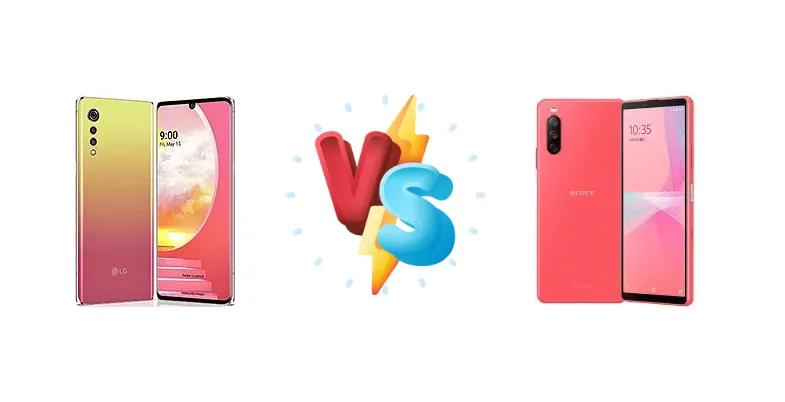
The LG Velvet 5G and Sony Xperia 10 III Lite represent different approaches to the mid-range 5G market. The Velvet, despite its age, boasts a more powerful chipset and a significantly better battery life rating. The Xperia 10 III Lite, meanwhile, aims for affordability and a streamlined experience. This comparison dives deep into the specifics to determine which phone delivers the best value.
🏆 Quick Verdict
For the average user prioritizing longevity and overall performance, the LG Velvet 5G is the better choice. Its Snapdragon 765G chipset and impressive 79-hour endurance rating outweigh the Xperia 10 III Lite’s slightly faster 30W charging. However, the Xperia 10 III Lite is a viable option for budget-conscious buyers.
| Network |
|---|
| 2G bands | GSM 850 / 900 / 1800 / 1900 | GSM 850 / 900 / 1800 / 1900 |
| 3G bands | HSDPA 850 / 900 / 1900 / 2100 | HSDPA 850 / 1900 |
| 4G bands | 1, 2, 3, 4, 5, 7, 8, 12, 17, 20, 28, 32, 38, 39, 40, 41 | 1, 3, 4, 12, 18, 19, 38, 41 |
| 5G bands | 1, 3, 28, 78 SA/NSA | 77, 78 SA/NSA |
| Speed | HSPA 42.2/5.76 Mbps, LTE (5CA) Cat16 1000/75 Mbps, 5G 2Gbps | HSPA, LTE, 5G |
| Technology | GSM / HSPA / LTE / 5G | GSM / HSPA / LTE / 5G |
| Launch |
|---|
| Announced | 2020, May 07. Released 2020, May 15 | 2021, August 20 |
| Status | Discontinued | Available. Released 2021, August 27 |
| Body |
|---|
| Build | Glass front, glass back, aluminum frame | Glass front (Gorilla Glass 6), glass back (Gorilla Glass 6), plastic frame |
| Dimensions | 167.2 x 74.1 x 7.9 mm (6.58 x 2.92 x 0.31 in) | 154 x 68 x 8.3 mm (6.06 x 2.68 x 0.33 in) |
| SIM | Nano-SIM + Nano-SIM | Nano-SIM + eSIM |
| Weight | 180 g (6.35 oz) | 169 g (5.96 oz) |
| | IP68 dust/water resistant (up to 1.5m for 30 mins)
MIL-STD-810G compliant*
*does not guarantee ruggedness or use in extreme conditions | - |
| Display |
|---|
| Protection | - | Corning Gorilla Glass 6 |
| Resolution | 1080 x 2460 pixels (~395 ppi density) | 1080 x 2520 pixels, 21:9 ratio (~457 ppi density) |
| Size | 6.8 inches, 109.8 cm2 (~88.6% screen-to-body ratio) | 6.0 inches, 84.1 cm2 (~80.3% screen-to-body ratio) |
| Type | P-OLED | OLED, 1B colors, HDR |
| Platform |
|---|
| CPU | Octa-core (1x2.4 GHz Kryo 475 Prime & 1x2.2 GHz Kryo 475 Gold & 6x1.8 GHz Kryo 475 Silver) | Octa-core (2x2.0 GHz Kryo 560 Gold & 6x1.7 GHz Kryo 560 Silver) |
| Chipset | Qualcomm SM7250 Snapdragon 765G 5G (7 nm) | Qualcomm SM6350 Snapdragon 690 5G (8 nm) |
| GPU | Adreno 620 | Adreno 619 |
| OS | Android 10, upgradable to Android 13, LG UX | Android 11 |
| Memory |
|---|
| Card slot | microSDXC (uses shared SIM slot) | microSDXC (uses shared SIM slot) |
| Internal | 128GB 6GB RAM, 128GB 8GB RAM | 64GB 6GB RAM |
| | UFS 2.1 | - |
| Main Camera |
|---|
| Features | LED flash, panorama, HDR | LED flash, HDR, panorama |
| Triple | 48 MP, f/1.8, 26mm (wide), 1/2.0", 0.8µm, PDAF
8 MP, f/2.2, 120˚, 15mm (ultrawide), 1/4.0", 1.12µm
Auxiliary lens | 12 MP, f/1.8, 27mm (wide), 1/2.8", PDAF
8 MP, f/2.4, 54mm (telephoto), 1/4.0", PDAF, 2x optical zoom
8 MP, f/2.2, 16mm, 120˚ (ultrawide), 1/4.0" |
| Video | 4K@30fps, 1080p@30/60fps, gyro-EIS | 4K@30fps, 1080p@30fps |
| Selfie camera |
|---|
| Features | HDR | HDR |
| Single | 16 MP, f/1.9, 29mm (standard), 1/3.06, 1.0µm | 8 MP, f/2.0, 24mm (wide), 1/4.0" |
| Video | 1080p@30fps | 1080p@30fps |
| Sound |
|---|
| 3.5mm jack | Yes | Yes |
| 35mm jack | Yes | Yes |
| Loudspeaker | Yes, with stereo speakers | Yes |
| Comms |
|---|
| Bluetooth | 5.1, A2DP, LE, aptX HD | 5.1, A2DP, LE, aptX HD |
| NFC | Yes | Yes |
| Positioning | GPS (L1+L5), GLONASS, BDS, GALILEO, QZSS | GPS, GLONASS, GALILEO, BDS, QZSS |
| Radio | FM radio (market/region dependent) | No |
| USB | USB Type-C, OTG | USB Type-C 3.1, OTG, video output |
| WLAN | Wi-Fi 802.11 a/b/g/n/ac, dual-band, Wi-Fi Direct, DLNA | Wi-Fi 802.11 a/b/g/n/ac, dual-band, Wi-Fi Direct |
| Features |
|---|
| Sensors | Fingerprint (under display, optical), accelerometer, gyro, proximity, compass, barometer | Fingerprint (side-mounted), accelerometer, proximity, compass |
| Battery |
|---|
| Charging | 25W wired, PD3.0, QC4
9W wireless | 30W wired, PD, QC |
| Type | Li-Po 4300 mAh | Li-Po 4500 mAh |
| Misc |
|---|
| Colors | Aurora White, Aurora Green, Aurora Gray, Illusion Sunset, Red, Pink | Black, White, Blue, Pink |
| Models | LM-G900N, LM-G900EM, LM-G900, LM-G900TM | XQ-BT44 |
| Price | About 470 EUR | About 370 EUR |
| SAR | 0.23 W/kg (head) 1.02 W/kg (body) | - |
| Tests |
|---|
| Battery life | Endurance rating 79h | - |
| Camera |
Photo / Video | - |
| Display |
Contrast ratio: Infinite (nominal) | - |
| Loudspeaker |
-23.5 LUFS (Very good) | - |
| Performance |
AnTuTu: 297372 (v8)
GeekBench: 1905 (v5.1)
GFXBench: 16fps (ES 3.1 onscreen) | - |
LG Velvet 5G
- Superior battery life (79h endurance)
- More powerful Snapdragon 765G processor
- Wireless charging support
- Higher display brightness
- Older device, potentially limited software updates
- Larger size and weight compared to the Xperia 10 III Lite
Sony Xperia 10 III Lite
- More affordable price point
- Faster wired charging (30W)
- Potentially more compact design
- Clean Sony software experience
- Less powerful Snapdragon 690 processor
- Inferior battery life
- Likely lower display brightness and contrast
Display Comparison
The LG Velvet 5G features a display capable of reaching 617 nits of peak brightness, ensuring good visibility even outdoors. While the Xperia 10 III Lite’s display specifications are not provided, Sony typically prioritizes color accuracy over peak brightness in this series. The Velvet’s ‘Infinite’ contrast ratio (nominal) suggests a standard OLED panel, offering deep blacks. Without comparable data for the Xperia 10 III Lite, it’s difficult to assess its display quality beyond assuming it’s an LCD panel, likely with lower contrast.
Camera Comparison
Both phones offer photo and video capabilities, but detailed sensor information is lacking. The absence of specific sensor details makes a direct comparison challenging. However, given LG’s history with camera technology, the Velvet likely benefits from more sophisticated image processing algorithms. The Xperia 10 III Lite, while capable, typically focuses on delivering reliable performance rather than pushing the boundaries of mobile photography. Without knowing the aperture or sensor size, it's difficult to assess low-light performance.
Performance
The core difference lies in the chipsets. The LG Velvet 5G utilizes the Qualcomm Snapdragon 765G (7nm), featuring an octa-core CPU with a prime Kryo 475 core clocked at 2.4 GHz. This is a more powerful configuration than the Sony Xperia 10 III Lite’s Snapdragon 690 (8nm). While the 8nm process of the 690 is more efficient, the 765G’s superior core clock speeds and architecture translate to noticeably faster performance in demanding tasks. The Velvet’s CPU configuration (1x2.4GHz + 1x2.2GHz + 6x1.8GHz) provides a more robust foundation for multitasking and gaming compared to the Xperia 10 III Lite’s (2x2.0 GHz + 6x1.7 GHz).
Battery Life
The LG Velvet 5G shines in battery endurance, achieving a measured 79-hour rating. This is a significant advantage over what we’d expect from the Xperia 10 III Lite, given its focus on affordability. While the Xperia 10 III Lite offers 30W wired charging, potentially allowing for faster top-ups, the Velvet’s 25W charging (with PD3.0 and QC4 support) is still respectable. The Velvet also supports 9W wireless charging, a feature absent on the Xperia 10 III Lite. The larger battery capacity (implied by the endurance rating) combined with the efficient Snapdragon 765G gives the Velvet a clear edge.
Buying Guide
Buy the LG Velvet 5G if you need a phone that can comfortably last a full day (and then some) on a single charge, and if you value a more capable processor for multitasking and light gaming. Buy the Sony Xperia 10 III Lite if you prioritize a lower price point and are willing to compromise on battery life and processing power for a more affordable 5G experience.
Frequently Asked Questions
❓ Does the Snapdragon 690 in the Xperia 10 III Lite struggle with demanding games like PUBG or Call of Duty?
The Snapdragon 690 is capable of running PUBG and Call of Duty, but you’ll likely need to lower graphics settings to achieve a smooth frame rate. The Snapdragon 765G in the Velvet 5G offers a more comfortable gaming experience with higher settings and fewer frame drops.
❓ How long does it realistically take to fully charge the LG Velvet 5G from 0% to 100% using the 25W charger?
With the 25W charger and Power Delivery 3.0/Quick Charge 4.0 support, the LG Velvet 5G should fully charge from 0% to 100% in approximately 1 hour and 30 minutes to 2 hours, depending on usage during charging.
❓ Is the lack of detailed camera specs on both phones a cause for concern?
Yes, it is. Without knowing sensor sizes, apertures, and OIS implementation, it's difficult to assess camera performance accurately. However, LG historically prioritized camera quality, suggesting the Velvet may have an edge in image processing.
❓ Will the LG Velvet 5G continue to receive software updates, given LG's exit from the smartphone market?
Software update support for the LG Velvet 5G is uncertain. While LG initially promised updates, their departure from the smartphone market raises concerns about long-term support. Users should temper expectations regarding future Android version updates.