
LG Velvet 5G vs Samsung Galaxy S23: A Detailed Comparison of Two 5G Smartphones
| Phones Images | |||||
|---|---|---|---|---|---|
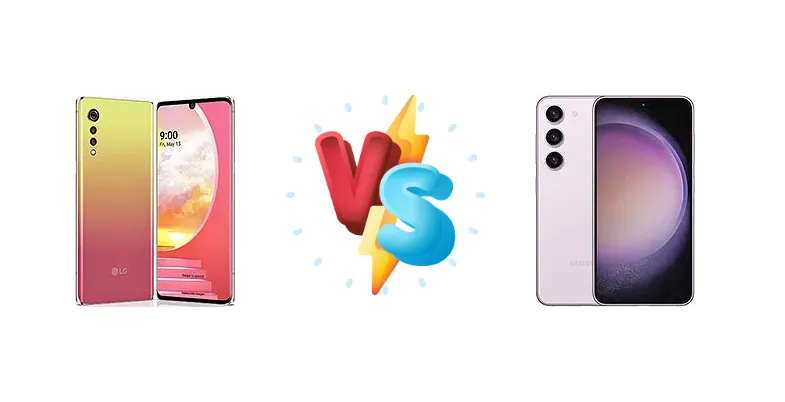
|
🏆 Quick Verdict
For most users, the Samsung Galaxy S23 is the superior choice. Its significantly faster Snapdragon 8 Gen 2 chipset, brighter display, and longer battery life outweigh the Velvet 5G’s potential affordability. However, budget-conscious users prioritizing 5G connectivity may find the Velvet 5G a viable alternative.
| PHONES | ||
|---|---|---|
| Phone Names | LG Velvet 5G | Samsung Galaxy S23 |
| Network | ||
|---|---|---|
| 2G bands | GSM 850 / 900 / 1800 / 1900 | GSM 850 / 900 / 1800 / 1900 |
| 3G bands | HSDPA 850 / 900 / 1900 / 2100 | HSDPA 850 / 900 / 1700(AWS) / 1900 / 2100 |
| 4G bands | 1, 2, 3, 4, 5, 7, 8, 12, 17, 20, 28, 32, 38, 39, 40, 41 | 1, 2, 3, 4, 5, 7, 8, 12, 13, 17, 18, 19, 20, 25, 26, 28, 32, 38, 39, 40, 41, 66 - International |
| 5G bands | 1, 3, 28, 78 SA/NSA | 1, 2, 3, 5, 7, 8, 12, 20, 25, 28, 38, 40, 41, 66, 75, 77, 78 SA/NSA/Sub6 - International |
| Speed | HSPA 42.2/5.76 Mbps, LTE (5CA) Cat16 1000/75 Mbps, 5G 2Gbps | HSPA, LTE (up to 7CA), 5G |
| Technology | GSM / HSPA / LTE / 5G | GSM / CDMA / HSPA / EVDO / LTE / 5G |
| - | 1, 7, 25, 28, 41, 66, 71, 78, 258, 260, 261 SA/NSA/Sub6/mmWave - USA | |
| Launch | ||
|---|---|---|
| Announced | 2020, May 07. Released 2020, May 15 | 2023, February 01 |
| Status | Discontinued | Available. Released 2023, February 17 |
| Body | ||
|---|---|---|
| Build | Glass front, glass back, aluminum frame | Glass front (Gorilla Glass Victus 2), glass back (Gorilla Glass Victus 2), aluminum frame |
| Dimensions | 167.2 x 74.1 x 7.9 mm (6.58 x 2.92 x 0.31 in) | 146.3 x 70.9 x 7.6 mm (5.76 x 2.79 x 0.30 in) |
| SIM | Nano-SIM + Nano-SIM | · Nano-SIM + eSIM· Nano-SIM + Nano-SIM + eSIM (max 2 at a time) |
| Weight | 180 g (6.35 oz) | 168 g (5.93 oz) |
| IP68 dust/water resistant (up to 1.5m for 30 mins) MIL-STD-810G compliant* *does not guarantee ruggedness or use in extreme conditions | IP68 dust/water resistant (up to 1.5m for 30 min) Armor aluminum frame with tougher drop and scratch resistance (advertised) | |
| Display | ||
|---|---|---|
| Protection | - | Corning Gorilla Glass Victus 2 |
| Resolution | 1080 x 2460 pixels (~395 ppi density) | 1080 x 2340 pixels, 19.5:9 ratio (~425 ppi density) |
| Size | 6.8 inches, 109.8 cm2 (~88.6% screen-to-body ratio) | 6.1 inches, 90.1 cm2 (~86.8% screen-to-body ratio) |
| Type | P-OLED | Dynamic AMOLED 2X, 120Hz, HDR10+, 1200 nits (HBM), 1750 nits (peak) |
| - | Always-on display | |
| Platform | ||
|---|---|---|
| CPU | Octa-core (1x2.4 GHz Kryo 475 Prime & 1x2.2 GHz Kryo 475 Gold & 6x1.8 GHz Kryo 475 Silver) | Octa-core (1x3.36 GHz Cortex-X3 & 2x2.8 GHz Cortex-A715 & 2x2.8 GHz Cortex-A710 & 3x2.0 GHz Cortex-A510) |
| Chipset | Qualcomm SM7250 Snapdragon 765G 5G (7 nm) | Qualcomm SM8550-AC Snapdragon 8 Gen 2 (4 nm) |
| GPU | Adreno 620 | Adreno 740 |
| OS | Android 10, upgradable to Android 13, LG UX | Android 13, up to 4 major Android upgrades, One UI 8 |
| Memory | ||
|---|---|---|
| Card slot | microSDXC (uses shared SIM slot) | No |
| Internal | 128GB 6GB RAM, 128GB 8GB RAM | 128GB 8GB RAM, 256GB 8GB RAM, 512GB 8GB RAM |
| UFS 2.1 | UFS 3.1 - 128GB only UFS 4.0 | |
| Main Camera | ||
|---|---|---|
| Features | LED flash, panorama, HDR | LED flash, auto-HDR, panorama |
| Single | - | 12 MP, f/2.2, 26mm (wide), Dual Pixel PDAF |
| Triple | 48 MP, f/1.8, 26mm (wide), 1/2.0", 0.8µm, PDAF 8 MP, f/2.2, 120˚, 15mm (ultrawide), 1/4.0", 1.12µm Auxiliary lens | 50 MP, f/1.8, 24mm (wide), 1/1.56", 1.0µm, dual pixel PDAF, OIS 10 MP, f/2.4, 70mm (telephoto), 1/3.94", 1.0µm, PDAF, OIS, 3x optical zoom 12 MP, f/2.2, 13mm, 120˚ (ultrawide), 1/2.55" 1.4µm, Super Steady video |
| Video | 4K@30fps, 1080p@30/60fps, gyro-EIS | 8K@24/30fps, 4K@30/60fps, 1080p@30/60/120/240fps, HDR10+, stereo sound rec., gyro-EIS |
| Selfie camera | ||
|---|---|---|
| Features | HDR | HDR, HDR10+ |
| Single | 16 MP, f/1.9, 29mm (standard), 1/3.06, 1.0µm | 12 MP, f/2.2, 26mm (wide), 1/3.2", 1.12µm, dual pixel PDAF |
| Video | 1080p@30fps | 4K@30/60fps, 1080p@30fps |
| Sound | ||
|---|---|---|
| 3.5mm jack | Yes | No |
| 35mm jack | Yes | No |
| Loudspeaker | Yes, with stereo speakers | Yes, with stereo speakers |
| - | 32-bit/384kHz audio Tuned by AKG | |
| Comms | ||
|---|---|---|
| Bluetooth | 5.1, A2DP, LE, aptX HD | 5.3, A2DP, LE |
| NFC | Yes | Yes |
| Positioning | GPS (L1+L5), GLONASS, BDS, GALILEO, QZSS | GPS, GLONASS, BDS, GALILEO |
| Radio | FM radio (market/region dependent) | No |
| USB | USB Type-C, OTG | USB Type-C 3.2, OTG |
| WLAN | Wi-Fi 802.11 a/b/g/n/ac, dual-band, Wi-Fi Direct, DLNA | Wi-Fi 802.11 a/b/g/n/ac/6e, tri-band, Wi-Fi Direct |
| Features | ||
|---|---|---|
| Sensors | Fingerprint (under display, optical), accelerometer, gyro, proximity, compass, barometer | Fingerprint (under display, ultrasonic), accelerometer, gyro, proximity, compass, barometer |
| - | Samsung DeX, Samsung Wireless DeX (desktop experience support) Bixby natural language commands and dictation Samsung Pay (Visa, MasterCard certified) | |
| Battery | ||
|---|---|---|
| Charging | 25W wired, PD3.0, QC4 9W wireless | 25W wired, PD3.0, 50% in 30 min 15W wireless (Qi) 4.5W reverse wireless |
| Type | Li-Po 4300 mAh | Li-Ion 3900 mAh |
| Misc | ||
|---|---|---|
| Colors | Aurora White, Aurora Green, Aurora Gray, Illusion Sunset, Red, Pink | Phantom Black, Cream, Green, Lavender, Graphite, Lime |
| Models | LM-G900N, LM-G900EM, LM-G900, LM-G900TM | SM-S911B, SM-S911B/DS, SM-S911U, SM-S911U1, SM-S911W, SM-S911N, SM-S9110, SM-S911E, SM-S911E/DS |
| Price | About 470 EUR | $ 237.95 / C$ 336.75 / £ 255.00 / € 322.41 / ₹ 49,990 |
| SAR | 0.23 W/kg (head) 1.02 W/kg (body) | 0.95 W/kg (head) 0.88 W/kg (body) |
| SAR EU | - | 0.96 W/kg (head) 1.30 W/kg (body) |
| Tests | ||
|---|---|---|
| Battery life | Endurance rating 79h | Endurance rating 101h |
| Camera | Photo / Video | Photo / Video |
| Display | Contrast ratio: Infinite (nominal) | Contrast ratio: Infinite (nominal) |
| Loudspeaker | -23.5 LUFS (Very good) | -27.0 LUFS (Good) |
| Performance | AnTuTu: 297372 (v8) GeekBench: 1905 (v5.1) GFXBench: 16fps (ES 3.1 onscreen) | AnTuTu: 1231075 (v9) GeekBench: 4950 (v5.1) GFXBench: 110fps (ES 3.1 onscreen) |
LG Velvet 5G
- More affordable price point
- Excellent battery endurance rating (79h)
- Functional 5G connectivity
- Significantly slower processor
- Dimmer display with lower peak brightness
- Less advanced camera system
Samsung Galaxy S23
- Blazing-fast Snapdragon 8 Gen 2 performance
- Bright and vibrant display (1198 nits)
- Superior camera quality and features
- Faster charging and wireless power sharing
- Higher price tag
- Potentially less battery endurance than advertised in specific use cases
Display Comparison
The Samsung Galaxy S23 boasts a significantly brighter display, reaching 1198 nits compared to the LG Velvet 5G’s 617 nits. This translates to vastly improved visibility outdoors under direct sunlight. Both displays share an 'Infinite' (nominal) contrast ratio, suggesting deep blacks, but the S23’s higher peak brightness provides a more vibrant and dynamic viewing experience. While both likely utilize OLED technology, the S23 benefits from advancements in panel calibration and color accuracy, though specific details like color gamut coverage aren't provided. The S23’s smaller size also contributes to a higher pixel density, resulting in a sharper image.
Camera Comparison
Both phones feature photo and video capabilities, but the S23 likely offers a more sophisticated camera system. While specific sensor details are missing for both, Samsung’s flagship typically employs larger sensors and more advanced image processing algorithms. The S23’s image stabilization (OIS) is likely more effective, resulting in sharper photos and smoother videos, especially in low-light conditions. The Velvet 5G’s camera is adequate for everyday use, but the S23 provides a more versatile and higher-quality photographic experience. The absence of specific sensor information makes a detailed comparison difficult, but Samsung’s reputation for camera innovation suggests a clear advantage.
Performance
The performance gap between these devices is substantial. The Galaxy S23’s Snapdragon 8 Gen 2 (4nm) is a generational leap over the Velvet 5G’s Snapdragon 765G (7nm). The 4nm process node delivers superior power efficiency and thermal management, meaning the S23 can sustain peak performance for longer periods without throttling. The S23’s CPU configuration – a Cortex-X3 prime core alongside A715 and A710 performance cores – offers significantly faster processing speeds than the Velvet 5G’s Kryo 475 cores. This difference is particularly noticeable in demanding tasks like gaming and video editing. The S23 also benefits from faster RAM (likely LPDDR5x vs LPDDR4x in the Velvet), further enhancing responsiveness.
Battery Life
Despite the LG Velvet 5G having a reported endurance rating of 79 hours, the Samsung Galaxy S23’s endurance rating of 101 hours and active use score of 11:27h indicates superior real-world battery performance. This is likely due to the Snapdragon 8 Gen 2’s improved power efficiency. Both phones support 25W wired charging with PD3.0, and the S23 reaches 50% charge in 30 minutes. The S23 also offers 15W wireless charging (Qi) and 4.5W reverse wireless charging, features absent in the Velvet 5G’s 9W wireless charging. The S23’s combination of efficient chipset and optimized software results in longer battery life despite not having a significantly larger battery capacity.
Buying Guide
Buy the LG Velvet 5G if you need a functional 5G smartphone on a tight budget and prioritize battery endurance over raw performance. You’ll appreciate its 79-hour endurance rating for extended use between charges. Buy the Samsung Galaxy S23 if you demand a premium experience with top-tier performance, a stunningly bright display, and a more refined camera system, and are willing to pay a premium for it.