
LG Velvet 5G vs Samsung Galaxy S20 FE: A Detailed Comparison of Two 5G Contenders
| Phones Images | |||||
|---|---|---|---|---|---|
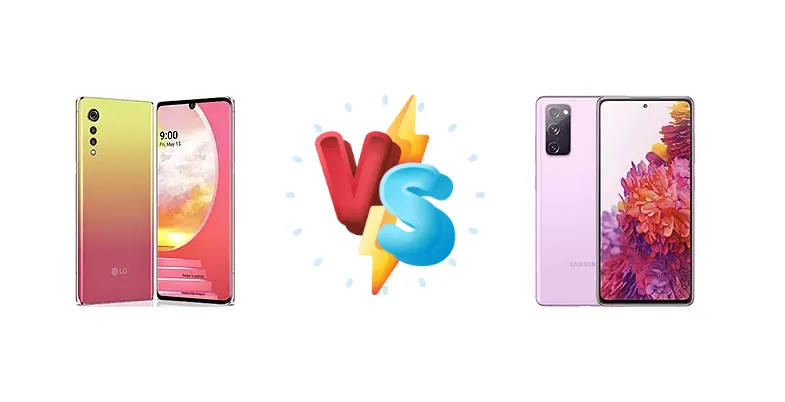
|
🏆 Quick Verdict
For most users, the Samsung Galaxy S20 FE 5G emerges as the stronger choice. Its Snapdragon 865 chipset delivers significantly better performance, and its superior battery endurance, boasting 110 hours versus the Velvet’s 79, provides a more reliable all-day experience. While the Velvet has its merits, the S20 FE’s overall package offers greater value.
| PHONES | ||
|---|---|---|
| Phone Names | LG Velvet 5G | Samsung Galaxy S20 FE 5G |
| Network | ||
|---|---|---|
| 2G bands | GSM 850 / 900 / 1800 / 1900 | GSM 850 / 900 / 1800 / 1900 |
| 3G bands | HSDPA 850 / 900 / 1900 / 2100 | HSDPA 850 / 900 / 1700(AWS) / 1900 / 2100 |
| 4G bands | 1, 2, 3, 4, 5, 7, 8, 12, 17, 20, 28, 32, 38, 39, 40, 41 | 1, 2, 3, 4, 5, 7, 8, 12, 13, 14, 20, 25, 26, 28, 29, 30, 38, 39, 40, 41, 46, 66, 71 - USA |
| 5G bands | 1, 3, 28, 78 SA/NSA | 2, 5, 41, 66, 71 Sub6 - USA |
| Speed | HSPA 42.2/5.76 Mbps, LTE (5CA) Cat16 1000/75 Mbps, 5G 2Gbps | HSPA 42.2/5.76 Mbps, LTE (5CA) Cat19 1800/200 Mbps, 5G |
| Technology | GSM / HSPA / LTE / 5G | GSM / CDMA / HSPA / EVDO / LTE / 5G |
| - | 1, 3, 5, 7, 8, 28, 40, 41, 78 Sub6 - International | |
| Launch | ||
|---|---|---|
| Announced | 2020, May 07. Released 2020, May 15 | 2020, September 23 |
| Status | Discontinued | Available. Released 2020, October 02 |
| Body | ||
|---|---|---|
| Build | Glass front, glass back, aluminum frame | Glass front (Gorilla Glass 3), plastic back, aluminum frame |
| Dimensions | 167.2 x 74.1 x 7.9 mm (6.58 x 2.92 x 0.31 in) | 159.8 x 74.5 x 8.4 mm (6.29 x 2.93 x 0.33 in) |
| SIM | Nano-SIM + Nano-SIM | · Nano-SIM· Nano-SIM + Nano-SIM |
| Weight | 180 g (6.35 oz) | 190 g (6.70 oz) |
| IP68 dust/water resistant (up to 1.5m for 30 mins) MIL-STD-810G compliant* *does not guarantee ruggedness or use in extreme conditions | IP68 dust/water resistant (up to 1.5m for 30 min) | |
| Display | ||
|---|---|---|
| Protection | - | Corning Gorilla Glass 3 |
| Resolution | 1080 x 2460 pixels (~395 ppi density) | 1080 x 2400 pixels, 20:9 ratio (~407 ppi density) |
| Size | 6.8 inches, 109.8 cm2 (~88.6% screen-to-body ratio) | 6.5 inches, 101.0 cm2 (~84.8% screen-to-body ratio) |
| Type | P-OLED | Super AMOLED, 120Hz, HDR10+ |
| - | Always-on display | |
| Platform | ||
|---|---|---|
| CPU | Octa-core (1x2.4 GHz Kryo 475 Prime & 1x2.2 GHz Kryo 475 Gold & 6x1.8 GHz Kryo 475 Silver) | Octa-core (1x2.84 GHz Cortex-A77 & 3x2.42 GHz Cortex-A77 & 4x1.80 GHz Cortex-A55) |
| Chipset | Qualcomm SM7250 Snapdragon 765G 5G (7 nm) | Qualcomm SM8250 Snapdragon 865 5G (7 nm+) |
| GPU | Adreno 620 | Adreno 650 |
| OS | Android 10, upgradable to Android 13, LG UX | Android 10, upgradable to Android 13, One UI 5.1 |
| Memory | ||
|---|---|---|
| Card slot | microSDXC (uses shared SIM slot) | microSDXC (uses shared SIM slot) |
| Internal | 128GB 6GB RAM, 128GB 8GB RAM | 128GB 6GB RAM, 128GB 8GB RAM, 256GB 6GB RAM, 256GB 8GB RAM |
| UFS 2.1 | UFS 3.1 | |
| Main Camera | ||
|---|---|---|
| Features | LED flash, panorama, HDR | LED flash, auto-HDR, panorama |
| Single | - | 2 MP |
| Triple | 48 MP, f/1.8, 26mm (wide), 1/2.0", 0.8µm, PDAF 8 MP, f/2.2, 120˚, 15mm (ultrawide), 1/4.0", 1.12µm Auxiliary lens | 12 MP, f/1.8, 26mm (wide), 1/1.76", 1.8µm, dual pixel PDAF, OIS 8 MP, f/2.4, 76mm (telephoto), 1/4.5", 1.0µm, PDAF, OIS, 3x optical zoom 12 MP, f/2.2, 13mm, 123˚ (ultrawide), 1/3.0", 1.12µm |
| Video | 4K@30fps, 1080p@30/60fps, gyro-EIS | 4K@30/60fps, 1080p@30/60fps, gyro-EIS |
| Selfie camera | ||
|---|---|---|
| Features | HDR | HDR |
| Single | 16 MP, f/1.9, 29mm (standard), 1/3.06, 1.0µm | 32 MP, f/2.2, 26mm (wide), 1/2.74", 0.8µm |
| Video | 1080p@30fps | 4K@30/60fps, 1080p@30/60fps, gyro-EIS |
| Sound | ||
|---|---|---|
| 3.5mm jack | Yes | No |
| 35mm jack | Yes | No |
| Loudspeaker | Yes, with stereo speakers | Yes, with stereo speakers |
| - | 32-bit/384kHz audio Tuned by AKG | |
| Comms | ||
|---|---|---|
| Bluetooth | 5.1, A2DP, LE, aptX HD | 5.0, A2DP, LE |
| NFC | Yes | Yes |
| Positioning | GPS (L1+L5), GLONASS, BDS, GALILEO, QZSS | GPS, GLONASS, BDS, GALILEO |
| Radio | FM radio (market/region dependent) | No |
| USB | USB Type-C, OTG | USB Type-C 3.2, OTG |
| WLAN | Wi-Fi 802.11 a/b/g/n/ac, dual-band, Wi-Fi Direct, DLNA | Wi-Fi 802.11 a/b/g/n/ac/6, dual-band, Wi-Fi Direct |
| Features | ||
|---|---|---|
| Browser | - | HTTP / WAP 2.0 |
| Sensors | Fingerprint (under display, optical), accelerometer, gyro, proximity, compass, barometer | Fingerprint (under display, optical), accelerometer, gyro, compass |
| - | Virtual proximity sensing Bixby natural language commands and dictation Samsung Pay (Visa, MasterCard certified) | |
| Battery | ||
|---|---|---|
| Charging | 25W wired, PD3.0, QC4 9W wireless | 25W wired, PD3.0 15W wireless (Qi) 4.5W reverse wireless |
| Stand-by | - | Up to 300 h |
| Talk time | - | Up to 5 h |
| Type | Li-Po 4300 mAh | Li-Ion 4500 mAh |
| Misc | ||
|---|---|---|
| Colors | Aurora White, Aurora Green, Aurora Gray, Illusion Sunset, Red, Pink | Cloud Lavender, Cloud Mint, Cloud Navy, Cloud White, Cloud Red, Cloud Orange |
| Models | LM-G900N, LM-G900EM, LM-G900, LM-G900TM | SM-G781B, SM-G781B/DS, SM-G781U, SM-G781U1, SM-G781W, SM-G7810, SM-G781N, SM-G781V |
| Price | About 470 EUR | $ 137.00 / C$ 531.23 / £ 169.00 / € 199.00 |
| SAR | 0.23 W/kg (head) 1.02 W/kg (body) | 0.70 W/kg (head) 0.82 W/kg (body) |
| SAR EU | - | 0.50 W/kg (head) 1.35 W/kg (body) |
| Pricing | ||
|---|---|---|
| 128GB 6GB RAM | - | $ 361.99 |
| 128GB 8GB RAM | - | $ 589.97 |
| 256GB 8GB RAM | - | $ 769.99 |
| Tests | ||
|---|---|---|
| Battery life | Endurance rating 79h | Endurance rating 110h |
| Camera | Photo / Video | Photo / Video |
| Display | Contrast ratio: Infinite (nominal) | Contrast ratio: Infinite (nominal) |
| Loudspeaker | -23.5 LUFS (Very good) | -26.3 LUFS (Good) |
| Performance | AnTuTu: 297372 (v8) GeekBench: 1905 (v5.1) GFXBench: 16fps (ES 3.1 onscreen) | AnTuTu: 543986 (v8) GeekBench: 3296 (v5.1) GFXBench: 45fps (ES 3.1 onscreen) |
LG Velvet 5G
- Unique and stylish design.
- 25W fast charging with multiple protocols (PD3.0, QC4).
- Competitive price point (at launch).
- Significantly weaker performance compared to the S20 FE.
- Lower battery endurance.
- Less vibrant display.
Samsung Galaxy S20 FE 5G
- Flagship-level Snapdragon 865 performance.
- Excellent battery life (110-hour endurance).
- Brighter and potentially more accurate display.
- Can be prone to throttling under sustained heavy load.
- Plastic back may feel less premium.
- Price varied significantly based on RAM/storage configuration.
Display Comparison
Both the LG Velvet 5G and Samsung Galaxy S20 FE 5G feature displays with an 'Infinite' contrast ratio, suggesting excellent black levels. However, the S20 FE pulls ahead with a measured peak brightness of 822 nits, compared to the Velvet’s 617 nits. This translates to better visibility in direct sunlight. While both likely utilize OLED panels, the S20 FE’s higher brightness and potentially more refined color calibration (based on Samsung’s display expertise) offer a more vibrant and comfortable viewing experience. The lack of specified refresh rates for both devices suggests a standard 60Hz panel, a notable omission compared to some competitors.
Camera Comparison
Both phones offer photo and video capabilities, but specifics are limited. Without detailed sensor information, it’s difficult to make a definitive judgment. However, the S20 FE’s higher-end chipset likely provides more processing power for image stabilization and computational photography. The S20 FE’s potential for higher-quality video recording, leveraging the Snapdragon 865’s image signal processor, is also a likely advantage. The presence of a 2MP macro camera on the Velvet is unlikely to significantly impact overall camera performance, serving more as a novelty feature.
Performance
The performance gap is the most significant differentiator. The Samsung Galaxy S20 FE 5G is equipped with the Qualcomm Snapdragon 865 5G (7nm+), a flagship-tier chipset, while the LG Velvet 5G utilizes the Snapdragon 765G (7nm). The 865’s Cortex-A77 prime cores, clocked at 2.84 GHz, offer a substantial performance advantage over the Velvet’s Kryo 475 Prime core at 2.4 GHz. This difference is particularly noticeable in demanding tasks like gaming and video editing. The S20 FE’s more advanced chipset also benefits from improved thermal management, reducing the likelihood of performance throttling during sustained workloads. The S20 FE’s RAM options (6GB or 8GB) further contribute to its multitasking capabilities.
Battery Life
The Samsung Galaxy S20 FE 5G boasts a significantly superior endurance rating of 110 hours, compared to the LG Velvet 5G’s 79 hours. This difference is likely attributable to a combination of a more efficient chipset and potentially a larger battery capacity (though specific capacities aren't provided). Both phones support 25W wired charging with PD3.0, offering reasonably fast charging speeds. The S20 FE also includes 15W wireless charging (Qi) and 4.5W reverse wireless charging, features absent on the Velvet, adding to its versatility.
Buying Guide
Buy the LG Velvet 5G if you prioritize a unique design and don't heavily rely on demanding applications. Its 25W charging with PD3.0 and QC4 is a plus for quick top-ups. Buy the Samsung Galaxy S20 FE 5G if you need a phone capable of handling intensive tasks like gaming and video editing, and if long battery life is a critical requirement. The S20 FE’s superior chipset and larger battery make it the clear winner for power users.