
LG Velvet 5G vs Samsung Galaxy A54: A Detailed Comparison of Mid-Range Champions
| Phones Images | |||||
|---|---|---|---|---|---|
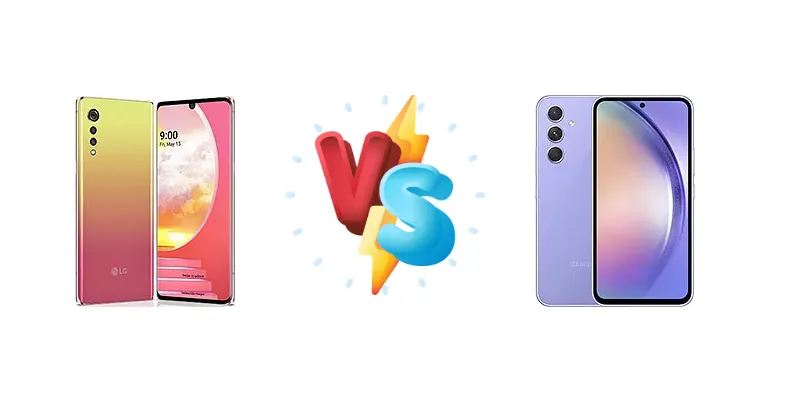
|
🏆 Quick Verdict
For most users, the Samsung Galaxy A54 is the better buy. Its significantly superior battery life – boasting an endurance rating of 119 hours versus the Velvet’s 79 – and brighter display outweigh the Velvet’s slightly older chipset. The A54 offers a more modern and reliable experience.
| PHONES | ||
|---|---|---|
| Phone Names | LG Velvet 5G | Samsung Galaxy A54 |
| Network | ||
|---|---|---|
| 2G bands | GSM 850 / 900 / 1800 / 1900 | GSM 850 / 900 / 1800 / 1900 |
| 3G bands | HSDPA 850 / 900 / 1900 / 2100 | HSDPA 850 / 900 / 1700(AWS) / 1900 / 2100 |
| 4G bands | 1, 2, 3, 4, 5, 7, 8, 12, 17, 20, 28, 32, 38, 39, 40, 41 | 1, 2, 3, 4, 5, 7, 8, 12, 17, 20, 26, 28, 32, 38, 40, 41, 66 - International |
| 5G bands | 1, 3, 28, 78 SA/NSA | 1, 3, 7, 8, 20, 28, 38, 40, 41, 77, 78 SA/NSA/Sub6 - International |
| Speed | HSPA 42.2/5.76 Mbps, LTE (5CA) Cat16 1000/75 Mbps, 5G 2Gbps | HSPA, LTE, 5G |
| Technology | GSM / HSPA / LTE / 5G | GSM / HSPA / LTE / 5G |
| - | 25, 41, 66, 71 SA/NSA/Sub6/mmWave - USA | |
| Launch | ||
|---|---|---|
| Announced | 2020, May 07. Released 2020, May 15 | 2023, March 15 |
| Status | Discontinued | Available. Released 2023, March 24 |
| Body | ||
|---|---|---|
| Build | Glass front, glass back, aluminum frame | Glass front (Gorilla Glass 5), glass back (Gorilla Glass 5), plastic frame |
| Dimensions | 167.2 x 74.1 x 7.9 mm (6.58 x 2.92 x 0.31 in) | 158.2 x 76.7 x 8.2 mm (6.23 x 3.02 x 0.32 in) |
| SIM | Nano-SIM + Nano-SIM | · Nano-SIM + eSIM· Nano-SIM + Nano-SIM |
| Weight | 180 g (6.35 oz) | 202 g (7.13 oz) |
| IP68 dust/water resistant (up to 1.5m for 30 mins) MIL-STD-810G compliant* *does not guarantee ruggedness or use in extreme conditions | IP67 dust/water resistant (up to 1m for 30 min) | |
| Display | ||
|---|---|---|
| Protection | - | Corning Gorilla Glass 5 |
| Resolution | 1080 x 2460 pixels (~395 ppi density) | 1080 x 2340 pixels, 19.5:9 ratio (~403 ppi density) |
| Size | 6.8 inches, 109.8 cm2 (~88.6% screen-to-body ratio) | 6.4 inches, 100.5 cm2 (~82.9% screen-to-body ratio) |
| Type | P-OLED | Super AMOLED, 120Hz, HDR10+, 1000 nits (HBM) |
| Platform | ||
|---|---|---|
| CPU | Octa-core (1x2.4 GHz Kryo 475 Prime & 1x2.2 GHz Kryo 475 Gold & 6x1.8 GHz Kryo 475 Silver) | Octa-core (4x2.4 GHz Cortex-A78 & 4x2.0 GHz Cortex-A55) |
| Chipset | Qualcomm SM7250 Snapdragon 765G 5G (7 nm) | Exynos 1380 (5 nm) |
| GPU | Adreno 620 | Mali-G68 MP5 |
| OS | Android 10, upgradable to Android 13, LG UX | Android 13, up to 4 major Android upgrades, One UI 7 |
| Memory | ||
|---|---|---|
| Card slot | microSDXC (uses shared SIM slot) | microSDXC (uses shared SIM slot) |
| Internal | 128GB 6GB RAM, 128GB 8GB RAM | 128GB 4GB RAM, 128GB 6GB RAM, 128GB 8GB RAM, 256GB 6GB RAM, 256GB 8GB RAM |
| UFS 2.1 | - | |
| Main Camera | ||
|---|---|---|
| Features | LED flash, panorama, HDR | LED flash, panorama, HDR |
| Single | - | 32 MP, f/2.2, 26mm (wide), 1/2.8", 0.8µm |
| Triple | 48 MP, f/1.8, 26mm (wide), 1/2.0", 0.8µm, PDAF 8 MP, f/2.2, 120˚, 15mm (ultrawide), 1/4.0", 1.12µm Auxiliary lens | 50 MP, f/1.8, 23mm (wide), 1/1.56", 1.0µm, PDAF, OIS 12 MP, f/2.2, 13mm, 123˚ (ultrawide), 1/3.X", 1.12µm 5 MP (macro) |
| Video | 4K@30fps, 1080p@30/60fps, gyro-EIS | 4K@30fps, 1080p@30/60fps, 720p@480fps, gyro-EIS |
| Selfie camera | ||
|---|---|---|
| Features | HDR | - |
| Single | 16 MP, f/1.9, 29mm (standard), 1/3.06, 1.0µm | 32 MP, f/2.2, 26mm (wide), 1/2.8", 0.8µm |
| Video | 1080p@30fps | 4K@30fps, 1080p@30/60fps |
| Sound | ||
|---|---|---|
| 3.5mm jack | Yes | No |
| 35mm jack | Yes | No |
| Loudspeaker | Yes, with stereo speakers | Yes, with stereo speakers |
| Comms | ||
|---|---|---|
| Bluetooth | 5.1, A2DP, LE, aptX HD | 5.3, A2DP, LE |
| NFC | Yes | Yes (market/region dependent) |
| Positioning | GPS (L1+L5), GLONASS, BDS, GALILEO, QZSS | GPS, GLONASS, GALILEO, BDS |
| Radio | FM radio (market/region dependent) | No |
| USB | USB Type-C, OTG | USB Type-C 2.0, OTG |
| WLAN | Wi-Fi 802.11 a/b/g/n/ac, dual-band, Wi-Fi Direct, DLNA | Wi-Fi 802.11 a/b/g/n/ac/6, dual-band, Wi-Fi Direct |
| Features | ||
|---|---|---|
| Sensors | Fingerprint (under display, optical), accelerometer, gyro, proximity, compass, barometer | Fingerprint (under display, optical), accelerometer, gyro, compass, barometer (USA only) |
| - | Virtual proximity sensing | |
| Battery | ||
|---|---|---|
| Charging | 25W wired, PD3.0, QC4 9W wireless | 25W wired |
| Type | Li-Po 4300 mAh | 5000 mAh |
| Misc | ||
|---|---|---|
| Colors | Aurora White, Aurora Green, Aurora Gray, Illusion Sunset, Red, Pink | Lime, Graphite, Violet, White |
| Models | LM-G900N, LM-G900EM, LM-G900, LM-G900TM | SM-A546V, SM-A546U, SM-A546U1, SM-A546B, SM-A546B/DS, SM-A546E, SM-A546E/DS, SM-A5460, SM-A546M, SM-A546M/DS, SM-A546W |
| Price | About 470 EUR | € 210.00 / $ 119.11 / £ 169.95 / ₹ 28,999 |
| SAR | 0.23 W/kg (head) 1.02 W/kg (body) | 0.81 W/kg (head) 0.67 W/kg (body) |
| SAR EU | - | 0.69 W/kg (head) 1.34 W/kg (body) |
| Tests | ||
|---|---|---|
| Battery life | Endurance rating 79h | Endurance rating 119h |
| Camera | Photo / Video | Photo / Video |
| Display | Contrast ratio: Infinite (nominal) | Contrast ratio: Infinite (nominal) |
| Loudspeaker | -23.5 LUFS (Very good) | -26.6 LUFS (Good) |
| Performance | AnTuTu: 297372 (v8) GeekBench: 1905 (v5.1) GFXBench: 16fps (ES 3.1 onscreen) | AnTuTu: 506678 (v9) GeekBench: 2703 (v5.1), 2797 (v6) GFXBench: 25fps (ES 3.1 onscreen) |
LG Velvet 5G
- Unique Waterfall Display Design
- Wireless Charging Support (9W)
- Potentially Lower Price (due to age)
- Significantly Shorter Battery Life
- Older Chipset (Snapdragon 765G)
- Limited Software Update Support
Samsung Galaxy A54
- Exceptional Battery Life (119h Endurance)
- Brighter and More Vibrant Display (980 nits)
- More Powerful and Efficient Chipset (Exynos 1380)
- No Wireless Charging
- Potentially Higher Price
- More Common Design
Display Comparison
The Samsung Galaxy A54 immediately pulls ahead in the display department with a measured peak brightness of 980 nits, nearly doubling the LG Velvet 5G’s 617 nits. This translates to significantly better visibility outdoors under direct sunlight. Both phones feature an 'Infinite' contrast ratio, a marketing term indicating excellent black levels, but the A54’s higher brightness provides a more impactful HDR experience. While both likely utilize OLED panels, the A54’s superior brightness suggests a more advanced panel technology.
Camera Comparison
Both devices are listed as having Photo/Video capabilities, but detailed sensor information is missing. However, given the A54’s position in the market, it likely features a more advanced camera system with larger sensors and improved image processing. The Velvet 5G, while capable, is hampered by its age and potentially less sophisticated image algorithms. Without specific sensor details, it’s difficult to make a definitive judgment, but the A54’s newer hardware gives it a probable advantage.
Performance
The Samsung Galaxy A54’s Exynos 1380 (5nm) chipset represents a generational leap over the LG Velvet 5G’s Snapdragon 765G (7nm). The 5nm process node allows for greater transistor density and improved power efficiency, meaning the A54 should deliver comparable or better performance with less heat generation. The A54’s CPU configuration – 4x2.4 GHz Cortex-A78 & 4x2.0 GHz Cortex-A55 – offers a more balanced approach than the Velvet’s 1x2.4 GHz Kryo 475 Prime, 1x2.2 GHz Kryo 475 Gold, and 6x1.8 GHz Kryo 475 Silver. While both are octa-core, the A54’s architecture is more modern and optimized for sustained performance.
Battery Life
Battery life is where the Samsung Galaxy A54 truly shines. Its endurance rating of 119 hours significantly surpasses the LG Velvet 5G’s 79 hours. This translates to nearly a full day and a half of additional usage on a single charge. While both support 25W wired charging, the A54’s more efficient chipset and larger battery capacity mean it can leverage that charging speed more effectively. The Velvet 5G also offers 9W wireless charging, a feature absent on the A54, but the convenience is offset by the slower charging speed.
Buying Guide
Buy the LG Velvet 5G if you prioritize a unique, waterfall display aesthetic and are comfortable with a phone that may have limited future software support. Buy the Samsung Galaxy A54 if you value long-lasting battery life, a brighter and more vibrant display, and the assurance of continued software updates from a major manufacturer.