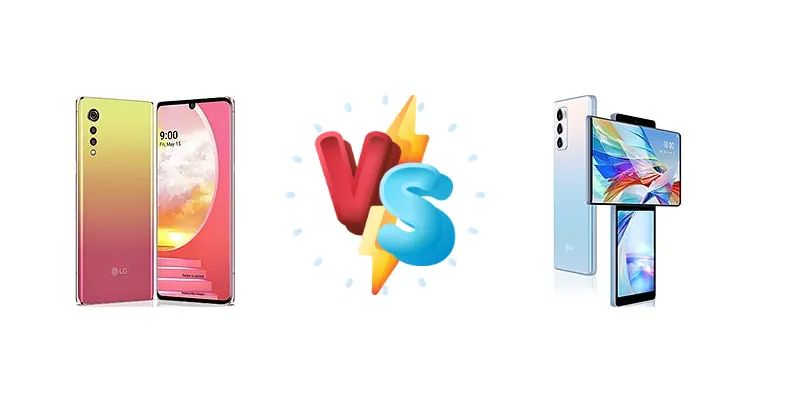
LG's 2020 lineup was defined by experimentation, and the Velvet 5G and Wing 5G represent two very different approaches. The Velvet aimed for a refined, mainstream experience, while the Wing boldly introduced a swiveling dual-screen form factor. Both leverage the Snapdragon 765G, but their target audiences and daily usability diverge significantly, especially considering their current price points in the used market.
🏆 Quick Verdict
For most users, the LG Wing 5G emerges as the more compelling choice. While the Velvet offers a more conventional experience, the Wing’s unique design, coupled with a slightly superior 87-hour endurance rating, provides a more memorable and potentially productive experience. However, the Wing’s form factor isn’t for everyone.
| Network |
|---|
| 2G bands | GSM 850 / 900 / 1800 / 1900 | GSM 850 / 900 / 1800 / 1900 |
| 3G bands | HSDPA 850 / 900 / 1900 / 2100 | HSDPA 850 / 900 / 1900 / 2100 |
| 4G bands | 1, 2, 3, 4, 5, 7, 8, 12, 17, 20, 28, 32, 38, 39, 40, 41 | 2, 3, 4, 5, 7, 12, 13, 20, 28, 46, 48, 66 - USA |
| 5G bands | 1, 3, 28, 78 SA/NSA | 2, 5, 66, 260, 261 Sub6, mmWave - USA |
| Speed | HSPA 42.2/5.76 Mbps, LTE (5CA) Cat16 1000/75 Mbps, 5G 2Gbps | HSPA, LTE, 5G |
| Technology | GSM / HSPA / LTE / 5G | GSM / CDMA / HSPA / LTE / 5G |
| | - | CDMA 800 / 1900 |
| Launch |
|---|
| Announced | 2020, May 07. Released 2020, May 15 | 2020, September 14. Released 2020, October 15 |
| Status | Discontinued | Discontinued |
| Body |
|---|
| Build | Glass front, glass back, aluminum frame | Glass front (Gorilla Glass 5), glass back (Gorilla Glass 5), aluminum frame |
| Dimensions | 167.2 x 74.1 x 7.9 mm (6.58 x 2.92 x 0.31 in) | 169.5 x 74.5 x 10.9 mm (6.67 x 2.93 x 0.43 in) |
| SIM | Nano-SIM + Nano-SIM | Nano-SIM + Nano-SIM |
| Weight | 180 g (6.35 oz) | 260 g (9.17 oz) |
| | IP68 dust/water resistant (up to 1.5m for 30 mins)
MIL-STD-810G compliant*
*does not guarantee ruggedness or use in extreme conditions | IP54, dust and water resistant
Water-repellent coating
MIL-STD-810G compliant*
*does not guarantee ruggedness or use in extreme conditions |
| Display |
|---|
| Protection | - | Corning Gorilla Glass 5 |
| Resolution | 1080 x 2460 pixels (~395 ppi density) | 1080 x 2460 pixels (~395 ppi density) |
| Size | 6.8 inches, 109.8 cm2 (~88.6% screen-to-body ratio) | 6.8 inches, 109.8 cm2 (~87.0% screen-to-body ratio) |
| Type | P-OLED | Rotating P-OLED |
| | - | Always-on display
Secondary display: G-OLED, 1080 x 1240 pixels, 3.9 inches |
| Platform |
|---|
| CPU | Octa-core (1x2.4 GHz Kryo 475 Prime & 1x2.2 GHz Kryo 475 Gold & 6x1.8 GHz Kryo 475 Silver) | Octa-core (1x2.4 GHz Kryo 475 Prime & 1x2.2 GHz Kryo 475 Gold & 6x1.8 GHz Kryo 475 Silver) |
| Chipset | Qualcomm SM7250 Snapdragon 765G 5G (7 nm) | Qualcomm SM7250 Snapdragon 765G 5G (7 nm) |
| GPU | Adreno 620 | Adreno 620 |
| OS | Android 10, upgradable to Android 13, LG UX | Android 10, upgradable to Android 12 |
| Memory |
|---|
| Card slot | microSDXC (uses shared SIM slot) | microSDXC (uses shared SIM slot) |
| Internal | 128GB 6GB RAM, 128GB 8GB RAM | 128GB 8GB RAM, 256GB 8GB RAM |
| | UFS 2.1 | UFS 2.1 |
| Main Camera |
|---|
| Features | LED flash, panorama, HDR | LED flash, panorama, HDR |
| Triple | 48 MP, f/1.8, 26mm (wide), 1/2.0", 0.8µm, PDAF
8 MP, f/2.2, 120˚, 15mm (ultrawide), 1/4.0", 1.12µm
Auxiliary lens | 64 MP, f/1.8, 25mm (wide), 1/1.72", 0.8µm, PDAF, OIS
13 MP, f/1.9, 117˚, (ultrawide), 1/3.4", 1.0µm
12 MP, f/2.2, 120˚, (ultrawide), 1/2.55", 1.4µm |
| Video | 4K@30fps, 1080p@30/60fps, gyro-EIS | 4K@30/60fps, 1080p@30/60fps, gyro-EIS |
| Selfie camera |
|---|
| Features | HDR | HDR |
| Single | 16 MP, f/1.9, 29mm (standard), 1/3.06, 1.0µm | Motorized pop-up 32 MP, f/1.9, 26mm (wide), 1/2.8", 0.8µm |
| Video | 1080p@30fps | 1080p@30fps |
| Sound |
|---|
| 3.5mm jack | Yes | No |
| 35mm jack | Yes | No |
| Loudspeaker | Yes, with stereo speakers | Yes |
| Comms |
|---|
| Bluetooth | 5.1, A2DP, LE, aptX HD | 5.1, A2DP, LE, aptX |
| NFC | Yes | Yes |
| Positioning | GPS (L1+L5), GLONASS, BDS, GALILEO, QZSS | GPS (L1+L5), GLONASS, BDS, GALILEO, QZSS |
| Radio | FM radio (market/region dependent) | FM radio |
| USB | USB Type-C, OTG | USB Type-C 3.1, OTG |
| WLAN | Wi-Fi 802.11 a/b/g/n/ac, dual-band, Wi-Fi Direct, DLNA | Wi-Fi 802.11 a/b/g/n/ac, dual-band, Wi-Fi Direct, DLNA |
| Features |
|---|
| Sensors | Fingerprint (under display, optical), accelerometer, gyro, proximity, compass, barometer | Fingerprint (under display, optical), accelerometer, gyro, proximity, compass |
| Battery |
|---|
| Charging | 25W wired, PD3.0, QC4
9W wireless | Wired, QC4
13W wireless |
| Type | Li-Po 4300 mAh | Li-Po 4000 mAh |
| Misc |
|---|
| Colors | Aurora White, Aurora Green, Aurora Gray, Illusion Sunset, Red, Pink | Aurora Gray, Illusion Sky |
| Models | LM-G900N, LM-G900EM, LM-G900, LM-G900TM | LMF100N, LM-F100N, LM-F100V, LM-F100 |
| Price | About 470 EUR | About 850 EUR |
| SAR | 0.23 W/kg (head) 1.02 W/kg (body) | 1.13 W/kg (head) 1.06 W/kg (body) |
| Tests |
|---|
| Battery life | Endurance rating 79h | Endurance rating 87h |
| Camera |
Photo / Video |
Photo / Video |
| Display |
Contrast ratio: Infinite (nominal) |
Contrast ratio: Infinite (nominal) |
| Loudspeaker |
-23.5 LUFS (Very good) |
-30.9 LUFS (Below average) |
| Performance |
AnTuTu: 297372 (v8)
GeekBench: 1905 (v5.1)
GFXBench: 16fps (ES 3.1 onscreen) |
AnTuTu: 315688 (v8)
GeekBench: 7898 (v4.4), 1952 (v5.1)
GFXBench: 17fps (ES 3.1 onscreen) |
LG Velvet 5G
- Brighter display for better outdoor visibility (617 nits)
- More conventional and comfortable form factor
- PD3.0 charging compatibility
- Shorter battery life (79h endurance)
- Less innovative design
- Limited multitasking capabilities compared to the Wing
LG Wing 5G
- Longer battery life (87h endurance)
- Unique swiveling dual-screen form factor for multitasking
- Creative camera possibilities with the secondary screen
- Dimmer display (586 nits)
- Less conventional and potentially less comfortable to hold
- Form factor may not appeal to all users
Display Comparison
Both the Velvet and Wing feature 'Infinite' contrast ratio displays, typical of OLED panels. However, the Velvet boasts a brighter panel at 617 nits, compared to the Wing’s 586 nits. This translates to better visibility under direct sunlight for the Velvet. While both offer a smooth visual experience, the Wing’s secondary display adds a layer of complexity. The Velvet’s single, larger display is arguably more practical for everyday content consumption, while the Wing’s secondary screen is geared towards multitasking and extended productivity.
Camera Comparison
Both phones are listed as having 'Photo / Video' capabilities, lacking specific details. Without sensor size or aperture information, a direct comparison is difficult. However, the Wing’s unique form factor allows for creative shooting angles and the use of the secondary screen as a viewfinder or monitor. The Velvet likely focuses on a more traditional camera experience. The absence of detailed camera specs suggests neither phone was positioned as a photography leader, but rather as capable all-rounders.
Performance
Both devices are powered by the Qualcomm Snapdragon 765G (7 nm) chipset, featuring the same CPU configuration: an octa-core setup with 1x2.4 GHz Kryo 475 Prime, 1x2.2 GHz Kryo 475 Gold, and 6x1.8 GHz Kryo 475 Silver cores. This means performance in typical tasks and gaming will be largely identical. The real-world difference will come down to thermal management, which isn’t specified in the data, but the Wing’s larger chassis *could* offer slightly better heat dissipation. Both likely utilize LPDDR4X RAM, as LPDDR5 was not common in this price bracket at the time.
Battery Life
The LG Wing 5G edges out the Velvet 5G in battery endurance, achieving an 87-hour rating versus the Velvet’s 79 hours. This 8-hour difference, while not massive, is noticeable in real-world usage. The Wing also supports 13W wireless charging, while the Velvet offers 9W. Both support QC4 fast charging, but the Velvet adds PD3.0 compatibility. The Wing’s larger battery capacity, combined with potentially more efficient power management due to its form factor, provides a tangible advantage for users who prioritize all-day battery life.
Buying Guide
Buy the LG Velvet 5G if you prioritize a traditional smartphone experience with a focus on comfortable ergonomics and a more understated aesthetic. It’s ideal for users who want reliable 5G connectivity without the complexity of a dual-screen setup. Buy the LG Wing 5G if you’re a power user seeking a multitasking powerhouse and are willing to adapt to a novel form factor. The swiveling screen unlocks unique productivity workflows and offers a distinct visual experience, making it perfect for content creators and those who frequently switch between apps.
Frequently Asked Questions
❓ Is the LG Wing 5G’s swiveling mechanism durable? Will it break after extended use?
LG extensively tested the Wing’s swiveling mechanism, claiming it could withstand over 200,000 swivels. While long-term durability depends on individual usage, reports suggest the hinge is generally robust. However, potential dust ingress into the mechanism remains a concern, especially without proper care.
❓ Does the Snapdragon 765G in either phone struggle with demanding games like Genshin Impact or Call of Duty Mobile?
The Snapdragon 765G is a capable mid-range chipset, but it’s not designed for ultra-high settings in demanding games. Both the Velvet and Wing can run these titles, but you’ll likely need to lower graphics settings to achieve a smooth and consistent frame rate. Expect moderate thermal throttling during extended gaming sessions.
❓ What are the practical benefits of the LG Wing’s secondary screen beyond just multitasking?
The secondary screen unlocks unique camera features, allowing you to use it as a viewfinder for selfies with the main camera or as a monitor for video recording. It also enhances video playback, providing a larger viewing area and allowing you to continue browsing while watching content. Finally, it’s useful for quick access to frequently used apps and controls.