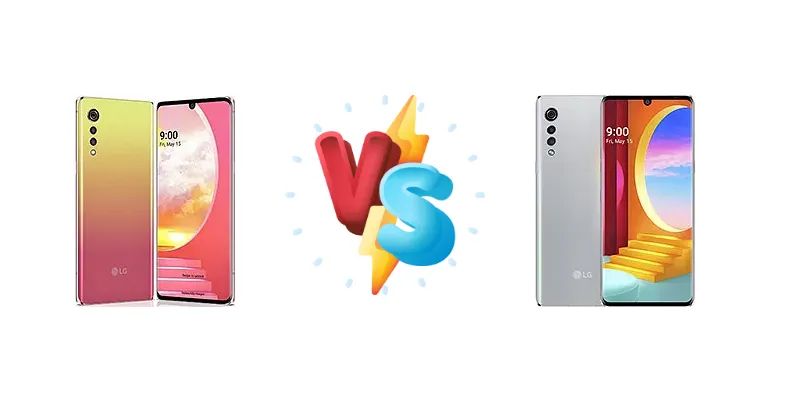
The LG Velvet and Velvet 5G represent LG's attempt to redefine the mid-range and upper-mid-range smartphone experience. While visually similar, the internal differences between these two devices are significant, particularly concerning performance and connectivity. This comparison dissects those differences to determine which Velvet offers the best value in today's market.
🏆 Quick Verdict
For most users, the LG Velvet 5G is the superior choice. The Snapdragon 765G offers a more modern architecture and 5G connectivity, while maintaining comparable battery life to the original Velvet. While the Snapdragon 845 in the original Velvet boasts higher clock speeds, the 765G’s efficiency and 5G support make it the more future-proof option.
| Network |
|---|
| 2G bands | GSM 850 / 900 / 1800 / 1900 | GSM 850 / 900 / 1800 / 1900 |
| 3G bands | HSDPA 850 / 900 / 1900 / 2100 | HSDPA 850 / 900 / 1900 / 2100 |
| 4G bands | 1, 2, 3, 4, 5, 7, 8, 12, 17, 20, 28, 32, 38, 39, 40, 41 | 1, 3, 7, 8, 20, 28, 38, 40 |
| 5G bands | 1, 3, 28, 78 SA/NSA | - |
| Speed | HSPA 42.2/5.76 Mbps, LTE (5CA) Cat16 1000/75 Mbps, 5G 2Gbps | HSPA, LTE |
| Technology | GSM / HSPA / LTE / 5G | GSM / HSPA / LTE |
| Launch |
|---|
| Announced | 2020, May 07. Released 2020, May 15 | 2020, July 28. Released 2020, July 31 |
| Status | Discontinued | Discontinued |
| Body |
|---|
| Build | Glass front, glass back, aluminum frame | Glass front, glass back, aluminum frame |
| Dimensions | 167.2 x 74.1 x 7.9 mm (6.58 x 2.92 x 0.31 in) | 167.1 x 74.1 x 7.9 mm (6.58 x 2.92 x 0.31 in) |
| SIM | Nano-SIM + Nano-SIM | Nano-SIM + Nano-SIM |
| Weight | 180 g (6.35 oz) | 180 g (6.35 oz) |
| | IP68 dust/water resistant (up to 1.5m for 30 mins)
MIL-STD-810G compliant*
*does not guarantee ruggedness or use in extreme conditions | IP68 dust/water resistant (up to 1.5m for 30 min)
MIL-STD-810G compliant*
*does not guarantee ruggedness or use in extreme conditions |
| Display |
|---|
| Resolution | 1080 x 2460 pixels (~395 ppi density) | 1080 x 2460 pixels (~395 ppi density) |
| Size | 6.8 inches, 109.8 cm2 (~88.6% screen-to-body ratio) | 6.8 inches, 109.8 cm2 (~88.7% screen-to-body ratio) |
| Type | P-OLED | P-OLED |
| Platform |
|---|
| CPU | Octa-core (1x2.4 GHz Kryo 475 Prime & 1x2.2 GHz Kryo 475 Gold & 6x1.8 GHz Kryo 475 Silver) | Octa-core (4x2.8 GHz Kryo 385 Gold & 4x1.8 GHz Kryo 385 Silver) |
| Chipset | Qualcomm SM7250 Snapdragon 765G 5G (7 nm) | Qualcomm SDM845 Snapdragon 845 (10 nm) |
| GPU | Adreno 620 | Adreno 630 |
| OS | Android 10, upgradable to Android 13, LG UX | Android 10, upgradable to Android 12 |
| Memory |
|---|
| Card slot | microSDXC (uses shared SIM slot) | microSDXC (uses shared SIM slot) |
| Internal | 128GB 6GB RAM, 128GB 8GB RAM | 128GB 6GB RAM |
| | UFS 2.1 | UFS 2.1 |
| Main Camera |
|---|
| Features | LED flash, panorama, HDR | LED flash, panorama, HDR |
| Triple | 48 MP, f/1.8, 26mm (wide), 1/2.0", 0.8µm, PDAF
8 MP, f/2.2, 120˚, 15mm (ultrawide), 1/4.0", 1.12µm
Auxiliary lens | 48 MP, f/1.8, 26mm (wide), 1/2.0", 0.8µm, PDAF
8 MP, f/2.2, 120˚, 15mm (ultrawide), 1/4.0", 1.12µm
Auxiliary lens |
| Video | 4K@30fps, 1080p@30/60fps, gyro-EIS | 4K@30fps, 1080p@30/60fps, gyro-EIS |
| Selfie camera |
|---|
| Features | HDR | HDR |
| Single | 16 MP, f/1.9, 29mm (standard), 1/3.06, 1.0µm | 16 MP, f/1.9, 29mm (standard), 1/3.06, 1.0µm |
| Video | 1080p@30fps | 4K@30fps, 1080p@30fps |
| Sound |
|---|
| 3.5mm jack | Yes | Yes |
| 35mm jack | Yes | Yes |
| Loudspeaker | Yes, with stereo speakers | Yes, with stereo speakers |
| Comms |
|---|
| Bluetooth | 5.1, A2DP, LE, aptX HD | 5.1, A2DP, LE |
| NFC | Yes | Yes |
| Positioning | GPS (L1+L5), GLONASS, BDS, GALILEO, QZSS | GPS |
| Radio | FM radio (market/region dependent) | FM radio |
| USB | USB Type-C, OTG | USB Type-C, OTG |
| WLAN | Wi-Fi 802.11 a/b/g/n/ac, dual-band, Wi-Fi Direct, DLNA | Wi-Fi 802.11 a/b/g/n/ac, dual-band, Wi-Fi Direct |
| Features |
|---|
| Sensors | Fingerprint (under display, optical), accelerometer, gyro, proximity, compass, barometer | Fingerprint (under display, optical), accelerometer, gyro, proximity, compass, barometer |
| Battery |
|---|
| Charging | 25W wired, PD3.0, QC4
9W wireless | 15W wired, QC3
9W wireless |
| Type | Li-Po 4300 mAh | Li-Po 4300 mAh |
| Misc |
|---|
| Colors | Aurora White, Aurora Green, Aurora Gray, Illusion Sunset, Red, Pink | Black, Aurora Silver |
| Models | LM-G900N, LM-G900EM, LM-G900, LM-G900TM | LMG910EMW, LM-G910EMW |
| Price | About 470 EUR | About 360 EUR |
| SAR | 0.23 W/kg (head) 1.02 W/kg (body) | - |
| Tests |
|---|
| Battery life | Endurance rating 79h | - |
| Camera |
Photo / Video | - |
| Display |
Contrast ratio: Infinite (nominal) | - |
| Loudspeaker |
-23.5 LUFS (Very good) | - |
| Performance |
AnTuTu: 297372 (v8)
GeekBench: 1905 (v5.1)
GFXBench: 16fps (ES 3.1 onscreen) | - |
LG Velvet 5G
- 5G Connectivity for faster data speeds
- More efficient Snapdragon 765G processor
- Faster 25W wired charging
- Potentially lower peak CPU performance compared to the 845
- May be slightly more expensive than the original Velvet
LG Velvet
- Higher peak CPU clock speeds (Snapdragon 845)
- Potentially lower price point
- Familiar Qualcomm Snapdragon ecosystem
- Lacks 5G connectivity
- Older, less efficient Snapdragon 845 processor
- Slower 15W wired charging
Display Comparison
Both the LG Velvet 5G and the standard Velvet share a similar display profile, but the 5G model boasts a measured peak brightness of 617 nits. While both feature an 'Infinite' contrast ratio (typical for OLED panels), the lack of detailed display specifications like color gamut coverage or PWM dimming frequency makes a direct comparison difficult. However, the higher peak brightness of the 5G model will translate to better visibility in direct sunlight. The similar form factors mean bezel sizes and overall screen real estate are virtually identical.
Camera Comparison
Both devices are listed as having 'Photo / Video' capabilities, but detailed camera specifications are absent. Without sensor size, aperture, or image processing details, a meaningful comparison is impossible. We can assume both phones offer a similar camera experience based on LG’s software optimization, but the 765G’s image signal processor (ISP) is likely more advanced, potentially leading to better low-light performance and faster image processing. The lack of information regarding OIS or specific lens configurations prevents a deeper analysis.
Performance
The core difference lies in the chipsets. The LG Velvet 5G utilizes the Qualcomm SM7250 Snapdragon 765G (7nm), an octa-core processor designed for efficiency and 5G integration. The original Velvet, however, features the older Qualcomm SDM845 Snapdragon 845 (10nm). While the 845 has higher peak clock speeds (2.8GHz vs 2.4GHz), the 7nm process of the 765G offers superior power efficiency and thermal management. This means the 765G is less likely to throttle under sustained load, providing more consistent performance during gaming or video editing. The 765G also benefits from an integrated 5G modem, a feature absent in the original Velvet.
Battery Life
Both the LG Velvet 5G and the standard Velvet offer 9W wireless charging. However, the wired charging speeds differ significantly: 25W with PD3.0 and QC4 for the 5G model versus 15W with QC3 for the original Velvet. Both achieve an endurance rating of 79 hours, suggesting similar real-world battery life despite the chipset differences. The faster charging on the 5G model allows for quicker top-ups, a significant convenience factor. The 7nm process of the 765G likely contributes to this comparable endurance despite the added power draw of 5G connectivity.
Buying Guide
Buy the LG Velvet 5G if you prioritize 5G connectivity, a more efficient processor for sustained performance, and faster charging speeds. It’s ideal for users who stream a lot of video, game occasionally, and want a phone that will remain relevant for longer. Buy the LG Velvet if you can find it at a significantly lower price and don’t need 5G, and value raw CPU power for specific, demanding tasks, understanding that the older chipset will likely show its age sooner.
Frequently Asked Questions
❓ Does the Snapdragon 765G in the Velvet 5G struggle with demanding games compared to the Snapdragon 845?
While the Snapdragon 845 has higher peak clock speeds, the Snapdragon 765G’s architecture and thermal efficiency allow it to maintain consistent performance for longer periods. You may see slightly lower initial frame rates in some titles, but the 765G is less prone to throttling, resulting in a smoother overall gaming experience, especially during extended sessions.
❓ Is the 5G connectivity on the Velvet 5G worth the extra cost if I don't have 5G coverage in my area?
Even without immediate 5G access, the Velvet 5G is a more future-proof investment. 5G networks are expanding rapidly, and the phone will be ready when coverage becomes available. Furthermore, the 765G chipset offers improvements in 4G LTE performance as well, providing a benefit even in areas without 5G.
❓ How much faster is the 25W charging on the Velvet 5G compared to the 15W charging on the original Velvet?
The 25W charging on the Velvet 5G can significantly reduce charging times. While exact 0-100% times aren't available, expect a roughly 30-40% faster charge compared to the original Velvet, allowing you to quickly top up your battery when needed.