
LG Velvet 5G vs. LG V50 ThinQ 5G: A Detailed Comparison
| Phones Images | |||||
|---|---|---|---|---|---|
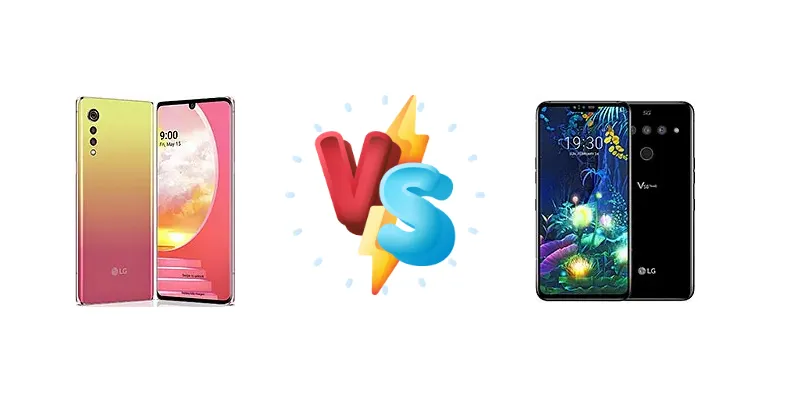
|
🏆 Quick Verdict
For the average user prioritizing longevity and consistent performance, the LG V50 ThinQ 5G is the better choice. Its significantly superior 96-hour endurance rating, coupled with the more powerful Snapdragon 855, outweighs the Velvet’s slightly brighter display and newer design. However, the Velvet offers a more modern aesthetic.
| PHONES | ||
|---|---|---|
| Phone Names | LG Velvet 5G | LG V50 ThinQ 5G |
| Network | ||
|---|---|---|
| 2G bands | GSM 850 / 900 / 1800 / 1900 | GSM 850 / 900 / 1800 / 1900 |
| 3G bands | HSDPA 850 / 900 / 1900 / 2100 | HSDPA 850 / 900 / 1700(AWS) / 1900 / 2100 - USA |
| 4G bands | 1, 2, 3, 4, 5, 7, 8, 12, 17, 20, 28, 32, 38, 39, 40, 41 | 1, 2, 3, 4, 5, 7, 8, 12, 13, 17, 20, 25, 26, 28, 40, 41, 46, 66, 71 - USA |
| 5G bands | 1, 3, 28, 78 SA/NSA | 41, 260, 261 NSA |
| Speed | HSPA 42.2/5.76 Mbps, LTE (5CA) Cat16 1000/75 Mbps, 5G 2Gbps | HSPA 42.2/5.76 Mbps, LTE (6CA) Cat18 1200/75 Mbps, 5G (2+ Gbps DL) |
| Technology | GSM / HSPA / LTE / 5G | GSM / CDMA / HSPA / EVDO / LTE / 5G |
| - | CDMA2000 1xEV-DO | |
| Launch | ||
|---|---|---|
| Announced | 2020, May 07. Released 2020, May 15 | 2019, February 24. Released 2019, April 19 |
| Status | Discontinued | Discontinued |
| Body | ||
|---|---|---|
| Build | Glass front, glass back, aluminum frame | Glass front (Gorilla Glass 5), glass back (Gorilla Glass 6), aluminum frame |
| Dimensions | 167.2 x 74.1 x 7.9 mm (6.58 x 2.92 x 0.31 in) | 159.2 x 76.1 x 8.3 mm (6.27 x 3.00 x 0.33 in) |
| SIM | Nano-SIM + Nano-SIM | · Nano-SIM· Nano-SIM + Nano-SIM |
| Weight | 180 g (6.35 oz) | 183 g (6.46 oz) |
| IP68 dust/water resistant (up to 1.5m for 30 mins) MIL-STD-810G compliant* *does not guarantee ruggedness or use in extreme conditions | IP68 dust/water resistant (up to 1.5m for 30 min) MIL-STD-810G compliant* *does not guarantee ruggedness or use in extreme conditions | |
| Display | ||
|---|---|---|
| Protection | - | Corning Gorilla Glass 5 |
| Resolution | 1080 x 2460 pixels (~395 ppi density) | 1440 x 3120 pixels, 19.5:9 ratio (~538 ppi density) |
| Size | 6.8 inches, 109.8 cm2 (~88.6% screen-to-body ratio) | 6.4 inches, 100.2 cm2 (~82.7% screen-to-body ratio) |
| Type | P-OLED | P-OLED, HDR10 |
| - | Always-on display | |
| Platform | ||
|---|---|---|
| CPU | Octa-core (1x2.4 GHz Kryo 475 Prime & 1x2.2 GHz Kryo 475 Gold & 6x1.8 GHz Kryo 475 Silver) | Octa-core (1x2.84 GHz Kryo 485 & 3x2.42 GHz Kryo 485 & 4x1.78 GHz Kryo 485) |
| Chipset | Qualcomm SM7250 Snapdragon 765G 5G (7 nm) | Qualcomm SM8150 Snapdragon 855 (7 nm) |
| GPU | Adreno 620 | Adreno 640 |
| OS | Android 10, upgradable to Android 13, LG UX | Android 9.0 (Pie), upgradable to Android 11 |
| Memory | ||
|---|---|---|
| Card slot | microSDXC (uses shared SIM slot) | microSDXC (dedicated slot) |
| Internal | 128GB 6GB RAM, 128GB 8GB RAM | 128GB 6GB RAM |
| UFS 2.1 | UFS 2.1 | |
| Main Camera | ||
|---|---|---|
| Features | LED flash, panorama, HDR | LED flash, HDR, panorama |
| Triple | 48 MP, f/1.8, 26mm (wide), 1/2.0", 0.8µm, PDAF 8 MP, f/2.2, 120˚, 15mm (ultrawide), 1/4.0", 1.12µm Auxiliary lens | 12 MP, 27mm (wide), f/1.5, 1/2.55", 1.4µm, dual pixel PDAF, 3-axis OIS 12 MP, 52mm (telephoto), f/2.4, 1/3.4", 1.0µm, 2x optical zoom, PDAF, OIS 16 MP, 16mm (ultrawide), f/1.9, 1/3.1", 1.0µm, no AF |
| Video | 4K@30fps, 1080p@30/60fps, gyro-EIS | 4K@30/60fps, 1080p@30/60/240fps, 24-bit/192kHz stereo sound rec., HDR10 video, gyro-EIS |
| Selfie camera | ||
|---|---|---|
| Dual | - | 8 MP, f/1.9, 26mm (wide), 1/4.0", 1.12µm 5 MP, 21mm (wide), f/2.2, 1/5.0", 1.12µm |
| Features | HDR | HDR |
| Single | 16 MP, f/1.9, 29mm (standard), 1/3.06, 1.0µm | - |
| Video | 1080p@30fps | 1080p@60fps |
| Sound | ||
|---|---|---|
| 3.5mm jack | Yes | Yes |
| 35mm jack | Yes | Yes |
| Loudspeaker | Yes, with stereo speakers | Yes, with stereo speakers |
| - | 32-bit/192kHz audio 24-bit/192kHz audio recording Tuned with Meridian Audio | |
| Comms | ||
|---|---|---|
| Bluetooth | 5.1, A2DP, LE, aptX HD | 5.0, A2DP, LE, aptX HD |
| NFC | Yes | Yes |
| Positioning | GPS (L1+L5), GLONASS, BDS, GALILEO, QZSS | GPS, GLONASS, GALILEO |
| Radio | FM radio (market/region dependent) | FM radio |
| USB | USB Type-C, OTG | USB Type-C 3.1 |
| WLAN | Wi-Fi 802.11 a/b/g/n/ac, dual-band, Wi-Fi Direct, DLNA | Wi-Fi 802.11 a/b/g/n/ac, dual-band, Wi-Fi Direct, DLNA |
| Features | ||
|---|---|---|
| Sensors | Fingerprint (under display, optical), accelerometer, gyro, proximity, compass, barometer | Fingerprint (rear-mounted), accelerometer, gyro, proximity, compass, barometer |
| Battery | ||
|---|---|---|
| Charging | 25W wired, PD3.0, QC4 9W wireless | 18W wired, PD2.0, QC3, 50% in 36 min 10W wireless (Qi) |
| Type | Li-Po 4300 mAh | Li-Po 4000 mAh, non-removable |
| Misc | ||
|---|---|---|
| Colors | Aurora White, Aurora Green, Aurora Gray, Illusion Sunset, Red, Pink | New Aurora Black |
| Models | LM-G900N, LM-G900EM, LM-G900, LM-G900TM | LM-V500, LM-V500N, LM-V500EM, LM-V500XM, LM-V450PM, LM-V450 |
| Price | About 470 EUR | About 550 EUR |
| SAR | 0.23 W/kg (head) 1.02 W/kg (body) | - |
| Tests | ||
|---|---|---|
| Audio quality | - | Noise -92.5dB / Crosstalk -92.6dB |
| Battery life | Endurance rating 79h | Endurance rating 96h |
| Camera | Photo / Video | Photo / Video |
| Display | Contrast ratio: Infinite (nominal) | Contrast ratio: 194000:1 (nominal) |
| Loudspeaker | -23.5 LUFS (Very good) | -25.2 LUFS (Very good) |
| Performance | AnTuTu: 297372 (v8) GeekBench: 1905 (v5.1) GFXBench: 16fps (ES 3.1 onscreen) | AnTuTu: 343758 (v7), 421934 (v8) GeekBench: 10928 (v4.4), 2672 (v5.1) GFXBench: 22fps (ES 3.1 onscreen) |
LG Velvet 5G
- Sleek and modern design
- Brighter display for outdoor visibility
- Faster wired charging (25W)
- Shorter battery life (79h endurance)
- Less powerful Snapdragon 765G chipset
- Lower display contrast ratio
LG V50 ThinQ 5G
- Exceptional battery life (96h endurance)
- More powerful Snapdragon 855 chipset
- Superior display contrast ratio
- Older design
- Slower wired charging (18W)
- Potentially fewer software updates
Display Comparison
The LG Velvet 5G boasts a peak brightness of 617 nits, exceeding the V50 ThinQ 5G’s 533 nits. This translates to better visibility in direct sunlight. However, the V50’s display compensates with a vastly superior contrast ratio of 194000:1 compared to the Velvet’s ‘Infinite’ (nominal) ratio. This means deeper blacks and more vibrant colors on the V50. While both offer a good viewing experience, the V50’s contrast provides a more visually striking image, while the Velvet excels in outdoor readability.
Camera Comparison
Both phones feature capable camera systems, but detailed sensor information is limited. The focus should be on the image processing capabilities of each chipset. The Snapdragon 855 in the V50 likely offers more robust image signal processing (ISP) capabilities, potentially leading to better dynamic range and low-light performance. Without specific sensor size data, it’s difficult to definitively declare a winner, but the V50’s processing power gives it an edge. The inclusion of a dedicated ISP in the 855 allows for faster and more efficient image processing.
Performance
The LG V50 ThinQ 5G is equipped with the Qualcomm Snapdragon 855 (7nm), featuring an octa-core CPU with a prime core clocked at 2.84 GHz. This chipset is demonstrably more powerful than the Snapdragon 765G (7nm) in the Velvet 5G, which tops out at 2.4 GHz. The 855’s Kryo 485 cores offer a performance advantage in demanding applications and gaming. While the Velvet’s 765G is efficient, the V50’s 855 provides a smoother experience for multitasking and resource-intensive tasks. The V50's chipset also benefits from a more mature optimization profile.
Battery Life
The LG V50 ThinQ 5G shines in battery life, achieving an endurance rating of 96 hours, significantly outperforming the Velvet 5G’s 79 hours. This 17-hour difference is substantial and translates to a full day of extra usage for the V50. While the Velvet supports faster 25W wired charging (with PD3.0 and QC4), the V50’s larger battery capacity and efficient chipset provide a longer-lasting experience. The V50’s 18W charging (with PD2.0 and QC3) reaches 50% in 36 minutes, while the Velvet’s charging times are not specified but likely similar.
Buying Guide
Buy the LG Velvet 5G if you value a sleek, contemporary design and are comfortable with slightly shorter battery life in exchange for a more modern aesthetic. Buy the LG V50 ThinQ 5G if you prioritize maximum battery endurance, raw processing power for demanding tasks, and a higher contrast display, and are willing to accept a slightly older design and potentially fewer software updates.