
LG Velvet 5G vs. LG G8X ThinQ: A Detailed Comparison for Power Users
| Phones Images | |||||
|---|---|---|---|---|---|
|
🏆 Quick Verdict
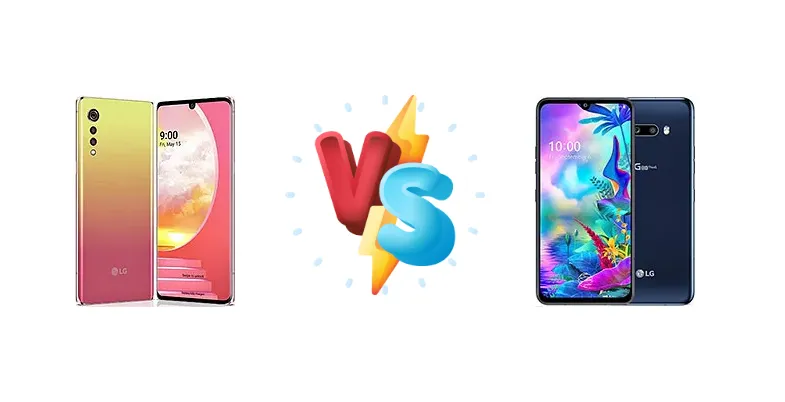
For most users, the LG G8X ThinQ emerges as the stronger choice. Its significantly superior battery endurance – 111 hours versus the Velvet’s 79 – and more powerful Snapdragon 855 chipset provide a more robust and long-lasting experience, despite the Velvet’s more modern design.
| PHONES | ||
|---|---|---|
| Phone Names | LG Velvet 5G | LG G8X ThinQ |
| Network | ||
|---|---|---|
| 2G bands | GSM 850 / 900 / 1800 / 1900 | GSM 850 / 900 / 1800 / 1900 |
| 3G bands | HSDPA 850 / 900 / 1900 / 2100 | HSDPA 850 / 900 / 1900 / 2100 |
| 4G bands | 1, 2, 3, 4, 5, 7, 8, 12, 17, 20, 28, 32, 38, 39, 40, 41 | 1, 2, 3, 4, 5, 7, 8, 12, 13, 17, 20, 28, 32, 38, 39, 40, 41 |
| 5G bands | 1, 3, 28, 78 SA/NSA | - |
| Speed | HSPA 42.2/5.76 Mbps, LTE (5CA) Cat16 1000/75 Mbps, 5G 2Gbps | HSPA 42.2/5.76 Mbps, LTE Cat20 1960/75 Mbps |
| Technology | GSM / HSPA / LTE / 5G | GSM / CDMA / HSPA / EVDO / LTE |
| - | 1, 2, 3, 4, 5, 7, 12, 14, 20, 29, 30, 38, 39, 40, 41, 46, 66 - USA | |
| Launch | ||
|---|---|---|
| Announced | 2020, May 07. Released 2020, May 15 | 2019, September 06. Released 2019, November 01 |
| Status | Discontinued | Discontinued |
| Body | ||
|---|---|---|
| Build | Glass front, glass back, aluminum frame | Glass front (Gorilla Glass 6), glass back (Gorilla Glass 5), aluminum frame |
| Dimensions | 167.2 x 74.1 x 7.9 mm (6.58 x 2.92 x 0.31 in) | 159.3 x 75.8 x 8.4 mm (6.27 x 2.98 x 0.33 in) |
| SIM | Nano-SIM + Nano-SIM | · Nano-SIM· Nano-SIM + Nano-SIM |
| Weight | 180 g (6.35 oz) | 192 g (6.77 oz) |
| IP68 dust/water resistant (up to 1.5m for 30 mins) MIL-STD-810G compliant* *does not guarantee ruggedness or use in extreme conditions | IP68 dust/water resistant (up to 1.5m for 30 min) MIL-STD-810G compliant* *does not guarantee ruggedness or use in extreme conditions | |
| Display | ||
|---|---|---|
| Protection | - | Corning Gorilla Glass 6 |
| Resolution | 1080 x 2460 pixels (~395 ppi density) | 1080 x 2340 pixels, 19.5:9 ratio (~403 ppi density) |
| Size | 6.8 inches, 109.8 cm2 (~88.6% screen-to-body ratio) | 6.4 inches, 100.5 cm2 (~83.3% screen-to-body ratio) |
| Type | P-OLED | OLED, HDR10 |
| - | Always-on display | |
| Platform | ||
|---|---|---|
| CPU | Octa-core (1x2.4 GHz Kryo 475 Prime & 1x2.2 GHz Kryo 475 Gold & 6x1.8 GHz Kryo 475 Silver) | Octa-core (1x2.84 GHz Kryo 485 & 3x2.42 GHz Kryo 485 & 4x1.78 GHz Kryo 485) |
| Chipset | Qualcomm SM7250 Snapdragon 765G 5G (7 nm) | Qualcomm SM8150 Snapdragon 855 (7 nm) |
| GPU | Adreno 620 | Adreno 640 |
| OS | Android 10, upgradable to Android 13, LG UX | Android 9.0 (Pie), upgradable to Android 12 |
| Memory | ||
|---|---|---|
| Card slot | microSDXC (uses shared SIM slot) | microSDXC (uses shared SIM slot) - dual-SIM model |
| Internal | 128GB 6GB RAM, 128GB 8GB RAM | 128GB 6GB RAM |
| UFS 2.1 | UFS 2.1 | |
| Main Camera | ||
|---|---|---|
| Dual | - | 12 MP, f/1.8, 27mm (wide), 1/2.55", 1.4µm, dual pixel PDAF, OIS 13 MP, f/2.4, 9mm (ultrawide), 1.0µm |
| Features | LED flash, panorama, HDR | Dual-LED dual-tone flash, HDR, panorama |
| Single | - | 3.15 MP, AF |
| Triple | 48 MP, f/1.8, 26mm (wide), 1/2.0", 0.8µm, PDAF 8 MP, f/2.2, 120˚, 15mm (ultrawide), 1/4.0", 1.12µm Auxiliary lens | - |
| Video | 4K@30fps, 1080p@30/60fps, gyro-EIS | 4K@30/60fps, 1080p@30/60/240fps, 24-bit/192kHz stereo sound rec., gyro-EIS |
| Selfie camera | ||
|---|---|---|
| Features | HDR | HDR |
| Single | 16 MP, f/1.9, 29mm (standard), 1/3.06, 1.0µm | 32 MP, f/1.9, 26mm (wide), 1/2.8", 0.8µm |
| Video | 1080p@30fps | 4K@30fps, gyro-EIS |
| Sound | ||
|---|---|---|
| 3.5mm jack | Yes | Yes |
| 35mm jack | Yes | Yes |
| Loudspeaker | Yes, with stereo speakers | Yes, with stereo speakers |
| - | 32-bit/192kHz audio 24-bit/192kHz audio recording Tuned by Meridian Audio | |
| Comms | ||
|---|---|---|
| Bluetooth | 5.1, A2DP, LE, aptX HD | 5.0, A2DP, LE, aptX HD |
| NFC | Yes | Yes |
| Positioning | GPS (L1+L5), GLONASS, BDS, GALILEO, QZSS | GPS, GLONASS, GALILEO, BDS |
| Radio | FM radio (market/region dependent) | FM radio |
| USB | USB Type-C, OTG | USB Type-C 3.1, OTG |
| WLAN | Wi-Fi 802.11 a/b/g/n/ac, dual-band, Wi-Fi Direct, DLNA | Wi-Fi 802.11 a/b/g/n/ac, dual-band, Wi-Fi Direct, DLNA |
| Features | ||
|---|---|---|
| Browser | - | HTML, Adobe Flash |
| Sensors | Fingerprint (under display, optical), accelerometer, gyro, proximity, compass, barometer | Fingerprint (under display, optical), accelerometer, gyro, proximity, compass, barometer |
| Battery | ||
|---|---|---|
| Charging | 25W wired, PD3.0, QC4 9W wireless | 21W wired, PD, QC3 9W wireless |
| Talk time | - | Up to 12 h (multimedia) |
| Type | Li-Po 4300 mAh | Li-Po 4000 mAh, non-removable |
| Misc | ||
|---|---|---|
| Colors | Aurora White, Aurora Green, Aurora Gray, Illusion Sunset, Red, Pink | New Aurora Black |
| Models | LM-G900N, LM-G900EM, LM-G900, LM-G900TM | LMG850EMW, LM-G850, 901LG, LM-G850N |
| Price | About 470 EUR | About 560 EUR |
| SAR | 0.23 W/kg (head) 1.02 W/kg (body) | 1.12 W/kg (body) |
| SAR EU | - | 0.90 W/kg (head) |
| Tests | ||
|---|---|---|
| Audio quality | - | Noise -93.2dB / Crosstalk -93.4dB |
| Battery life | Endurance rating 79h | Endurance rating 111h |
| Camera | Photo / Video | Photo / Video |
| Display | Contrast ratio: Infinite (nominal) | Contrast ratio: Infinite (nominal) |
| Loudspeaker | -23.5 LUFS (Very good) | -24.9 LUFS (Very good) |
| Performance | AnTuTu: 297372 (v8) GeekBench: 1905 (v5.1) GFXBench: 16fps (ES 3.1 onscreen) | AnTuTu: 339726 (v7), 411980 (v8) GeekBench: 11251 (v4.4), 2870 (v5.1) GFXBench: 38fps (ES 3.1 onscreen) |
LG Velvet 5G
- More modern and sleek design
- Supports 25W fast charging
- 5G connectivity for faster data speeds
- Significantly shorter battery life
- Less powerful Snapdragon 765G chipset
- Potentially lower performance in demanding tasks
LG G8X ThinQ
- Exceptional battery life (111h endurance)
- More powerful Snapdragon 855 processor
- Faster performance for gaming and multitasking
- Older design aesthetic
- Slightly slower wired charging (21W)
- May run slightly warmer under heavy load
Display Comparison
Both the LG Velvet 5G and G8X ThinQ feature displays with an 'Infinite' contrast ratio, suggesting deep blacks. However, the G8X ThinQ edges out the Velvet with a measured peak brightness of 603 nits compared to the Velvet’s 617 nits. While the difference is minimal, the G8X’s slightly higher brightness could offer better visibility in direct sunlight. Both lack high refresh rate panels, a notable omission considering the competition. The Velvet’s design incorporates a more modern, curved display, while the G8X maintains a more traditional flat panel.
Camera Comparison
Both phones offer a 'Photo / Video' camera experience, but the context data lacks specifics to differentiate them beyond that. Given LG’s history, both likely feature a multi-camera setup with standard wide, ultrawide, and potentially depth sensors. Without sensor size or aperture information, it’s difficult to assess image quality differences. However, the G8X’s more powerful ISP (Image Signal Processor) within the Snapdragon 855 could potentially offer better image processing capabilities, especially in low-light conditions. The absence of detail regarding camera features makes a definitive comparison impossible.
Performance
The core difference lies in the chipsets. The LG G8X ThinQ boasts the Qualcomm Snapdragon 855 (7nm), featuring an octa-core CPU clocked up to 2.84 GHz. This is a significant step up from the LG Velvet 5G’s Snapdragon 765G (7nm) with its peak clock speed of 2.4 GHz. The 855’s Kryo 485 cores offer a performance advantage in CPU-intensive tasks and gaming. While the 765G is a capable mid-range chip, the 855 provides a smoother experience for demanding applications. The G8X’s superior processing power translates to faster app loading times and more responsive multitasking.
Battery Life
Battery life is where the G8X ThinQ truly shines. Its endurance rating of 111 hours is substantially higher than the Velvet 5G’s 79 hours. This difference is likely due to the more efficient Snapdragon 855 combined with a larger battery capacity (though not specified in the data). While both support 9W wireless charging, the G8X offers slightly faster 21W wired charging compared to the Velvet’s 25W, though both utilize PD and QC standards. The G8X’s superior battery life makes it the clear winner for users who prioritize all-day usage.
Buying Guide
Buy the LG Velvet 5G if you prioritize a sleek, modern aesthetic and are willing to trade some battery life and raw performance for a more contemporary design. It’s ideal for users who primarily browse, consume media, and take casual photos. Buy the LG G8X ThinQ if you demand maximum battery life and need the extra processing power for demanding tasks like gaming or video editing. It’s the better option for power users and those who frequently travel or are away from a charger.