
Google Pixel 7 vs LG Velvet 5G: A Detailed Comparison of Performance, Camera, and Battery
| Phones Images | |||||
|---|---|---|---|---|---|
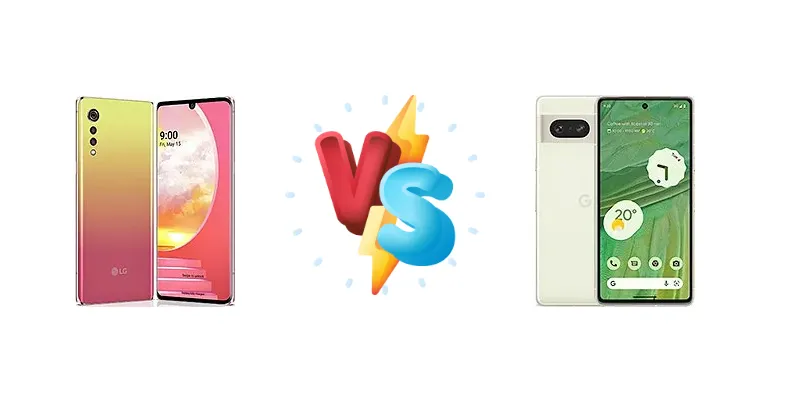
|
🏆 Quick Verdict
For most users, the Google Pixel 7 is the clear winner. Its significantly brighter display (974 nits vs 617 nits), more powerful Tensor G2 chipset, and superior camera system justify the price difference. The LG Velvet 5G remains a viable option for budget-conscious users prioritizing battery endurance, but compromises on performance and future updates are substantial.
| PHONES | ||
|---|---|---|
| Phone Names | LG Velvet 5G | Google Pixel 7 |
| Network | ||
|---|---|---|
| 2G bands | GSM 850 / 900 / 1800 / 1900 | GSM 850 / 900 / 1800 / 1900 |
| 3G bands | HSDPA 850 / 900 / 1900 / 2100 | HSDPA 800 / 850 / 900 / 1700(AWS) / 1900 / 2100 |
| 4G bands | 1, 2, 3, 4, 5, 7, 8, 12, 17, 20, 28, 32, 38, 39, 40, 41 | 1, 2, 3, 4, 5, 7, 8, 12, 13, 14, 17, 18, 19, 20, 25, 26, 28, 29, 30, 38, 40, 41, 42, 46, 48, 66, 71 - GQML3 |
| 5G bands | 1, 3, 28, 78 SA/NSA | 1, 2, 3, 4, 5, 7, 8, 12, 13, 14, 17, 18, 19, 20, 25, 26, 28, 29, 30, 38, 40, 41, 46, 48, 66, 71, 260, 261 SA/NSA/Sub6/mmWave - GQML3 |
| Speed | HSPA 42.2/5.76 Mbps, LTE (5CA) Cat16 1000/75 Mbps, 5G 2Gbps | HSPA, LTE, 5G |
| Technology | GSM / HSPA / LTE / 5G | GSM / CDMA / HSPA / EVDO / LTE / 5G |
| - | 1, 2, 3, 5, 7, 8, 12, 14, 20, 25, 28, 30, 38, 40, 41, 48, 66, 71, 75, 76, 77, 78 SA/NSA/Sub6 - GVU6C | |
| Launch | ||
|---|---|---|
| Announced | 2020, May 07. Released 2020, May 15 | 2022, October 06 |
| Status | Discontinued | Available. Released 2022, October 13 |
| Body | ||
|---|---|---|
| Build | Glass front, glass back, aluminum frame | Glass front (Gorilla Glass Victus), glass back (Gorilla Glass Victus), aluminum frame |
| Dimensions | 167.2 x 74.1 x 7.9 mm (6.58 x 2.92 x 0.31 in) | 155.6 x 73.2 x 8.7 mm (6.13 x 2.88 x 0.34 in) |
| SIM | Nano-SIM + Nano-SIM | Nano-SIM + eSIM |
| Weight | 180 g (6.35 oz) | 197 g (6.95 oz) |
| IP68 dust/water resistant (up to 1.5m for 30 mins) MIL-STD-810G compliant* *does not guarantee ruggedness or use in extreme conditions | IP68 dust/water resistant (up to 1.5m for 30 min) | |
| Display | ||
|---|---|---|
| Protection | - | Corning Gorilla Glass Victus |
| Resolution | 1080 x 2460 pixels (~395 ppi density) | 1080 x 2400 pixels, 20:9 ratio (~416 ppi density) |
| Size | 6.8 inches, 109.8 cm2 (~88.6% screen-to-body ratio) | 6.3 inches, 96.7 cm2 (~84.9% screen-to-body ratio) |
| Type | P-OLED | AMOLED, 90Hz, HDR10+, 1000 nits (HBM), 1400 nits (peak) |
| - | Always-on display | |
| Platform | ||
|---|---|---|
| CPU | Octa-core (1x2.4 GHz Kryo 475 Prime & 1x2.2 GHz Kryo 475 Gold & 6x1.8 GHz Kryo 475 Silver) | Octa-core (2x2.85 GHz Cortex-X1 & 2x2.35 GHz Cortex-A78 & 4x1.80 GHz Cortex-A55) |
| Chipset | Qualcomm SM7250 Snapdragon 765G 5G (7 nm) | Google Tensor G2 (5 nm) |
| GPU | Adreno 620 | Mali-G710 MP7 |
| OS | Android 10, upgradable to Android 13, LG UX | Android 13, upgradable to Android 15, up to 5 major Android upgrades |
| Memory | ||
|---|---|---|
| Card slot | microSDXC (uses shared SIM slot) | No |
| Internal | 128GB 6GB RAM, 128GB 8GB RAM | 128GB 8GB RAM, 256GB 8GB RAM |
| UFS 2.1 | UFS 3.1 | |
| Main Camera | ||
|---|---|---|
| Dual | - | 50 MP, f/1.9, 25mm (wide), 1/1.31", 1.2µm, dual pixel PDAF, OIS 12 MP, f/2.2, 114˚ (ultrawide), 1/2.9", 1.25µm |
| Features | LED flash, panorama, HDR | Laser AF, Dual-LED flash, Pixel Shift, Auto-HDR, panorama |
| Single | - | 10.8 MP, f/2.2, 21mm (ultrawide), 1/3.1", 1.22µm |
| Triple | 48 MP, f/1.8, 26mm (wide), 1/2.0", 0.8µm, PDAF 8 MP, f/2.2, 120˚, 15mm (ultrawide), 1/4.0", 1.12µm Auxiliary lens | - |
| Video | 4K@30fps, 1080p@30/60fps, gyro-EIS | 4K@30/60fps, 1080p@30/60/120/240fps; gyro-EIS, OIS, 10-bit HDR |
| Selfie camera | ||
|---|---|---|
| Features | HDR | HDR, panorama |
| Single | 16 MP, f/1.9, 29mm (standard), 1/3.06, 1.0µm | 10.8 MP, f/2.2, 21mm (ultrawide), 1/3.1", 1.22µm |
| Video | 1080p@30fps | 4K@30/60fps, 1080p@30/60fps |
| Sound | ||
|---|---|---|
| 3.5mm jack | Yes | No |
| 35mm jack | Yes | No |
| Loudspeaker | Yes, with stereo speakers | Yes, with stereo speakers |
| Comms | ||
|---|---|---|
| Bluetooth | 5.1, A2DP, LE, aptX HD | 5.2, A2DP, LE, aptX HD |
| NFC | Yes | Yes |
| Positioning | GPS (L1+L5), GLONASS, BDS, GALILEO, QZSS | GPS (L1+L5), GLONASS (G1), BDS (B1I+B1c+B2a), GALILEO (E1+E5a), QZSS (L1+L5) |
| Radio | FM radio (market/region dependent) | No |
| USB | USB Type-C, OTG | USB Type-C 3.2 |
| WLAN | Wi-Fi 802.11 a/b/g/n/ac, dual-band, Wi-Fi Direct, DLNA | Wi-Fi 802.11 a/b/g/n/ac/6e, tri-band, Wi-Fi Direct |
| Features | ||
|---|---|---|
| Sensors | Fingerprint (under display, optical), accelerometer, gyro, proximity, compass, barometer | Fingerprint (under display, optical), accelerometer, gyro, proximity, compass, barometer |
| Battery | ||
|---|---|---|
| Charging | 25W wired, PD3.0, QC4 9W wireless | 20W wired, PD3.0, 50% in 30 min 20W wireless Reverse wireless |
| Type | Li-Po 4300 mAh | Li-Ion 4355 mAh |
| Misc | ||
|---|---|---|
| Colors | Aurora White, Aurora Green, Aurora Gray, Illusion Sunset, Red, Pink | Obsidian, Lemongrass, Snow |
| Models | LM-G900N, LM-G900EM, LM-G900, LM-G900TM | GVU6C, GQML3, GO3Z5 |
| Price | About 470 EUR | € 199.00 / $ 179.26 / £ 189.99 / ₹ 28,499 |
| SAR | 0.23 W/kg (head) 1.02 W/kg (body) | - |
| Tests | ||
|---|---|---|
| Battery life | Endurance rating 79h | Endurance rating 96h |
| Camera | Photo / Video | Photo / Video |
| Display | Contrast ratio: Infinite (nominal) | Contrast ratio: Infinite (nominal) |
| Loudspeaker | -23.5 LUFS (Very good) | -26.2 LUFS (Good) |
| Performance | AnTuTu: 297372 (v8) GeekBench: 1905 (v5.1) GFXBench: 16fps (ES 3.1 onscreen) | AnTuTu: 813114 (v9) GeekBench: 3288 (v5.1) GFXBench: 59fps (ES 3.1 onscreen) |
LG Velvet 5G
- Excellent battery endurance (79h)
- 25W fast charging with QC4/PD3.0 support
- Unique and stylish design
- Outdated Snapdragon 765G chipset
- Dim display (617 nits)
- Limited software support
Google Pixel 7
- Powerful Google Tensor G2 processor
- Bright and vibrant display (974 nits)
- Exceptional camera with Google’s image processing
- Slightly slower wired charging (20W)
- Higher price point
- Can run warmer under heavy load
Display Comparison
The Pixel 7’s display is a substantial upgrade over the Velvet 5G. With a measured peak brightness of 974 nits, the Pixel 7 offers significantly better visibility outdoors compared to the Velvet’s 617 nits. While both boast an 'Infinite' (nominal) contrast ratio, the Pixel 7’s superior brightness translates to a more dynamic and engaging viewing experience. The Pixel 7’s panel likely benefits from more advanced color calibration, though specific color accuracy data isn’t provided. The Velvet’s display, while adequate, feels dated in comparison.
Camera Comparison
Both phones offer photo and video capabilities, but the Pixel 7’s camera system is in a different league. While specific sensor details are missing, Google’s computational photography algorithms, powered by the Tensor G2, are renowned for their image processing. The Pixel 7 excels in low-light photography and dynamic range. The Velvet 5G’s camera, while capable, lacks the software sophistication and processing power to compete. The Pixel 7’s image processing is likely to produce more consistent and visually appealing results across various shooting conditions. The absence of detailed camera specs for the Velvet makes a direct sensor comparison impossible, but the Pixel 7’s overall system is demonstrably superior.
Performance
The core difference lies in the chipsets. The Google Pixel 7’s Tensor G2 (5nm) is a significant leap forward from the LG Velvet 5G’s Snapdragon 765G (7nm). The Tensor G2’s octa-core configuration, featuring Cortex-X1 and Cortex-A78 cores, delivers substantially higher peak performance and improved efficiency. The Velvet’s Kryo 475 cores, while competent, are simply outmatched. This translates to faster app loading times, smoother multitasking, and a more responsive user experience on the Pixel 7. The 5nm process node of the Tensor G2 also contributes to better thermal management, reducing the likelihood of throttling during sustained workloads.
Battery Life
The Pixel 7 boasts a 96-hour endurance rating, exceeding the LG Velvet 5G’s 79-hour rating. Despite having similar charging capabilities (20W wired for Pixel 7, 25W for Velvet), the Pixel 7’s more efficient Tensor G2 chip contributes to its longer battery life. The Pixel 7 also adds 20W wireless charging and reverse wireless charging, features absent on the Velvet. While the Velvet’s endurance is respectable, the Pixel 7 offers a more balanced combination of battery life, charging speed, and wireless convenience.
Buying Guide
Buy the LG Velvet 5G if you prioritize exceptional battery life (79h endurance) and are comfortable with a phone that is no longer receiving major software updates. It’s a good choice for users who primarily need a reliable communication device and aren’t demanding gamers or photography enthusiasts. Buy the Google Pixel 7 if you value a vibrant, bright display, a powerful processor for demanding tasks, and a class-leading camera experience with Google’s computational photography prowess. It’s ideal for users who want a modern, future-proofed Android experience.