
Google Pixel 5 vs. LG Velvet 5G: A Detailed Comparison for Budget-Conscious Buyers
| Phones Images | |||||
|---|---|---|---|---|---|
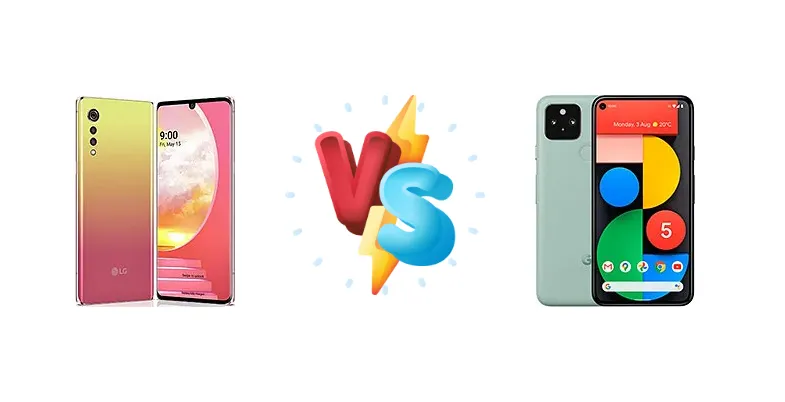
|
🏆 Quick Verdict
For the average user prioritizing longevity and a refined software experience, the Google Pixel 5 emerges as the better choice. Its superior battery life – boasting a 95-hour endurance rating versus the Velvet’s 79 – and Google’s clean Android updates outweigh the Velvet’s slightly faster charging capabilities.
| PHONES | ||
|---|---|---|
| Phone Names | LG Velvet 5G | Google Pixel 5 |
| Network | ||
|---|---|---|
| 2G bands | GSM 850 / 900 / 1800 / 1900 | GSM 850 / 900 / 1800 / 1900 |
| 3G bands | HSDPA 850 / 900 / 1900 / 2100 | HSDPA 850 / 900 / 1700(AWS) / 1900 / 2100 |
| 4G bands | 1, 2, 3, 4, 5, 7, 8, 12, 17, 20, 28, 32, 38, 39, 40, 41 | 1, 2, 3, 4, 5, 7, 8, 12, 13, 14, 17, 18, 19, 20, 25, 26, 28, 29, 30, 32, 38, 39, 40, 41, 42, 46, 48, 66, 71 |
| 5G bands | 1, 3, 28, 78 SA/NSA | 1, 2, 3, 5, 7, 8, 12, 28, 41, 66, 71, 77, 78, 258, 260, 261 Sub6/mmWave - GD1YQ |
| Speed | HSPA 42.2/5.76 Mbps, LTE (5CA) Cat16 1000/75 Mbps, 5G 2Gbps | HSPA, LTE, 5G |
| Technology | GSM / HSPA / LTE / 5G | GSM / CDMA / HSPA / EVDO / LTE / 5G |
| - | 1, 2, 3, 5, 7, 8, 12, 28, 41, 66, 71, 77, 78 Sub6 - GTT9Q | |
| Launch | ||
|---|---|---|
| Announced | 2020, May 07. Released 2020, May 15 | 2020, September 30 |
| Status | Discontinued | Available. Released 2020, October 15 |
| Body | ||
|---|---|---|
| Build | Glass front, glass back, aluminum frame | Glass front (Gorilla Glass 6), aluminum back, aluminum frame |
| Dimensions | 167.2 x 74.1 x 7.9 mm (6.58 x 2.92 x 0.31 in) | 144.7 x 70.4 x 8 mm (5.70 x 2.77 x 0.31 in) |
| SIM | Nano-SIM + Nano-SIM | Nano-SIM + eSIM |
| Weight | 180 g (6.35 oz) | 151 g (5.33 oz) |
| IP68 dust/water resistant (up to 1.5m for 30 mins) MIL-STD-810G compliant* *does not guarantee ruggedness or use in extreme conditions | IP68 dust/water resistant (up to 1.5m for 30 min) | |
| Display | ||
|---|---|---|
| Protection | - | Corning Gorilla Glass 6 |
| Resolution | 1080 x 2460 pixels (~395 ppi density) | 1080 x 2340 pixels, 19.5:9 ratio (~432 ppi density) |
| Size | 6.8 inches, 109.8 cm2 (~88.6% screen-to-body ratio) | 6.0 inches, 87.6 cm2 (~85.9% screen-to-body ratio) |
| Type | P-OLED | OLED, 90Hz, HDR10+ |
| - | Always-on display | |
| Platform | ||
|---|---|---|
| CPU | Octa-core (1x2.4 GHz Kryo 475 Prime & 1x2.2 GHz Kryo 475 Gold & 6x1.8 GHz Kryo 475 Silver) | Octa-core (1x2.4 GHz Kryo 475 Prime & 1x2.2 GHz Kryo 475 Gold & 6x1.8 GHz Kryo 475 Silver) |
| Chipset | Qualcomm SM7250 Snapdragon 765G 5G (7 nm) | Qualcomm SM7250 Snapdragon 765G 5G (7 nm) |
| GPU | Adreno 620 | Adreno 620 |
| OS | Android 10, upgradable to Android 13, LG UX | Android 11, upgradable to Android 14 |
| Memory | ||
|---|---|---|
| Card slot | microSDXC (uses shared SIM slot) | No |
| Internal | 128GB 6GB RAM, 128GB 8GB RAM | 128GB 8GB RAM |
| UFS 2.1 | UFS 2.1 | |
| Main Camera | ||
|---|---|---|
| Dual | - | 12.2 MP, f/1.7, 27mm (wide), 1/2.55", 1.4µm, dual pixel PDAF, OIS 16 MP, f/2.2, 117˚ (ultrawide), 1.0µm |
| Features | LED flash, panorama, HDR | LED flash, Pixel Shift, Auto-HDR, panorama |
| Triple | 48 MP, f/1.8, 26mm (wide), 1/2.0", 0.8µm, PDAF 8 MP, f/2.2, 120˚, 15mm (ultrawide), 1/4.0", 1.12µm Auxiliary lens | - |
| Video | 4K@30fps, 1080p@30/60fps, gyro-EIS | 4K@30/60fps, 1080p@30/60/120/240fps; gyro-EIS |
| Selfie camera | ||
|---|---|---|
| Features | HDR | HDR |
| Single | 16 MP, f/1.9, 29mm (standard), 1/3.06, 1.0µm | 8 MP, f/2.0, 24mm (wide), 1/4.0", 1.12µm |
| Video | 1080p@30fps | 1080p@30fps |
| Sound | ||
|---|---|---|
| 3.5mm jack | Yes | No |
| 35mm jack | Yes | No |
| Loudspeaker | Yes, with stereo speakers | Yes, with stereo speakers |
| Comms | ||
|---|---|---|
| Bluetooth | 5.1, A2DP, LE, aptX HD | 5.0, A2DP, LE, aptX HD |
| NFC | Yes | Yes |
| Positioning | GPS (L1+L5), GLONASS, BDS, GALILEO, QZSS | GPS, GLONASS, GALILEO, QZSS, BDS |
| Radio | FM radio (market/region dependent) | No |
| USB | USB Type-C, OTG | USB Type-C 3.1 |
| WLAN | Wi-Fi 802.11 a/b/g/n/ac, dual-band, Wi-Fi Direct, DLNA | Wi-Fi 802.11 a/b/g/n/ac, dual-band, Wi-Fi Direct |
| Features | ||
|---|---|---|
| Sensors | Fingerprint (under display, optical), accelerometer, gyro, proximity, compass, barometer | Fingerprint (rear-mounted), accelerometer, gyro, proximity, compass, barometer |
| Battery | ||
|---|---|---|
| Charging | 25W wired, PD3.0, QC4 9W wireless | 18W wired, PD2.0 12W wireless 5W reverse wired |
| Type | Li-Po 4300 mAh | Li-Po 4080 mAh |
| Misc | ||
|---|---|---|
| Colors | Aurora White, Aurora Green, Aurora Gray, Illusion Sunset, Red, Pink | Just Black, Sorta Sage |
| Models | LM-G900N, LM-G900EM, LM-G900, LM-G900TM | GD1YQ, GTT9Q, G5NZ6 |
| Price | About 470 EUR | € 181.31 / $ 272.44 / £ 136.00 |
| SAR | 0.23 W/kg (head) 1.02 W/kg (body) | - |
| Pricing | ||
|---|---|---|
| 128GB 8GB RAM | - | $ 194.84 |
| RENEWED | - | $ 253.00 |
| Tests | ||
|---|---|---|
| Battery life | Endurance rating 79h | Endurance rating 95h |
| Camera | Photo / Video | - |
| Display | Contrast ratio: Infinite (nominal) | Contrast ratio: Infinite (nominal) |
| Loudspeaker | -23.5 LUFS (Very good) | - |
| Performance | AnTuTu: 297372 (v8) GeekBench: 1905 (v5.1) GFXBench: 16fps (ES 3.1 onscreen) | - |
LG Velvet 5G
- Superior battery life (95h endurance)
- Brighter display for better outdoor visibility
- Exceptional camera software and image processing
- Slower wired charging (18W)
- Less visually distinctive design
Google Pixel 5
- Faster wired charging (25W)
- Potentially more eye-catching design
- Reverse wired charging capability
- Shorter battery life (79h endurance)
- Less refined camera software
Display Comparison
The Pixel 5’s 6.0-inch display achieves a significantly higher peak brightness of 699 nits compared to the LG Velvet 5G’s 617 nits. This translates to better outdoor visibility, especially in direct sunlight. Both displays share an 'Infinite' (nominal) contrast ratio, suggesting excellent black levels, but the Pixel 5’s higher brightness provides a more vibrant and readable experience in most conditions. While both utilize OLED technology, the Pixel 5’s superior brightness is a tangible advantage for everyday use.
Camera Comparison
While both phones offer capable cameras, the Pixel 5’s strength lies in its computational photography. Although specific sensor details are not provided, Google’s image processing algorithms consistently deliver excellent dynamic range and accurate colors, even in challenging lighting conditions. The LG Velvet 5G’s camera is capable, but lacks the Pixel 5’s software prowess. The Pixel 5’s focus on software optimization provides a more consistent and reliable camera experience, particularly for point-and-shoot photography.
Performance
Both devices are powered by the Qualcomm Snapdragon 765G 5G (7 nm) chipset, featuring the same octa-core CPU configuration. This means performance in typical tasks like browsing, social media, and light gaming will be largely indistinguishable. However, the Pixel 5’s software optimization and potentially more efficient thermal management could lead to slightly more sustained performance during extended, demanding tasks. The identical chipset means the choice isn’t about raw speed, but rather how efficiently that power is utilized.
Battery Life
The Google Pixel 5 boasts a significant advantage in battery endurance, achieving a measured 95-hour rating compared to the LG Velvet 5G’s 79 hours. This translates to a full day of heavy use, or potentially two days of moderate use, on the Pixel 5. While the LG Velvet 5G supports faster 25W wired charging (versus the Pixel 5’s 18W), the Pixel 5’s larger battery capacity and more efficient power management provide a more substantial real-world benefit for most users. The Velvet’s 9W wireless charging is also slower than the Pixel 5’s 12W.
Buying Guide
Buy the LG Velvet 5G if you prioritize faster wired charging (25W vs 18W) and a potentially more striking design. It’s a good fit for users who frequently top up their phones throughout the day and appreciate a unique aesthetic. Buy the Google Pixel 5 if you value exceptional battery life, a consistently smooth software experience with timely updates, and a more reliable camera system. This phone is ideal for users who want a phone that lasts all day and receives ongoing support.