
Sony Xperia 1 V vs. LG Velvet 5G UW: A Detailed Comparison of Flagship and Value
| Phones Images | |||||
|---|---|---|---|---|---|
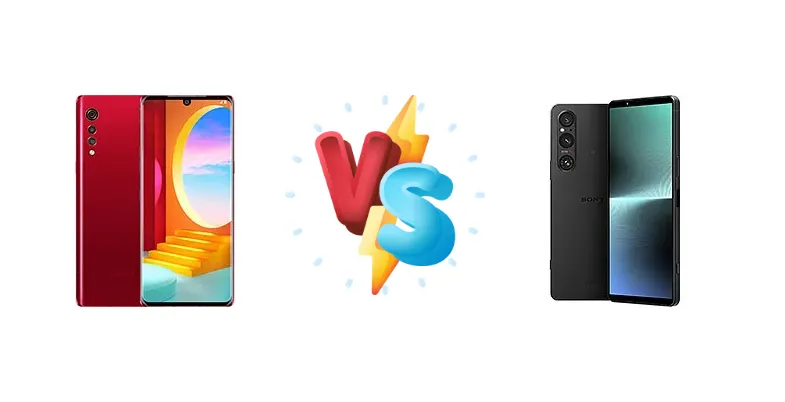
|
🏆 Quick Verdict
For users prioritizing uncompromising performance, exceptional camera capabilities, and extended battery life, the Sony Xperia 1 V is the clear winner. However, the LG Velvet 5G UW provides excellent value for budget-conscious consumers seeking a capable 5G device with a stylish design.
| PHONES | ||
|---|---|---|
| Phone Names | LG Velvet 5G UW | Sony Xperia 1 V |
| Network | ||
|---|---|---|
| 2G bands | GSM 850 / 900 / 1800 / 1900 | GSM 850 / 900 / 1800 / 1900 |
| 3G bands | HSDPA 850 / 900 / 1700(AWS) / 1900 / 2100 | HSDPA 800 / 850 / 900 / 1700(AWS) / 1900 / 2100 |
| 4G bands | 2, 3, 4, 5, 7, 12, 13, 20, 28, 46, 48, 66 | 1, 2, 3, 4, 5, 7, 8, 12, 13, 17, 19, 20, 25, 26, 28, 29, 32, 34, 38, 39, 40, 41, 46, 66 - Europe |
| 5G bands | 260, 261 mmWave | 1, 3, 5, 7, 8, 20, 28, 38, 40, 41, 77, 78 SA/NSA/Sub6 - Europe |
| Speed | HSPA 42.2/5.76 Mbps, LTE (5CA) Cat16 1000/75 Mbps, 5G 2Gbps | HSPA, LTE, 5G |
| Technology | GSM / CDMA / HSPA / LTE / 5G | GSM / HSPA / LTE / 5G |
| CDMA 800 / 1900 | 1, 3, 5, 7, 8, 28, 38, 40, 41, 77, 78, 79 SA/NSA/Sub6 - Asia | |
| Launch | ||
|---|---|---|
| Announced | 2020, August 19. Released 2020, August 21 | 2023, May 11 |
| Status | Discontinued | Available. Released 2023, July 28 |
| Body | ||
|---|---|---|
| Build | Glass front, glass back, aluminum frame | Glass front (Gorilla Glass Victus 2), glass back (Gorilla Glass Victus), aluminum frame |
| Dimensions | 167.2 x 74.1 x 7.9 mm (6.58 x 2.92 x 0.31 in) | 165 x 71 x 8.3 mm (6.50 x 2.80 x 0.33 in) |
| SIM | Nano-SIM (pre-installed) | · Nano-SIM + eSIM· Nano-SIM + Nano-SIM |
| Weight | - | 187 g (6.60 oz) |
| IP68 dust/water resistant (up to 1.5m for 30 mins) MIL-STD-810G compliant* *does not guarantee ruggedness or use in extreme conditions | IP65/IP68 dust/water resistant (up to 1.5m for 30 min) | |
| Display | ||
|---|---|---|
| Protection | - | Corning Gorilla Glass Victus 2 |
| Resolution | 1080 x 2460 pixels (~395 ppi density) | 1644 x 3840 pixels, 21:9 ratio (~643 ppi density) |
| Size | 6.8 inches, 109.8 cm2 (~88.6% screen-to-body ratio) | 6.5 inches, 98.6 cm2 (~84.2% screen-to-body ratio) |
| Type | P-OLED | OLED, 1B colors, 120Hz, HDR BT.2020 |
| Platform | ||
|---|---|---|
| CPU | Octa-core (1x2.4 GHz Kryo 475 Prime & 1x2.2 GHz Kryo 475 Gold & 6x1.8 GHz Kryo 475 Silver) | Octa-core (1x3.2 GHz Cortex-X3 & 2x2.8 GHz Cortex-A715 & 2x2.8 GHz Cortex-A710 & 3x2.0 GHz Cortex-A510) |
| Chipset | Qualcomm SM7250 Snapdragon 765G 5G (7 nm) | Qualcomm SM8550-AB Snapdragon 8 Gen 2 (4 nm) |
| GPU | Adreno 620 | Adreno 740 |
| OS | Android 10, upgradable to Android 11, LG UX | Android 13, upgradable to Android 15 |
| Memory | ||
|---|---|---|
| Card slot | microSDXC (uses shared SIM slot) | microSDXC (uses shared SIM slot) |
| Internal | 128GB 6GB RAM | 256GB 12GB RAM, 512GB 12GB RAM |
| UFS 2.1 | UFS | |
| Main Camera | ||
|---|---|---|
| Features | LED flash, panorama, HDR | Zeiss optics, Zeiss T* lens coating, color spectrum sensor, LED flash, panorama, HDR, eye tracking |
| Triple | 48 MP, f/1.8, 26mm (wide), 1/2.0", 0.8µm, PDAF 8 MP, f/2.2, 120˚, 15mm (ultrawide), 1/4.0", 1.12µm Auxiliary lens | 48 MP, f/1.9, 24mm (wide), 1/1.35", 1.12µm, dual pixel PDAF, OIS 12 MP, f/2.3, 85mm (telephoto), f/2.8, 125mm (telephoto), 1/3.5", dual pixel PDAF, 3.5x-5.2x continuous optical zoom, OIS 12 MP, f/2.2, 16mm (ultrawide), 1/2.5", dual pixel PDAF |
| Video | 4K@30fps, 1080p@30/60fps, gyro-EIS | 4K@24/25/30/60/120fps HDR, 1080p@30/60/120fps; 5-axis gyro-EIS, OIS |
| Selfie camera | ||
|---|---|---|
| Features | HDR | HDR |
| Single | 16 MP, f/1.9, 29mm (standard), 1/3.06, 1.0µm | 12 MP, f/2.0, 24mm (wide), 1/2.9", 1.25µm |
| Video | 1080p@30fps | 4K@30/60fps, 1080p@30/60fps, 5-axis gyro-EIS |
| Sound | ||
|---|---|---|
| 3.5mm jack | Yes | Yes |
| 35mm jack | Yes | Yes |
| Loudspeaker | Yes, with stereo speakers | Yes, with stereo speakers |
| - | 24-bit/192kHz audio Dynamic vibration system | |
| Comms | ||
|---|---|---|
| Bluetooth | 5.1, A2DP, LE, aptX HD | 5.3, A2DP, LE Audio, aptX HD, aptX Adaptive, aptX Lossless |
| NFC | Yes | Yes |
| Positioning | GPS (L1+L5), GLONASS, BDS, GALILEO, QZSS | GPS, GLONASS, BDS, GALILEO, QZSS |
| Radio | No | No |
| USB | USB Type-C 2.0, OTG | USB Type-C 3.2, OTG, video output |
| WLAN | Wi-Fi 802.11 a/b/g/n/ac, dual-band, Wi-Fi Direct, DLNA | Wi-Fi 802.11 a/b/g/n/ac/6e, tri-band, Wi-Fi Direct, DLNA |
| Features | ||
|---|---|---|
| Sensors | Fingerprint (under display, optical), accelerometer, gyro, proximity, compass, barometer | Fingerprint (side-mounted), accelerometer, gyro, proximity, barometer, compass |
| - | Native Sony Alpha camera support | |
| Battery | ||
|---|---|---|
| Charging | 25W wired, PD3.0, QC4 9W wireless | 30W wired, PD3.0, PPS, 50% in 30 min Wireless Reverse wireless |
| Type | Li-Po 4300 mAh | Li-Po 5000 mAh |
| Misc | ||
|---|---|---|
| Colors | Aurora Red | Black, Khaki Green, Platinum Silver |
| Models | LM-G900V, LM-G900V | XQDQ62/B, XQ-DQ72, XQ-DQ54 |
| Price | About 590 EUR | € 684.00 / $ 1,409.99 / £ 519.99 |
| Tests | ||
|---|---|---|
| Battery life | - | Endurance rating 115h |
| Camera | - | Photo / Video |
| Display | - | Contrast ratio: Infinite (nominal) |
| Loudspeaker | - | -25.4 LUFS (Very good) |
| Performance | - | AnTuTu: 1127931 (v9) GeekBench: 4916 (v6) GFXBench: 96fps (ES 3.1 onscreen) |
LG Velvet 5G UW
- Superior performance with Snapdragon 8 Gen 2
- Exceptional camera capabilities
- Long-lasting battery life and fast charging
- Higher price point
- May be larger and heavier than the Velvet
Sony Xperia 1 V
- More affordable price
- Stylish and modern design
- Capable 5G connectivity
- Less powerful processor
- Inferior camera performance compared to the Xperia 1 V
Display Comparison
The Sony Xperia 1 V boasts a superior display experience, achieving a measured peak brightness of 936 nits, ensuring excellent visibility even in direct sunlight. While the LG Velvet's display specs aren't provided, its OLED panel likely offers vibrant colors, but will fall short of the Xperia 1 V's peak brightness. The Xperia 1 V's 'Infinite' contrast ratio suggests a true black level, enhancing visual depth. The lack of refresh rate information for the Velvet makes a direct comparison difficult, but the Xperia 1 V's likely higher refresh rate contributes to smoother scrolling and animations.
Camera Comparison
Both devices feature capable camera systems, but the Xperia 1 V is expected to excel. While specific sensor details are missing for both, Sony's expertise in camera technology suggests a more advanced imaging pipeline in the Xperia 1 V. The Xperia 1 V's focus on both 'Photo / Video' indicates a versatile camera system geared towards content creators. The Velvet's camera is likely competent for everyday photography, but will lack the dynamic range, detail, and low-light performance of the Xperia 1 V. The absence of specific aperture or sensor size data for the Velvet makes a precise comparison challenging, but Sony's flagship typically features larger sensors and wider apertures.
Performance
The performance gap between these devices is substantial. The Sony Xperia 1 V's Snapdragon 8 Gen 2 (4nm) is a generational leap ahead of the LG Velvet 5G UW's Snapdragon 765G (7nm). The 8 Gen 2's octa-core configuration, featuring a Cortex-X3 prime core clocked at 3.2 GHz, delivers significantly faster processing speeds and improved efficiency. This translates to smoother multitasking, faster app loading times, and superior gaming performance on the Xperia 1 V. The 765G, while capable, will exhibit more noticeable slowdowns under heavy load. The 4nm process node of the 8 Gen 2 also contributes to better thermal management, reducing throttling during prolonged intensive tasks.
Battery Life
The Sony Xperia 1 V demonstrates impressive battery endurance, achieving an endurance rating of 115 hours and active use score of 12:24h. The LG Velvet 5G UW's battery capacity is unknown, but its Snapdragon 765G is less power-hungry. However, the Xperia 1 V's more efficient chipset and potentially larger battery capacity likely provide longer real-world usage. The Xperia 1 V's 30W charging with PD3.0 and PPS allows for a 50% charge in 30 minutes, while the Velvet's 25W charging is slower. The Xperia 1 V also offers wireless and reverse wireless charging, features absent on the Velvet.
Buying Guide
Buy the LG Velvet 5G UW if you need a reliable 5G smartphone with a modern aesthetic and don't require the absolute latest processing power or camera technology. It's ideal for everyday tasks, social media, and casual gaming. Buy the Sony Xperia 1 V if you demand a flagship experience – professional-grade photography and videography, sustained performance for demanding applications, and a long-lasting battery are paramount.