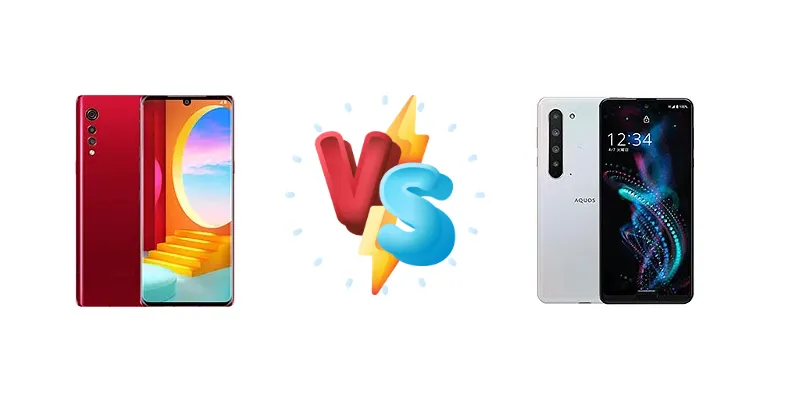
The LG Velvet 5G UW and Sharp Aquos R5G represent interesting points in the 5G smartphone landscape. The Velvet aimed for a premium feel at a more accessible price point, leveraging the Snapdragon 765G. The Aquos R5G, meanwhile, opted for a flagship-tier Snapdragon 865, but with a more regional focus. This comparison dissects the core differences between these two devices, focusing on how their chipsets translate to real-world performance and user experience.
🏆 Quick Verdict
For the average user prioritizing raw performance and future-proofing, the Sharp Aquos R5G is the clear winner. Its Snapdragon 865 offers a significant performance uplift over the Velvet’s 765G, especially in demanding tasks like gaming and video editing. However, the LG Velvet 5G UW remains a compelling option for those seeking a stylish device with solid 5G connectivity at a potentially lower price.
| Network |
|---|
| 2G bands | GSM 850 / 900 / 1800 / 1900 | GSM 850 / 900 / 1800 / 1900 |
| 3G bands | HSDPA 850 / 900 / 1700(AWS) / 1900 / 2100 | HSDPA 850 / 900 / 1900 / 2100 |
| 4G bands | 2, 3, 4, 5, 7, 12, 13, 20, 28, 46, 48, 66 | 1, 3, 7, 8, 20, 28, 38, 41 |
| 5G bands | 260, 261 mmWave | 1, 3, 28, 78 SA/NSA |
| Speed | HSPA 42.2/5.76 Mbps, LTE (5CA) Cat16 1000/75 Mbps, 5G 2Gbps | HSPA, LTE, 5G |
| Technology | GSM / CDMA / HSPA / LTE / 5G | GSM / HSPA / LTE / 5G |
| | CDMA 800 / 1900 | - |
| Launch |
|---|
| Announced | 2020, August 19. Released 2020, August 21 | 2020, February. Released 2020, February |
| Status | Discontinued | Discontinued |
| Body |
|---|
| Build | Glass front, glass back, aluminum frame | - |
| Dimensions | 167.2 x 74.1 x 7.9 mm (6.58 x 2.92 x 0.31 in) | 162 x 75 x 8.9 mm (6.38 x 2.95 x 0.35 in) |
| SIM | Nano-SIM (pre-installed) | Nano-SIM |
| Weight | - | 189 g (6.67 oz) |
| | IP68 dust/water resistant (up to 1.5m for 30 mins)
MIL-STD-810G compliant*
*does not guarantee ruggedness or use in extreme conditions | IPX5/IP6X/IPX8 water/dust resistant (up to 1.5m for 30 min) |
| Display |
|---|
| Resolution | 1080 x 2460 pixels (~395 ppi density) | 1440 x 3168 pixels (~544 ppi density) |
| Size | 6.8 inches, 109.8 cm2 (~88.6% screen-to-body ratio) | 6.4 inches, 99.5 cm2 (~81.9% screen-to-body ratio) |
| Type | P-OLED | IGZO IPS LCD, 1B colors, 120Hz, Dolby Vision |
| Platform |
|---|
| CPU | Octa-core (1x2.4 GHz Kryo 475 Prime & 1x2.2 GHz Kryo 475 Gold & 6x1.8 GHz Kryo 475 Silver) | Octa-core (1x2.84 GHz Cortex-A77 & 3x2.42 GHz Cortex-A77 & 4x1.80 GHz Cortex-A55) |
| Chipset | Qualcomm SM7250 Snapdragon 765G 5G (7 nm) | Qualcomm SM8250 Snapdragon 865 5G (7 nm+) |
| GPU | Adreno 620 | Adreno 650 |
| OS | Android 10, upgradable to Android 11, LG UX | Android 10 |
| Memory |
|---|
| Card slot | microSDXC (uses shared SIM slot) | No |
| Internal | 128GB 6GB RAM | 256GB 12GB RAM |
| | UFS 2.1 | UFS 3.0 |
| Main Camera |
|---|
| Features | LED flash, panorama, HDR | LED flash, panorama |
| Triple | 48 MP, f/1.8, 26mm (wide), 1/2.0", 0.8µm, PDAF
8 MP, f/2.2, 120˚, 15mm (ultrawide), 1/4.0", 1.12µm
Auxiliary lens | 12 MP, f/1.7, 26mm (wide), 1.4µm, dual pixel PDAF, OIS
12 MP, f/2.7, 52mm (telephoto), 1.0µm, PDAF, 2x optical zoom, OIS
48 MP, f/2.9, 19mm (ultrawide), 0.8µm
TOF 3D (depth) |
| Video | 4K@30fps, 1080p@30/60fps, gyro-EIS | 8K@30fps, 1080p@30fps |
| Selfie camera |
|---|
| Features | HDR | - |
| Single | 16 MP, f/1.9, 29mm (standard), 1/3.06, 1.0µm | 16 MP, f/2.0, 26mm (wide), 0.7µm |
| Video | 1080p@30fps | 1080p@30fps |
| Sound |
|---|
| 3.5mm jack | Yes | No |
| 35mm jack | Yes | No |
| Loudspeaker | Yes, with stereo speakers | Yes, with stereo speakers |
| | - | 24-bit/192kHz audio |
| Comms |
|---|
| Bluetooth | 5.1, A2DP, LE, aptX HD | 5.1, A2DP, LE, aptX HD, aptX Adaptive |
| NFC | Yes | Yes |
| Positioning | GPS (L1+L5), GLONASS, BDS, GALILEO, QZSS | GPS (L1+L5), GLONASS, BDS, GALILEO, QZSS |
| Radio | No | No |
| USB | USB Type-C 2.0, OTG | USB Type-C 3.1 |
| WLAN | Wi-Fi 802.11 a/b/g/n/ac, dual-band, Wi-Fi Direct, DLNA | Wi-Fi 802.11 a/b/g/n/ac/ax/6, dual-band, Wi-Fi Direct |
| Features |
|---|
| Sensors | Fingerprint (under display, optical), accelerometer, gyro, proximity, compass, barometer | Fingerprint (front-mounted), accelerometer, gyro, proximity, compass |
| Battery |
|---|
| Charging | 25W wired, PD3.0, QC4
9W wireless | - |
| Type | Li-Po 4300 mAh | Li-Ion 3730 mAh |
| Misc |
|---|
| Colors | Aurora Red | Glare Black, Aurora White |
| Models | LM-G900V, LM-G900V | SH-51A, SHG01, SH-R50 |
| Price | About 590 EUR | About 700 EUR |
LG Velvet 5G UW
- Stylish design and comfortable in-hand feel
- Supports fast 25W wired charging
- More widely available internationally
- Snapdragon 765G is less powerful than the 865
- May exhibit throttling under sustained load
Sharp Aquos R5G
- Significantly faster Snapdragon 865 processor
- Superior graphics performance for gaming
- More advanced ISP for better camera quality
- Potentially higher price point
- More limited regional availability
Display Comparison
While specific display specs beyond the chipsets aren't provided, the Aquos R5G's positioning suggests a higher-quality panel. The Snapdragon 865's image signal processor (ISP) is more capable, hinting at potentially better display calibration and image processing for the screen. The Velvet, relying on the 765G, likely offers a good, but less refined, visual experience. Bezels and color accuracy are unknown, but the R5G's flagship status suggests a more premium display experience.
Camera Comparison
The Snapdragon 865 in the Aquos R5G features a more advanced ISP, enabling faster image processing, better dynamic range, and improved low-light performance. While sensor sizes and lens apertures are unknown, the 865’s capabilities suggest a superior camera system overall. The Velvet’s 765G ISP is competent, but lacks the advanced features and processing power of its flagship counterpart. The R5G is likely to excel in video recording, benefiting from the 865’s enhanced video encoding capabilities.
Performance
The core difference lies in the chipsets. The Sharp Aquos R5G’s Snapdragon 865 (7nm+) boasts a faster Cortex-A77 prime core clocked at 2.84 GHz compared to the LG Velvet 5G UW’s Kryo 475 Prime at 2.4 GHz. This, coupled with the 865’s more powerful Adreno 650 GPU, translates to significantly faster processing speeds and superior graphics performance. The 765G in the Velvet is capable, but the 865 offers a substantial advantage in sustained workloads. The 865’s 7nm+ node also suggests slightly improved thermal efficiency, potentially mitigating throttling during extended gaming sessions. The Velvet's Kryo cores, while efficient, simply can't match the raw power of the 865's architecture.
Battery Life
Battery capacity isn't specified for either device. However, the Aquos R5G’s Snapdragon 865, despite its higher performance, benefits from a more efficient 7nm+ process. The LG Velvet 5G UW supports 25W wired charging with PD3.0 and QC4, and 9W wireless charging. The R5G’s charging capabilities are unknown, but a flagship device often includes faster charging options. The 865’s efficiency could offset a potentially smaller battery capacity in the R5G, leading to comparable real-world battery life, especially with optimized software.
Buying Guide
Buy the LG Velvet 5G UW if you need a stylish, well-designed phone with reliable 5G connectivity and are comfortable with a mid-range processor that handles everyday tasks smoothly. Buy the Sharp Aquos R5G if you prioritize maximum performance for gaming, content creation, or demanding applications, and are willing to potentially pay a premium and accept a more regionally-focused device.
Frequently Asked Questions
❓ Does the Snapdragon 765G in the LG Velvet 5G UW struggle with demanding games like Genshin Impact?
Yes, the Snapdragon 765G is a mid-range processor and will likely require reduced graphics settings and may experience frame drops in graphically intensive games like Genshin Impact. While playable, the experience won't be as smooth or visually impressive as on the Aquos R5G with its Snapdragon 865.
❓ Is the Sharp Aquos R5G's Snapdragon 865 likely to overheat during prolonged gaming sessions?
The Snapdragon 865 is known to generate heat under sustained load. However, the Aquos R5G’s design and thermal management system (details unknown) will play a crucial role. The 7nm+ process is more efficient than older nodes, potentially mitigating throttling, but extended gaming may still lead to some performance reduction.
❓ Which phone is better suited for recording 4K video?
The Sharp Aquos R5G is better suited for 4K video recording. The Snapdragon 865’s advanced ISP offers superior video encoding capabilities, resulting in higher-quality footage with better dynamic range and stabilization.
❓ How does the 5G UW support on the LG Velvet 5G UW impact real-world speeds?
5G UW (Ultra Wideband) support on the Velvet, when available, provides significantly faster 5G speeds compared to standard 5G. However, availability of 5G UW networks is limited to specific areas, primarily in the US, and requires a compatible carrier plan.