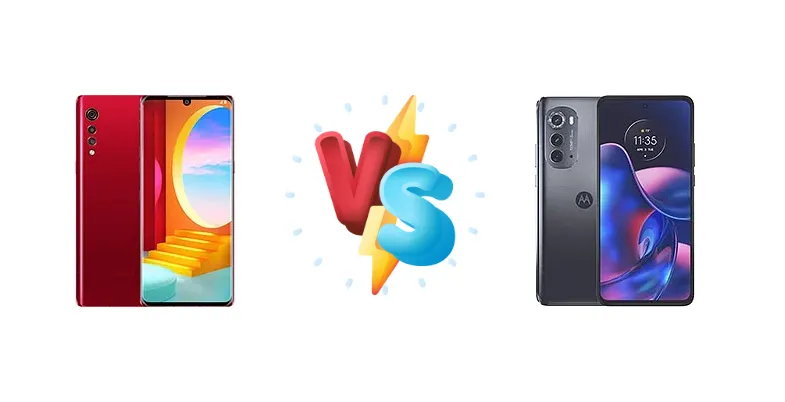
The LG Velvet 5G UW, despite its age, remains a compelling option due to its unique design and continued availability at discounted prices. The Motorola Edge (2022) represents a more recent attempt at a well-rounded mid-range experience. This comparison dissects their core components to determine which device delivers the best performance and value in today's market.
🏆 Quick Verdict
For most users, the Motorola Edge (2022) is the better buy. Its MediaTek Dimensity 1050 chipset offers a significant performance uplift over the LG Velvet’s Snapdragon 765G, translating to smoother multitasking and gaming. While the Velvet offers a more refined aesthetic, the Edge’s faster charging and newer architecture provide a more future-proof experience.
| Network |
|---|
| 2G bands | GSM 850 / 900 / 1800 / 1900 | GSM 850 / 900 / 1800 / 1900 |
| 3G bands | HSDPA 850 / 900 / 1700(AWS) / 1900 / 2100 | HSDPA 850 / 900 / 1700(AWS) / 1900 / 2100 |
| 4G bands | 2, 3, 4, 5, 7, 12, 13, 20, 28, 46, 48, 66 | 1, 2, 3, 4, 5, 7, 8, 12, 13, 14, 20, 29, 30, 40, 41, 48, 66 |
| 5G bands | 260, 261 mmWave | 2, 5, 30, 66 SA/NSA |
| Speed | HSPA 42.2/5.76 Mbps, LTE (5CA) Cat16 1000/75 Mbps, 5G 2Gbps | HSPA, LTE, 5G |
| Technology | GSM / CDMA / HSPA / LTE / 5G | GSM / HSPA / LTE / 5G |
| | CDMA 800 / 1900 | SA/NSA/Sub6/mmWave |
| Launch |
|---|
| Announced | 2020, August 19. Released 2020, August 21 | 2022, August 18 |
| Status | Discontinued | Available. Released 2022, September 22 |
| Body |
|---|
| Build | Glass front, glass back, aluminum frame | Glass front, plastic frame, plastic back |
| Dimensions | 167.2 x 74.1 x 7.9 mm (6.58 x 2.92 x 0.31 in) | 160.9 x 74.2 x 8 mm (6.33 x 2.92 x 0.31 in) |
| SIM | Nano-SIM (pre-installed) | Nano-SIM + eSIM |
| Weight | - | 170 g (6.00 oz) |
| | IP68 dust/water resistant (up to 1.5m for 30 mins)
MIL-STD-810G compliant*
*does not guarantee ruggedness or use in extreme conditions | Water-repellent design |
| Display |
|---|
| Resolution | 1080 x 2460 pixels (~395 ppi density) | 1080 x 2400 pixels, 20:9 ratio (~399 ppi density) |
| Size | 6.8 inches, 109.8 cm2 (~88.6% screen-to-body ratio) | 6.6 inches, 105.2 cm2 (~88.1% screen-to-body ratio) |
| Type | P-OLED | OLED, 1B colors, 144Hz, HDR10+ |
| Platform |
|---|
| CPU | Octa-core (1x2.4 GHz Kryo 475 Prime & 1x2.2 GHz Kryo 475 Gold & 6x1.8 GHz Kryo 475 Silver) | Octa-core (2x2.5 GHz Cortex-A78 & 6x2.0 GHz Cortex-A55) |
| Chipset | Qualcomm SM7250 Snapdragon 765G 5G (7 nm) | MediaTek Dimensity 1050 (6 nm) |
| GPU | Adreno 620 | Arm Mali-G610 MC3 |
| OS | Android 10, upgradable to Android 11, LG UX | Android 12, upgradable to Android 14 |
| Memory |
|---|
| Card slot | microSDXC (uses shared SIM slot) | No |
| Internal | 128GB 6GB RAM | 128GB 6GB RAM, 128GB 8GB RAM, 256GB 8GB RAM |
| | UFS 2.1 | - |
| Main Camera |
|---|
| Features | LED flash, panorama, HDR | LED flash, HDR, panorama |
| Triple | 48 MP, f/1.8, 26mm (wide), 1/2.0", 0.8µm, PDAF
8 MP, f/2.2, 120˚, 15mm (ultrawide), 1/4.0", 1.12µm
Auxiliary lens | 50 MP, f/1.8, (wide), 1/1.55", 1.0µm, multi-directional PDAF, OIS
13 MP, f/1.5, 120˚ (ultrawide), 1.12µm
Auxiliary lens |
| Video | 4K@30fps, 1080p@30/60fps, gyro-EIS | 4K@30fps, 1080p@30/60/120fps, gyro-EIS |
| Selfie camera |
|---|
| Features | HDR | HDR |
| Single | 16 MP, f/1.9, 29mm (standard), 1/3.06, 1.0µm | 32 MP, f/2.5, (wide), 0.7µm |
| Video | 1080p@30fps | 1080p@30fps |
| Sound |
|---|
| 3.5mm jack | Yes | No |
| 35mm jack | Yes | No |
| Loudspeaker | Yes, with stereo speakers | Yes, with stereo speakers |
| Comms |
|---|
| Bluetooth | 5.1, A2DP, LE, aptX HD | 5.2, A2DP, LE |
| NFC | Yes | Yes |
| Positioning | GPS (L1+L5), GLONASS, BDS, GALILEO, QZSS | GPS, GLONASS, BDS, GALILEO |
| Radio | No | No |
| USB | USB Type-C 2.0, OTG | USB Type-C 2.0, OTG |
| WLAN | Wi-Fi 802.11 a/b/g/n/ac, dual-band, Wi-Fi Direct, DLNA | Wi-Fi 802.11 a/b/g/n/ac/6e, tri-band, Wi-Fi Direct |
| Features |
|---|
| Sensors | Fingerprint (under display, optical), accelerometer, gyro, proximity, compass, barometer | Fingerprint (under display, optical), accelerometer, gyro, proximity, compass, barometer |
| Battery |
|---|
| Charging | 25W wired, PD3.0, QC4
9W wireless | 30W wired
15W wireless
5W reverse wired |
| Type | Li-Po 4300 mAh | Li-Po 5000 mAh |
| Misc |
|---|
| Colors | Aurora Red | Grey |
| Models | LM-G900V, LM-G900V | - |
| Price | About 590 EUR | $ 98.84 |
LG Velvet 5G UW
- Unique and aesthetically pleasing design
- Wireless charging support
- PD3.0 and QC4 fast charging compatibility
- Older Snapdragon 765G chipset
- Potentially slower performance
- Limited software update support
Motorola Edge (2022)
- More powerful MediaTek Dimensity 1050 chipset
- Faster 30W wired charging
- Reverse wired charging capability
- Less distinctive design
- Potentially less refined software experience
- May lack some of the LG Velvet's unique features
Display Comparison
Neither device boasts a cutting-edge display. The LG Velvet’s panel specs are unavailable, but its market positioning suggests a standard OLED. The Motorola Edge (2022) also utilizes an OLED panel, but details regarding peak brightness and color accuracy are missing. However, the Edge’s newer manufacturing process likely results in improved efficiency. Both phones likely feature a 60Hz refresh rate, a common compromise in this price bracket.
Camera Comparison
Detailed camera specs are limited. Both phones likely feature multi-camera systems, but the LG Velvet’s image processing is known for its vibrant, sometimes oversaturated, results. The Motorola Edge (2022) likely aims for a more natural look. Without sensor size information, it’s difficult to definitively declare a winner, but the newer image signal processor (ISP) within the Dimensity 1050 suggests improved noise reduction and dynamic range capabilities for the Motorola Edge.
Performance
The core difference lies in the chipsets. The Motorola Edge (2022) leverages the MediaTek Dimensity 1050, built on a 6nm process, offering a clear advantage in efficiency and raw power compared to the LG Velvet’s 7nm Snapdragon 765G. The Dimensity 1050’s octa-core configuration (2x2.5 GHz Cortex-A78 & 6x2.0 GHz Cortex-A55) provides a more robust CPU performance profile than the Snapdragon 765G’s (1x2.4 GHz Kryo 475 Prime & 1x2.2 GHz Kryo 475 Gold & 6x1.8 GHz Kryo 475 Silver). This translates to faster app loading times and smoother multitasking on the Motorola Edge. While both support 5G, the Dimensity 1050’s modem is likely more advanced.
Battery Life
Battery capacity is not specified for either device. However, the Motorola Edge (2022) gains an edge with its 30W wired charging, significantly faster than the LG Velvet’s 25W charging. The Edge also supports 15W wireless charging and 5W reverse wired charging, features absent on the Velvet. While a larger battery capacity on the Velvet could offset the slower charging, the Dimensity 1050’s superior efficiency likely results in comparable real-world battery life despite potentially having a smaller cell.
Buying Guide
Buy the LG Velvet 5G UW if you prioritize a unique, aesthetically pleasing design and are comfortable with a slightly older chipset. Its 25W charging and wireless charging capabilities are still respectable. Buy the Motorola Edge (2022) if you value raw performance, faster charging speeds (30W wired), and a more modern processor for demanding applications and future software updates.
Frequently Asked Questions
❓ Is the Dimensity 1050 in the Motorola Edge (2022) prone to overheating during extended gaming sessions?
The Dimensity 1050’s 6nm process and efficient core design generally result in good thermal management. While some throttling is inevitable during prolonged, demanding gaming, it’s unlikely to be a significant issue for the Motorola Edge (2022). The Snapdragon 765G in the LG Velvet, being an older and less efficient chip, is more likely to throttle under similar conditions.
❓ Does the LG Velvet 5G UW still receive software updates, and for how long?
LG has largely exited the smartphone market, meaning software update support for the Velvet 5G UW is limited and likely nearing its end. The Motorola Edge (2022), while not guaranteed years of updates, will likely receive at least one major Android version upgrade and security patches for a longer period.
❓ How does the charging speed of the Motorola Edge (2022) compare in real-world usage?
The Motorola Edge (2022)'s 30W charging can typically take a compatible battery from 0-100% in approximately 60-75 minutes, depending on battery capacity. The LG Velvet’s 25W charging will likely require closer to 90-100 minutes for a full charge. The Edge’s faster charging is particularly beneficial for quick top-ups throughout the day.