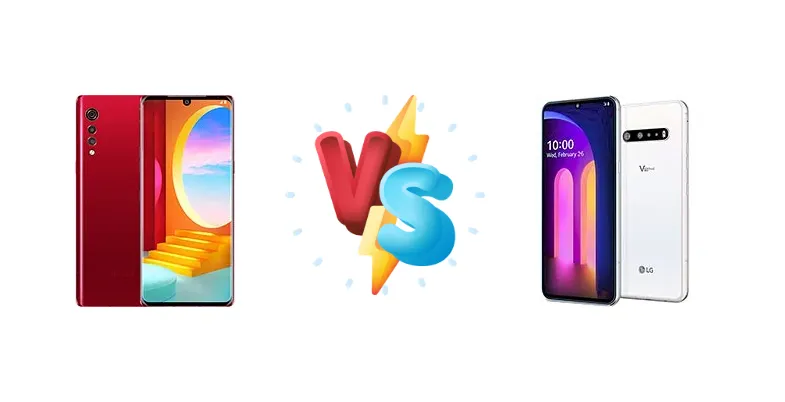
The LG Velvet 5G UW and V60 ThinQ 5G represent different approaches to the 5G smartphone experience. The V60, released as a 2020 flagship, aimed for top-tier performance, while the Velvet, launched later, prioritized a more refined design and a balance between features and price. This comparison dissects their core components to determine which LG phone best suits your needs in 2023 and beyond.
🏆 Quick Verdict
For the average user prioritizing value and a modern design, the LG Velvet 5G UW emerges as the better choice. While the V60 boasts a more powerful Snapdragon 865, the Velvet’s Snapdragon 765G provides sufficient performance for most tasks, coupled with a more contemporary aesthetic and potentially lower price point.
| Network |
|---|
| 2G bands | GSM 850 / 900 / 1800 / 1900 | GSM 850 / 900 / 1800 / 1900 |
| 3G bands | HSDPA 850 / 900 / 1700(AWS) / 1900 / 2100 | HSDPA 850 / 900 / 1700(AWS) / 1900 / 2100 |
| 4G bands | 2, 3, 4, 5, 7, 12, 13, 20, 28, 46, 48, 66 | 2, 4, 5, 12, 25, 26, 41, 46, 48, 66, 71 - USA |
| 5G bands | 260, 261 mmWave | 2, 25, 41, 66, 71 SA/NSA/Sub6 |
| Speed | HSPA 42.2/5.76 Mbps, LTE (5CA) Cat16 1000/75 Mbps, 5G 2Gbps | HSPA 42.2/5.76 Mbps, LTE (7CA) Cat22, 5G |
| Technology | GSM / CDMA / HSPA / LTE / 5G | GSM / CDMA / HSPA / EVDO / LTE / 5G |
| | CDMA 800 / 1900 | CDMA2000 1xEV-DO |
| Launch |
|---|
| Announced | 2020, August 19. Released 2020, August 21 | 2020, February 26. Released 2020, March 20 |
| Status | Discontinued | Discontinued |
| Body |
|---|
| Build | Glass front, glass back, aluminum frame | Glass front (Gorilla Glass 5), glass back (Gorilla Glass 6), aluminum frame |
| Dimensions | 167.2 x 74.1 x 7.9 mm (6.58 x 2.92 x 0.31 in) | 169.3 x 77.6 x 8.9 mm (6.67 x 3.06 x 0.35 in) |
| SIM | Nano-SIM (pre-installed) | · Nano-SIM· Nano-SIM + Nano-SIM |
| Weight | - | 213 g (Global)/ 218 g (Verizon) (7.51 oz) |
| | IP68 dust/water resistant (up to 1.5m for 30 mins)
MIL-STD-810G compliant*
*does not guarantee ruggedness or use in extreme conditions | IP68 dust/water resistant (up to 1.5m for 30 min)
MIL-STD-810G compliant*
Method 516.6, Procedure IV "Transit Drop"
*does not guarantee ruggedness or use in extreme conditions |
| Display |
|---|
| Protection | - | Corning Gorilla Glass 5 |
| Resolution | 1080 x 2460 pixels (~395 ppi density) | 1080 x 2460 pixels (~395 ppi density) |
| Size | 6.8 inches, 109.8 cm2 (~88.6% screen-to-body ratio) | 6.8 inches, 109.8 cm2 (~83.6% screen-to-body ratio) |
| Type | P-OLED | P-OLED, HDR10+ |
| | - | Always-on display |
| Platform |
|---|
| CPU | Octa-core (1x2.4 GHz Kryo 475 Prime & 1x2.2 GHz Kryo 475 Gold & 6x1.8 GHz Kryo 475 Silver) | Octa-core (1x2.84 GHz Cortex-A77 & 3x2.42 GHz Cortex-A77 & 4x1.80 GHz Cortex-A55) |
| Chipset | Qualcomm SM7250 Snapdragon 765G 5G (7 nm) | Qualcomm SM8250 Snapdragon 865 5G (7 nm+) |
| GPU | Adreno 620 | Adreno 650 |
| OS | Android 10, upgradable to Android 11, LG UX | Android 10, upgradable to Android 13 |
| Memory |
|---|
| Card slot | microSDXC (uses shared SIM slot) | microSDXC (uses shared SIM slot) - dual-SIM model |
| Internal | 128GB 6GB RAM | 128GB 8GB RAM, 256GB 8GB RAM |
| | UFS 2.1 | UFS 2.1 |
| Main Camera |
|---|
| Dual | - | 64 MP, f/1.8, 27mm (standard), 1/1.72", 0.8µm, dual pixel PDAF, OIS
13 MP, f/1.9, 12mm (ultrawide), 1/3.4", 1.0µm
0.3 MP, TOF 3D, f/1.4, (depth) |
| Features | LED flash, panorama, HDR | Dual-LED dual-tone flash, HDR, panorama |
| Triple | 48 MP, f/1.8, 26mm (wide), 1/2.0", 0.8µm, PDAF
8 MP, f/2.2, 120˚, 15mm (ultrawide), 1/4.0", 1.12µm
Auxiliary lens | - |
| Video | 4K@30fps, 1080p@30/60fps, gyro-EIS | 8K@30fps, 4K@30/60fps, 1080p, HDR10+, 24-bit/192kHz stereo sound rec., gyro-EIS |
| Selfie camera |
|---|
| Features | HDR | HDR |
| Single | 16 MP, f/1.9, 29mm (standard), 1/3.06, 1.0µm | 10 MP, f/1.9, 30mm (standard), 1/3.1", 1.22µm |
| Video | 1080p@30fps | 4K@30fps, gyro-EIS |
| Sound |
|---|
| 3.5mm jack | Yes | Yes |
| 35mm jack | Yes | Yes |
| Loudspeaker | Yes, with stereo speakers | Yes, with stereo speakers |
| | - | 32-bit/192kHz audio
24-bit/192kHz audio recording |
| Comms |
|---|
| Bluetooth | 5.1, A2DP, LE, aptX HD | 5.1, A2DP, LE, aptX HD |
| NFC | Yes | Yes |
| Positioning | GPS (L1+L5), GLONASS, BDS, GALILEO, QZSS | GPS, GLONASS, GALILEO, BDS |
| Radio | No | FM radio (USA model only) |
| USB | USB Type-C 2.0, OTG | USB Type-C 3.1, OTG |
| WLAN | Wi-Fi 802.11 a/b/g/n/ac, dual-band, Wi-Fi Direct, DLNA | Wi-Fi 802.11 a/b/g/n/ac/6, dual-band, Wi-Fi Direct, DLNA |
| Features |
|---|
| Sensors | Fingerprint (under display, optical), accelerometer, gyro, proximity, compass, barometer | Fingerprint (under display, optical), accelerometer, gyro, proximity, compass, barometer |
| Battery |
|---|
| Charging | 25W wired, PD3.0, QC4
9W wireless | Wired, PD2.0, QC4
Wireless |
| Type | Li-Po 4300 mAh | Li-Po 5000 mAh |
| Misc |
|---|
| Colors | Aurora Red | Classy Blue, Classy White |
| Models | LM-G900V, LM-G900V | LM-V600, A001LG |
| Price | About 590 EUR | About 700 EUR |
| Tests |
|---|
| Battery life | - |
Endurance rating 103h
|
LG Velvet 5G UW
- More modern design and aesthetics
- Faster charging with PD3.0 and QC4
- Wireless charging support
- Less powerful processor than the V60
- Potentially lower camera performance in challenging conditions
LG V60 ThinQ 5G
- Significantly more powerful Snapdragon 865 processor
- Likely superior camera hardware (larger sensor, OIS)
- Stronger GPU performance for gaming
- Older design with potentially larger bezels
- Potentially higher price point
- May experience more thermal throttling under sustained load
Display Comparison
While specific display specs aren't provided, the LG Velvet’s design language suggests a focus on a more immersive experience with minimal bezels. The V60, being an earlier model, likely has more pronounced bezels. Both phones likely utilize OLED panels, common for LG flagships, but the Velvet may benefit from advancements in color calibration and brightness achieved since the V60’s release. The absence of refresh rate data makes a direct comparison impossible, but the Velvet’s later release date increases the likelihood of a smoother display experience.
Camera Comparison
Without detailed camera specifications, a precise comparison is difficult. However, the V60, as a flagship, likely features a larger primary sensor and more sophisticated image processing algorithms. The Velvet’s camera system likely prioritizes computational photography and AI enhancements. The absence of information regarding OIS (Optical Image Stabilization) is notable; its presence on the V60 would be a significant advantage for low-light photography and video recording. The inclusion of a 2MP macro lens on either device is likely a marketing feature with limited real-world utility.
Performance
The core difference lies in the chipsets: the LG V60 ThinQ 5G’s Snapdragon 865 (7nm+) significantly outperforms the Velvet 5G UW’s Snapdragon 765G (7nm). The 865 features a Cortex-A77 prime core clocked at 2.84 GHz, compared to the Velvet’s Kryo 475 Prime at 2.4 GHz. This translates to faster app loading, smoother multitasking, and superior gaming performance on the V60. However, the 765G is still a capable performer, and the Velvet’s more efficient chipset may result in better sustained performance under load due to reduced thermal throttling. The V60’s Adreno 650 GPU also provides a substantial graphical advantage.
Battery Life
Both the LG Velvet 5G UW and V60 ThinQ 5G share an endurance rating of 103 hours, suggesting similar real-world battery life despite potential differences in battery capacity. The V60 supports both PD2.0 and QC4 charging, while the Velvet upgrades to PD3.0 and QC4, potentially offering slightly faster charging speeds with compatible chargers. The Velvet’s 25W wired charging is a step up from the V60’s unspecified wired charging, and the addition of 9W wireless charging provides added convenience.
Buying Guide
Buy the LG Velvet 5G UW if you need a stylish, modern smartphone with reliable 5G connectivity and don’t require the absolute highest processing power for demanding games or applications. Buy the LG V60 ThinQ 5G if you prioritize raw performance, especially for gaming or video editing, and are willing to accept a larger, more dated design, and potentially a higher price.
Frequently Asked Questions
❓ Does the Snapdragon 765G in the Velvet 5G UW struggle with demanding games like Genshin Impact?
While the Snapdragon 765G isn't as powerful as the 865, it can handle Genshin Impact at medium settings with reasonable frame rates. Expect some frame drops during intense combat scenarios. The V60 would provide a smoother experience at higher settings.
❓ Is the LG V60 ThinQ 5G still receiving software updates in 2023?
LG has exited the smartphone market, so official software updates for the V60 are unlikely. However, the Android community may provide custom ROMs to extend its lifespan and security.
❓ How does the 5G performance differ between the Velvet 5G UW and the V60 ThinQ 5G?
Both phones support 5G, but the Velvet 5G UW is specifically tuned for Verizon’s Ultra Wideband (UW) network. This means it may achieve faster 5G speeds on Verizon’s network compared to the V60, but performance on other carriers will be similar.
❓ Which phone is better for video recording, especially in low light?
The LG V60 ThinQ 5G likely has an advantage in video recording, particularly in low light, due to its potentially larger sensor and the inclusion of OIS. This will result in more stable and brighter footage.