
LG Velvet 5G UW vs. LG V50 ThinQ 5G: A Detailed Showdown
| Phones Images | |||||
|---|---|---|---|---|---|
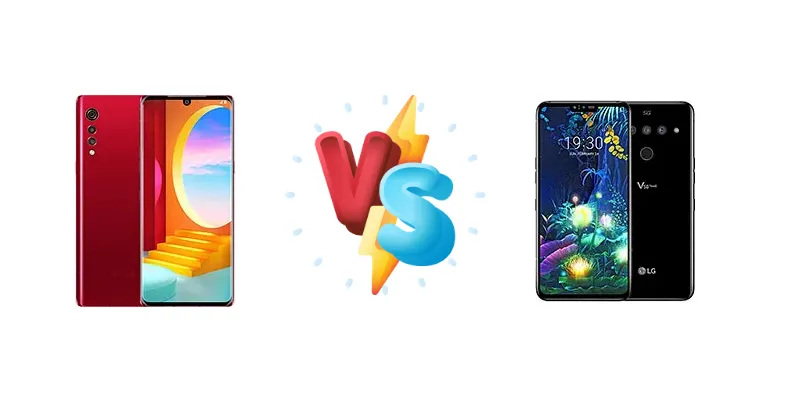
|
🏆 Quick Verdict
The LG V50 ThinQ 5G generally edges out the Velvet 5G UW thanks to its superior Snapdragon 855 chipset, brighter display, and faster charging. However, the Velvet might appeal to those seeking a more modern design and potentially a slightly lower price point, assuming availability.
| PHONES | ||
|---|---|---|
| Phone Names | LG Velvet 5G UW | LG V50 ThinQ 5G |
| Network | ||
|---|---|---|
| 2G bands | GSM 850 / 900 / 1800 / 1900 | GSM 850 / 900 / 1800 / 1900 |
| 3G bands | HSDPA 850 / 900 / 1700(AWS) / 1900 / 2100 | HSDPA 850 / 900 / 1700(AWS) / 1900 / 2100 - USA |
| 4G bands | 2, 3, 4, 5, 7, 12, 13, 20, 28, 46, 48, 66 | 1, 2, 3, 4, 5, 7, 8, 12, 13, 17, 20, 25, 26, 28, 40, 41, 46, 66, 71 - USA |
| 5G bands | 260, 261 mmWave | 41, 260, 261 NSA |
| Speed | HSPA 42.2/5.76 Mbps, LTE (5CA) Cat16 1000/75 Mbps, 5G 2Gbps | HSPA 42.2/5.76 Mbps, LTE (6CA) Cat18 1200/75 Mbps, 5G (2+ Gbps DL) |
| Technology | GSM / CDMA / HSPA / LTE / 5G | GSM / CDMA / HSPA / EVDO / LTE / 5G |
| CDMA 800 / 1900 | CDMA2000 1xEV-DO | |
| Launch | ||
|---|---|---|
| Announced | 2020, August 19. Released 2020, August 21 | 2019, February 24. Released 2019, April 19 |
| Status | Discontinued | Discontinued |
| Body | ||
|---|---|---|
| Build | Glass front, glass back, aluminum frame | Glass front (Gorilla Glass 5), glass back (Gorilla Glass 6), aluminum frame |
| Dimensions | 167.2 x 74.1 x 7.9 mm (6.58 x 2.92 x 0.31 in) | 159.2 x 76.1 x 8.3 mm (6.27 x 3.00 x 0.33 in) |
| SIM | Nano-SIM (pre-installed) | · Nano-SIM· Nano-SIM + Nano-SIM |
| Weight | - | 183 g (6.46 oz) |
| IP68 dust/water resistant (up to 1.5m for 30 mins) MIL-STD-810G compliant* *does not guarantee ruggedness or use in extreme conditions | IP68 dust/water resistant (up to 1.5m for 30 min) MIL-STD-810G compliant* *does not guarantee ruggedness or use in extreme conditions | |
| Display | ||
|---|---|---|
| Protection | - | Corning Gorilla Glass 5 |
| Resolution | 1080 x 2460 pixels (~395 ppi density) | 1440 x 3120 pixels, 19.5:9 ratio (~538 ppi density) |
| Size | 6.8 inches, 109.8 cm2 (~88.6% screen-to-body ratio) | 6.4 inches, 100.2 cm2 (~82.7% screen-to-body ratio) |
| Type | P-OLED | P-OLED, HDR10 |
| - | Always-on display | |
| Platform | ||
|---|---|---|
| CPU | Octa-core (1x2.4 GHz Kryo 475 Prime & 1x2.2 GHz Kryo 475 Gold & 6x1.8 GHz Kryo 475 Silver) | Octa-core (1x2.84 GHz Kryo 485 & 3x2.42 GHz Kryo 485 & 4x1.78 GHz Kryo 485) |
| Chipset | Qualcomm SM7250 Snapdragon 765G 5G (7 nm) | Qualcomm SM8150 Snapdragon 855 (7 nm) |
| GPU | Adreno 620 | Adreno 640 |
| OS | Android 10, upgradable to Android 11, LG UX | Android 9.0 (Pie), upgradable to Android 11 |
| Memory | ||
|---|---|---|
| Card slot | microSDXC (uses shared SIM slot) | microSDXC (dedicated slot) |
| Internal | 128GB 6GB RAM | 128GB 6GB RAM |
| UFS 2.1 | UFS 2.1 | |
| Main Camera | ||
|---|---|---|
| Features | LED flash, panorama, HDR | LED flash, HDR, panorama |
| Triple | 48 MP, f/1.8, 26mm (wide), 1/2.0", 0.8µm, PDAF 8 MP, f/2.2, 120˚, 15mm (ultrawide), 1/4.0", 1.12µm Auxiliary lens | 12 MP, 27mm (wide), f/1.5, 1/2.55", 1.4µm, dual pixel PDAF, 3-axis OIS 12 MP, 52mm (telephoto), f/2.4, 1/3.4", 1.0µm, 2x optical zoom, PDAF, OIS 16 MP, 16mm (ultrawide), f/1.9, 1/3.1", 1.0µm, no AF |
| Video | 4K@30fps, 1080p@30/60fps, gyro-EIS | 4K@30/60fps, 1080p@30/60/240fps, 24-bit/192kHz stereo sound rec., HDR10 video, gyro-EIS |
| Selfie camera | ||
|---|---|---|
| Dual | - | 8 MP, f/1.9, 26mm (wide), 1/4.0", 1.12µm 5 MP, 21mm (wide), f/2.2, 1/5.0", 1.12µm |
| Features | HDR | HDR |
| Single | 16 MP, f/1.9, 29mm (standard), 1/3.06, 1.0µm | - |
| Video | 1080p@30fps | 1080p@60fps |
| Sound | ||
|---|---|---|
| 3.5mm jack | Yes | Yes |
| 35mm jack | Yes | Yes |
| Loudspeaker | Yes, with stereo speakers | Yes, with stereo speakers |
| - | 32-bit/192kHz audio 24-bit/192kHz audio recording Tuned with Meridian Audio | |
| Comms | ||
|---|---|---|
| Bluetooth | 5.1, A2DP, LE, aptX HD | 5.0, A2DP, LE, aptX HD |
| NFC | Yes | Yes |
| Positioning | GPS (L1+L5), GLONASS, BDS, GALILEO, QZSS | GPS, GLONASS, GALILEO |
| Radio | No | FM radio |
| USB | USB Type-C 2.0, OTG | USB Type-C 3.1 |
| WLAN | Wi-Fi 802.11 a/b/g/n/ac, dual-band, Wi-Fi Direct, DLNA | Wi-Fi 802.11 a/b/g/n/ac, dual-band, Wi-Fi Direct, DLNA |
| Features | ||
|---|---|---|
| Sensors | Fingerprint (under display, optical), accelerometer, gyro, proximity, compass, barometer | Fingerprint (rear-mounted), accelerometer, gyro, proximity, compass, barometer |
| Battery | ||
|---|---|---|
| Charging | 25W wired, PD3.0, QC4 9W wireless | 18W wired, PD2.0, QC3, 50% in 36 min 10W wireless (Qi) |
| Type | Li-Po 4300 mAh | Li-Po 4000 mAh, non-removable |
| Misc | ||
|---|---|---|
| Colors | Aurora Red | New Aurora Black |
| Models | LM-G900V, LM-G900V | LM-V500, LM-V500N, LM-V500EM, LM-V500XM, LM-V450PM, LM-V450 |
| Price | About 590 EUR | About 550 EUR |
| Tests | ||
|---|---|---|
| Audio quality | - | Noise -92.5dB / Crosstalk -92.6dB |
| Battery life | - | Endurance rating 96h |
| Camera | - | Photo / Video |
| Display | - | Contrast ratio: 194000:1 (nominal) |
| Loudspeaker | - | -25.2 LUFS (Very good) |
| Performance | - | AnTuTu: 343758 (v7), 421934 (v8) GeekBench: 10928 (v4.4), 2672 (v5.1) GFXBench: 22fps (ES 3.1 onscreen) |
LG Velvet 5G UW
- Modern design
- 5G connectivity
- Potentially lower price (depending on availability)
- PD3.0 fast charging
- Less powerful chipset
- Likely dimmer display
- Camera not as impressive as V50
- Wireless charging slower
LG V50 ThinQ 5G
- Superior performance (Snapdragon 855)
- Brighter and higher contrast display
- Excellent camera quality
- Exceptional battery life
- Faster wired charging
- Older design
- May be harder to find in good condition
- Wireless charging slower
Display Comparison
The LG V50 ThinQ 5G boasts a significantly brighter display (533 nits vs. Velvet's likely lower brightness, estimated around 400-450 nits) and an incredibly high contrast ratio (194000:1), resulting in a more vivid and immersive viewing experience. While both feature OLED panels, the V50's display is noticeably superior. The Velvet likely has a slightly more modern aspect ratio, but the V50's quality is hard to beat.
Camera Comparison
Both phones offer capable camera systems, but the V50 ThinQ 5G likely holds an advantage due to its more advanced image processing capabilities associated with the Snapdragon 855. While specific camera specs aren't detailed, the V50's reputation for excellent photo and video quality suggests it's the better choice for photography enthusiasts. The Velvet's camera is still good, but not exceptional.
Performance
Here, the LG V50 ThinQ 5G takes a commanding lead. Its Snapdragon 855 chipset is considerably more powerful than the Snapdragon 765G in the Velvet. Expect smoother multitasking, faster app loading times, and better performance in demanding games on the V50. The Velvet is still capable, but the V50 offers a premium experience.
Battery Life
The LG V50 ThinQ 5G is advertised with an impressive endurance rating of 96 hours, suggesting exceptional battery life. While the Velvet's battery capacity is likely similar (around 4000mAh), the V50's more efficient chipset contributes to its longer runtime. The V50 also charges faster with PD2.0 and QC3 support, while the Velvet uses PD3.0 and QC4.
Buying Guide
The LG Velvet 5G UW is best suited for users prioritizing a sleek design and 5G connectivity on a budget. The LG V50 ThinQ 5G is ideal for power users who demand top-tier performance, a vibrant display, and a robust camera system, especially if they can find one in good condition.