
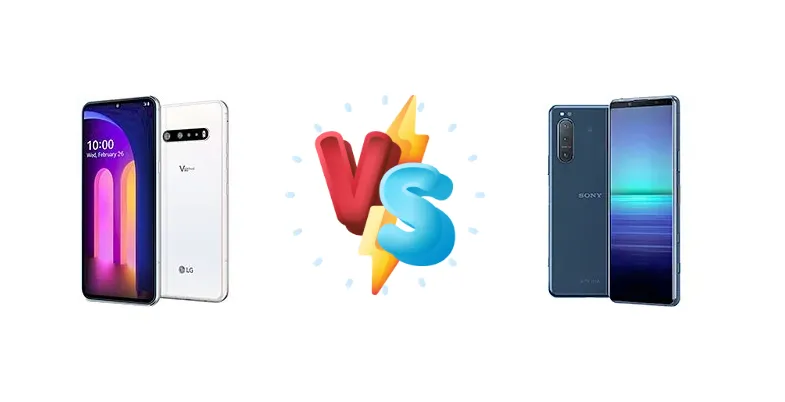
LG V60 ThinQ 5G vs. Sony Xperia 5 II: A Detailed Comparison for Power Users
| Phones Images | |||||
|---|---|---|---|---|---|
|
🏆 Quick Verdict
For the average user prioritizing longevity and value, the LG V60 ThinQ 5G emerges as the winner. Its comparable battery life, coupled with a lower price point, makes it a compelling choice. However, users valuing a more compact design and potentially faster charging will find the Sony Xperia 5 II appealing.
| PHONES | ||
|---|---|---|
| Phone Names | LG V60 ThinQ 5G | Sony Xperia 5 II |
| Network | ||
|---|---|---|
| 2G bands | GSM 850 / 900 / 1800 / 1900 | GSM 850 / 900 / 1800 / 1900 |
| 3G bands | HSDPA 850 / 900 / 1700(AWS) / 1900 / 2100 | HSDPA 800 / 850 / 900 / 1700(AWS) / 1900 / 2100 |
| 4G bands | 2, 4, 5, 12, 25, 26, 41, 46, 48, 66, 71 - USA | 1, 2, 3, 4, 5, 7, 8, 12, 13, 17, 19, 20, 25, 26, 28, 29, 32, 34, 38, 39, 40, 41, 46, 48, 66 |
| 5G bands | 2, 25, 41, 66, 71 SA/NSA/Sub6 | 1, 3, 8, 28, 77, 78 SA/NSA |
| Speed | HSPA 42.2/5.76 Mbps, LTE (7CA) Cat22, 5G | HSPA 42.2/5.76 Mbps, LTE Cat18 1200/150 Mbps, 5G |
| Technology | GSM / CDMA / HSPA / EVDO / LTE / 5G | GSM / HSPA / LTE / 5G |
| CDMA2000 1xEV-DO | - | |
| Launch | ||
|---|---|---|
| Announced | 2020, February 26. Released 2020, March 20 | 2020, September 17 |
| Status | Discontinued | Available. Released 2020, October 12 |
| Body | ||
|---|---|---|
| Build | Glass front (Gorilla Glass 5), glass back (Gorilla Glass 6), aluminum frame | Glass front (Gorilla Glass 6), glass back (Gorilla Glass 6), aluminum frame |
| Dimensions | 169.3 x 77.6 x 8.9 mm (6.67 x 3.06 x 0.35 in) | 158 x 68 x 8 mm (6.22 x 2.68 x 0.31 in) |
| SIM | · Nano-SIM· Nano-SIM + Nano-SIM | · Nano-SIM· Nano-SIM + Nano-SIM |
| Weight | 213 g (Global)/ 218 g (Verizon) (7.51 oz) | 163 g (5.75 oz) |
| IP68 dust/water resistant (up to 1.5m for 30 min) MIL-STD-810G compliant* Method 516.6, Procedure IV "Transit Drop" *does not guarantee ruggedness or use in extreme conditions | IP65/IP68 dust/water resistant (up to 1.5m for 30 mins) | |
| Display | ||
|---|---|---|
| Protection | Corning Gorilla Glass 5 | Corning Gorilla Glass 6 |
| Resolution | 1080 x 2460 pixels (~395 ppi density) | 1080 x 2520 pixels, 21:9 ratio (~449 ppi density) |
| Size | 6.8 inches, 109.8 cm2 (~83.6% screen-to-body ratio) | 6.1 inches, 86.9 cm2 (~80.9% screen-to-body ratio) |
| Type | P-OLED, HDR10+ | OLED, 120Hz, HDR BT.2020 |
| Always-on display | Triluminos display X-Reality Engine | |
| Platform | ||
|---|---|---|
| CPU | Octa-core (1x2.84 GHz Cortex-A77 & 3x2.42 GHz Cortex-A77 & 4x1.80 GHz Cortex-A55) | Octa-core (1x2.84 GHz Cortex-A77 & 3x2.42 GHz Cortex-A77 & 4x1.80 GHz Cortex-A55) |
| Chipset | Qualcomm SM8250 Snapdragon 865 5G (7 nm+) | Qualcomm SM8250 Snapdragon 865 5G (7 nm+) |
| GPU | Adreno 650 | Adreno 650 |
| OS | Android 10, upgradable to Android 13 | Android 10, upgradable to Android 12 |
| Memory | ||
|---|---|---|
| Card slot | microSDXC (uses shared SIM slot) - dual-SIM model | microSDXC (uses shared SIM slot) |
| Internal | 128GB 8GB RAM, 256GB 8GB RAM | 128GB 8GB RAM, 256GB 8GB RAM |
| UFS 2.1 | UFS 3.0 | |
| Main Camera | ||
|---|---|---|
| Dual | 64 MP, f/1.8, 27mm (standard), 1/1.72", 0.8µm, dual pixel PDAF, OIS 13 MP, f/1.9, 12mm (ultrawide), 1/3.4", 1.0µm 0.3 MP, TOF 3D, f/1.4, (depth) | - |
| Features | Dual-LED dual-tone flash, HDR, panorama | Zeiss optics, color spectrum sensor, LED flash, panorama, HDR, eye tracking |
| Triple | - | 12 MP, f/1.7, 24mm (wide), 1/1.7", 1.8µm, dual pixel PDAF, OIS 12 MP, f/2.4, 70mm (telephoto), 1/3.4", 1.0µm, PDAF, 3x optical zoom, OIS 12 MP, f/2.2, 124˚, 16mm (ultrawide), 1/2.55", dual pixel PDAF |
| Video | 8K@30fps, 4K@30/60fps, 1080p, HDR10+, 24-bit/192kHz stereo sound rec., gyro-EIS | 4K@24/30/60/120fps HDR, 1080p, 5-axis gyro-EIS, OIS |
| Selfie camera | ||
|---|---|---|
| Features | HDR | HDR |
| Single | 10 MP, f/1.9, 30mm (standard), 1/3.1", 1.22µm | 8 MP, f/2.0, 24mm (wide), 1/4.0", 1.12µm |
| Video | 4K@30fps, gyro-EIS | 1080p@30fps, 5-axis gyro-EIS |
| Sound | ||
|---|---|---|
| 3.5mm jack | Yes | Yes |
| 35mm jack | Yes | Yes |
| Loudspeaker | Yes, with stereo speakers | Yes, with stereo speakers |
| 32-bit/192kHz audio 24-bit/192kHz audio recording | 24-bit/192kHz audio Dynamic vibration system | |
| Comms | ||
|---|---|---|
| Bluetooth | 5.1, A2DP, LE, aptX HD | 5.1, A2DP, aptX HD, LE |
| NFC | Yes | Yes |
| Positioning | GPS, GLONASS, GALILEO, BDS | GPS, GLONASS, BDS, GALILEO, QZSS |
| Radio | FM radio (USA model only) | No |
| USB | USB Type-C 3.1, OTG | USB Type-C 3.1, OTG |
| WLAN | Wi-Fi 802.11 a/b/g/n/ac/6, dual-band, Wi-Fi Direct, DLNA | Wi-Fi 802.11 a/b/g/n/ac/6, dual-band, Wi-Fi Direct, DLNA |
| Features | ||
|---|---|---|
| Sensors | Fingerprint (under display, optical), accelerometer, gyro, proximity, compass, barometer | Fingerprint (side-mounted), accelerometer, gyro, proximity, barometer, compass |
| Battery | ||
|---|---|---|
| Charging | Wired, PD2.0, QC4 Wireless | 21W wired, PD3.0, 50% in 30 min |
| Type | Li-Po 5000 mAh | Li-Ion 4000 mAh |
| Misc | ||
|---|---|---|
| Colors | Classy Blue, Classy White | Black, Grey, Blue, Pink |
| Models | LM-V600, A001LG | SO-52A, XQ-AS52, XQ-AS62, XQ-AS72, A002SO, SOG02 |
| Price | About 700 EUR | About 650 EUR |
| Pricing | ||
|---|---|---|
| 128GB 8GB RAM | - | $ 695.00 |
| RENEWED | - | £ 239.00 |
| Tests | ||
|---|---|---|
| Battery life | Endurance rating 103h | Endurance rating 102h |
| Camera | - | Photo / Video |
| Display | - | Contrast ratio: Infinite (nominal) |
| Loudspeaker | - | -28.3 LUFS (Average) |
| Performance | - | AnTuTu: 532655 (v8) GeekBench: 3301 (v5.1) GFXBench: 41fps (ES 3.1 onscreen) |
LG V60 ThinQ 5G
- Slightly better battery endurance (103h rating)
- Potentially lower price point due to age
- Likely larger display size for media consumption
- Charging speed details are unavailable
- Larger form factor may not suit all users
Sony Xperia 5 II
- Brighter display (600 nits) for outdoor visibility
- Faster charging (21W, 50% in 30 min)
- More compact and pocketable design
- Slightly lower battery endurance (102h rating)
- Higher initial price ($695 for 128GB/8GB)
Display Comparison
Both devices utilize the Qualcomm Snapdragon 865 chipset, but diverge significantly in their display implementations. The Sony Xperia 5 II boasts a measured peak brightness of 600 nits, offering superior visibility in direct sunlight compared to the LG V60, for which brightness data is unavailable. While the V60’s display size isn’t specified, the Xperia 5 II’s compact 6.1-inch form factor caters to users who prefer one-handed operation. Both displays feature an infinite (nominal) contrast ratio, typical of OLED panels, but the Xperia 5 II’s higher brightness provides a more vibrant and punchy image in bright environments.
Camera Comparison
Both devices are described as having 'Photo / Video' capabilities, lacking specific details. Without sensor size, aperture, or image processing details, a direct comparison is limited. However, Sony’s brand reputation in camera technology suggests a focus on color accuracy and dynamic range, potentially offering a more refined photographic experience. The LG V60’s camera system likely prioritizes versatility, but without specifics, it’s difficult to assess its strengths. The absence of detail regarding OIS or advanced features makes it impossible to determine a clear winner.
Performance
Both the LG V60 ThinQ 5G and the Sony Xperia 5 II are powered by the Qualcomm SM8250 Snapdragon 865 5G (7 nm+). Critically, they share the same CPU configuration: an octa-core setup with 1x2.84 GHz Cortex-A77, 3x2.42 GHz Cortex-A77, and 4x1.80 GHz Cortex-A55 cores. This means raw processing power will be nearly identical for most tasks. However, thermal management, which isn’t detailed in the provided data, could differentiate real-world sustained performance. The Xperia 5 II’s smaller size *may* offer a slight advantage in heat dissipation, but this is speculative without further testing. Both devices support 5G connectivity, leveraging the Snapdragon 865’s integrated modem.
Battery Life
The LG V60 ThinQ 5G boasts an endurance rating of 103 hours, marginally exceeding the Sony Xperia 5 II’s 102-hour rating. While the difference is minimal, the V60’s larger battery capacity (unspecified) likely contributes to this slight advantage. The Xperia 5 II supports 21W wired charging with PD3.0, claiming a 50% charge in 30 minutes. The LG V60 supports both PD2.0 and QC4, but charging speed specifics are missing. For users prioritizing quick top-ups, the Xperia 5 II’s 21W charging offers a tangible benefit, while the V60 may require a longer charging duration.
Buying Guide
Buy the LG V60 ThinQ 5G if you need maximum battery life and a larger screen for media consumption, and are comfortable with a larger device. It’s ideal for users who prioritize value and don’t mind a slightly older model. Buy the Sony Xperia 5 II if you prefer a more pocketable flagship experience, appreciate a brighter display for outdoor visibility, and value faster charging capabilities, even if it means a slightly higher price.