
LG V60 ThinQ 5G vs. Sony Xperia 1 III: A Deep Dive into Battery, Performance, and Camera
| Phones Images | |||||
|---|---|---|---|---|---|
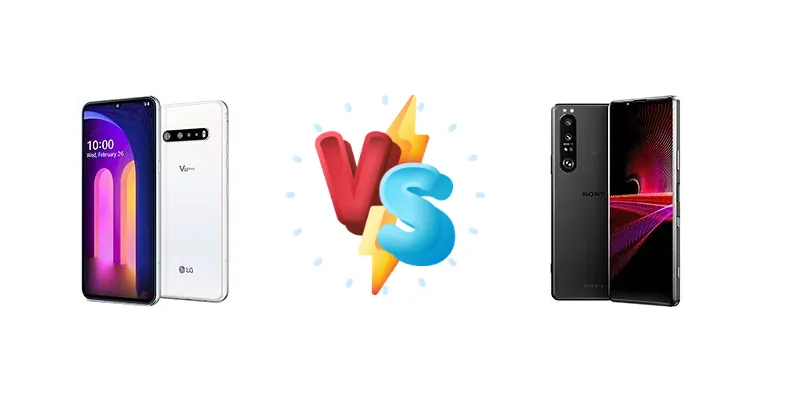
|
🏆 Quick Verdict
For the average user prioritizing longevity, the LG V60 ThinQ 5G is the clear winner, offering a remarkable 103-hour endurance rating. However, content creators and those demanding the latest performance will find the Sony Xperia 1 III’s Snapdragon 888 and advanced camera features worth the premium.
| PHONES | ||
|---|---|---|
| Phone Names | LG V60 ThinQ 5G | Sony Xperia 1 III |
| Network | ||
|---|---|---|
| 2G bands | GSM 850 / 900 / 1800 / 1900 | GSM 850 / 900 / 1800 / 1900 |
| 3G bands | HSDPA 850 / 900 / 1700(AWS) / 1900 / 2100 | HSDPA 800 / 850 / 900 / 1700(AWS) / 1900 / 2100 |
| 4G bands | 2, 4, 5, 12, 25, 26, 41, 46, 48, 66, 71 - USA | 1, 2, 3, 4, 5, 7, 8, 12, 13, 17, 19, 20, 25, 26, 28, 29, 32, 34, 38, 39, 40, 41, 46, 66 - Europe |
| 5G bands | 2, 25, 41, 66, 71 SA/NSA/Sub6 | 1, 3, 5, 7, 8, 20, 28, 38, 40, 41, 77, 78 SA/NSA/Sub6 - Europe |
| Speed | HSPA 42.2/5.76 Mbps, LTE (7CA) Cat22, 5G | HSPA, LTE, 5G |
| Technology | GSM / CDMA / HSPA / EVDO / LTE / 5G | GSM / HSPA / LTE / 5G |
| CDMA2000 1xEV-DO | SA/NSA/Sub6/mmWave - USA (specific) | |
| Launch | ||
|---|---|---|
| Announced | 2020, February 26. Released 2020, March 20 | 2021, April 14 |
| Status | Discontinued | Available. Released 2021, August 25 |
| Body | ||
|---|---|---|
| Build | Glass front (Gorilla Glass 5), glass back (Gorilla Glass 6), aluminum frame | Glass front (Gorilla Glass Victus), glass back (Gorilla Glass 6), aluminum frame |
| Dimensions | 169.3 x 77.6 x 8.9 mm (6.67 x 3.06 x 0.35 in) | 165 x 71 x 8.2 mm (6.50 x 2.80 x 0.32 in) |
| SIM | · Nano-SIM· Nano-SIM + Nano-SIM | Nano-SIM + Nano-SIM |
| Weight | 213 g (Global)/ 218 g (Verizon) (7.51 oz) | 186 g / 187.1 g (mmWave) (6.56 oz) |
| IP68 dust/water resistant (up to 1.5m for 30 min) MIL-STD-810G compliant* Method 516.6, Procedure IV "Transit Drop" *does not guarantee ruggedness or use in extreme conditions | IP65/IP68 dust/water resistant (up to 1.5m for 30 min) | |
| Display | ||
|---|---|---|
| Protection | Corning Gorilla Glass 5 | Corning Gorilla Glass Victus |
| Resolution | 1080 x 2460 pixels (~395 ppi density) | 1644 x 3840 pixels, 21:9 ratio (~643 ppi density) |
| Size | 6.8 inches, 109.8 cm2 (~83.6% screen-to-body ratio) | 6.5 inches, 98.6 cm2 (~84.2% screen-to-body ratio) |
| Type | P-OLED, HDR10+ | OLED, 1B colors, 120Hz, HDR BT.2020 |
| Always-on display | Runs at 1096 x 2560 pixels except for select use cases | |
| Platform | ||
|---|---|---|
| CPU | Octa-core (1x2.84 GHz Cortex-A77 & 3x2.42 GHz Cortex-A77 & 4x1.80 GHz Cortex-A55) | Octa-core (1x2.84 GHz Cortex-X1 & 3x2.42 GHz Cortex-A78 & 4x1.80 GHz Cortex-A55) |
| Chipset | Qualcomm SM8250 Snapdragon 865 5G (7 nm+) | Qualcomm SM8350 Snapdragon 888 5G (5 nm) |
| GPU | Adreno 650 | Adreno 660 |
| OS | Android 10, upgradable to Android 13 | Android 11, upgradable to Android 13 |
| Memory | ||
|---|---|---|
| Card slot | microSDXC (uses shared SIM slot) - dual-SIM model | microSDXC (uses shared SIM slot) |
| Internal | 128GB 8GB RAM, 256GB 8GB RAM | 256GB 12GB RAM, 512GB 12GB RAM |
| UFS 2.1 | UFS 3.X | |
| Main Camera | ||
|---|---|---|
| Dual | 64 MP, f/1.8, 27mm (standard), 1/1.72", 0.8µm, dual pixel PDAF, OIS 13 MP, f/1.9, 12mm (ultrawide), 1/3.4", 1.0µm 0.3 MP, TOF 3D, f/1.4, (depth) | - |
| Features | Dual-LED dual-tone flash, HDR, panorama | Zeiss optics, Zeiss T* lens coating, color spectrum sensor, LED flash, panorama, HDR, eye tracking |
| Single | - | 8 MP, f/2.0, 24mm (wide), 1/4", 1.12µm |
| Triple | - | 12 MP, f/1.7, 24mm (wide), 1/1.7", 1.8µm, dual pixel PDAF, OIS 12 MP, f/2.3, 70mm (telephoto), f/2.8, 105mm (telephoto), 1/2.9", dual pixel PDAF, 3x/4.4x optical zoom, OIS 12 MP, f/2.2, 124˚, 16mm (ultrawide), 1/2.6", dual pixel PDAF 0.3 MP, TOF 3D, (depth) |
| Video | 8K@30fps, 4K@30/60fps, 1080p, HDR10+, 24-bit/192kHz stereo sound rec., gyro-EIS | 4K@24/25/30/60/120fps HDR, 1080p@30/60/120fps; 5-axis gyro-EIS, OIS |
| Selfie camera | ||
|---|---|---|
| Features | HDR | HDR |
| Single | 10 MP, f/1.9, 30mm (standard), 1/3.1", 1.22µm | 8 MP, f/2.0, 24mm (wide), 1/4.0", 1.12µm |
| Video | 4K@30fps, gyro-EIS | 1080p@30fps, 5-axis gyro-EIS |
| Sound | ||
|---|---|---|
| 3.5mm jack | Yes | Yes |
| 35mm jack | Yes | Yes |
| Loudspeaker | Yes, with stereo speakers | Yes, with stereo speakers |
| 32-bit/192kHz audio 24-bit/192kHz audio recording | 24-bit/192kHz audio Dynamic vibration system | |
| Comms | ||
|---|---|---|
| Bluetooth | 5.1, A2DP, LE, aptX HD | 5.2, A2DP, LE, aptX HD, aptX Adaptive |
| NFC | Yes | Yes |
| Positioning | GPS, GLONASS, GALILEO, BDS | GPS, GLONASS, BDS, GALILEO, QZSS |
| Radio | FM radio (USA model only) | No |
| USB | USB Type-C 3.1, OTG | USB Type-C 3.1, OTG, video output |
| WLAN | Wi-Fi 802.11 a/b/g/n/ac/6, dual-band, Wi-Fi Direct, DLNA | Wi-Fi 802.11 a/b/g/n/ac/6, dual-band, Wi-Fi Direct, DLNA |
| Features | ||
|---|---|---|
| Sensors | Fingerprint (under display, optical), accelerometer, gyro, proximity, compass, barometer | Fingerprint (side-mounted), accelerometer, gyro, proximity, barometer, compass |
| - | Native Sony Alpha camera support | |
| Battery | ||
|---|---|---|
| Charging | Wired, PD2.0, QC4 Wireless | 30W wired, PD, 50% in 30 min Wireless Reverse wireless |
| Type | Li-Po 5000 mAh | Li-Po 4500 mAh |
| Misc | ||
|---|---|---|
| Colors | Classy Blue, Classy White | Frosted Black, Frosted Gray, Frosted Purple |
| Models | LM-V600, A001LG | XQBC62/V, XQBC52V.UKCX, SO-51B, SOG03, A101SO, XQ-BC62, XQ-BC72, XQ-BC52, XQ-BC01, XQ-BC11, XQ-BC21, XQ-BC72 |
| Price | About 700 EUR | € 505.26 / $ 903.43 |
| Tests | ||
|---|---|---|
| Battery life | Endurance rating 103h | Endurance rating 82h |
| Camera | - | Photo / Video |
| Display | - | Contrast ratio: Infinite (nominal) |
| Loudspeaker | - | -26.5 LUFS (Good) |
| Performance | - | AnTuTu: 607423 (v8) GeekBench: 3515 (v5.1) GFXBench: 54fps (ES 3.1 onscreen) |
LG V60 ThinQ 5G
- Exceptional battery life (103h endurance)
- More affordable price point
- Supports fast wired and wireless charging
- Older Snapdragon 865 chipset
- Less advanced camera features
- Display brightness is lower than the Xperia 1 III
Sony Xperia 1 III
- Powerful Snapdragon 888 5G chipset
- Bright and color-accurate display
- Advanced camera system with pro-grade features
- Significantly shorter battery life (82h endurance)
- Higher price tag
- Can run warmer under sustained load
Display Comparison
The Sony Xperia 1 III boasts a brighter display, reaching a measured 620 nits, compared to the LG V60’s unspecified peak brightness. This difference is noticeable in direct sunlight. While both offer an 'infinite' contrast ratio (typical for OLED panels), the Xperia 1 III’s display is geared towards color accuracy, crucial for photo and video editing. The V60’s display, while good, doesn’t emphasize the same level of professional calibration. Bezels are comparable, but the Xperia 1 III’s taller 21:9 aspect ratio caters to multitasking and media consumption.
Camera Comparison
Both devices feature capable camera systems, but their philosophies differ. The Xperia 1 III focuses on professional-grade control and versatility, offering a suite of features for both photo and video. While specific sensor details are unavailable, the Xperia 1 III’s emphasis on continuous optical zoom and real-time tracking suggests a more sophisticated system. The LG V60, while capable, likely prioritizes computational photography and ease of use. The absence of detailed camera specs for the V60 makes a direct sensor comparison impossible, but the Xperia 1 III’s feature set caters to a more discerning photographer.
Performance
The Xperia 1 III’s Snapdragon 888 5G (5nm) represents a significant architectural leap over the V60’s Snapdragon 865 5G (7nm+). The 888’s Cortex-X1 prime core delivers faster single-core performance, while the improved Adreno 660 GPU provides a substantial boost in graphics processing. Both phones utilize an octa-core CPU configuration with similar Cortex-A77 and A55 cores, but the Xperia 1 III’s newer architecture and 5nm process translate to better thermal efficiency and sustained performance under load. While the V60 is still capable, the Xperia 1 III offers a smoother experience for demanding games and applications.
Battery Life
The LG V60 ThinQ 5G’s 103-hour endurance rating is its standout feature, significantly outperforming the Xperia 1 III’s 82-hour rating. This translates to considerably longer battery life in real-world usage. The Xperia 1 III compensates with faster charging – 30W wired with 50% charge in 30 minutes – and the addition of wireless and reverse wireless charging. The V60 supports wired charging with PD2.0 and QC4, as well as wireless charging, but lacks reverse wireless capabilities. The V60’s larger battery capacity, combined with the more efficient Snapdragon 865, results in a clear advantage in longevity.
Buying Guide
Buy the LG V60 ThinQ 5G if you need a phone that will reliably last through a full day – and then some – of heavy use, and value exceptional battery life above all else. Buy the Sony Xperia 1 III if you prioritize professional-grade photography and videography capabilities, demand the latest processor for demanding tasks, and appreciate a bright, high-quality display.