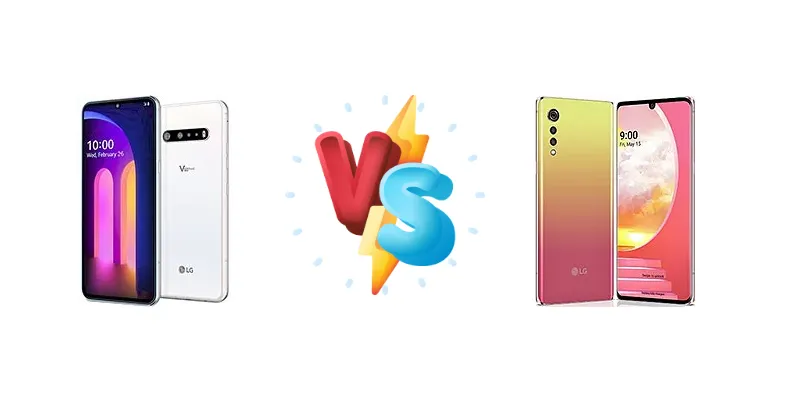
The LG V60 ThinQ 5G and LG Velvet 5G represent distinct approaches to the 5G smartphone experience. The V60, released as a flagship, prioritizes raw power with its Snapdragon 865, while the Velvet aims for a more balanced package with a focus on design and a more efficient Snapdragon 765G. This comparison dissects their key differences to determine which device best suits your needs.
🏆 Quick Verdict
For users prioritizing performance and extended battery life, the LG V60 ThinQ 5G is the clear winner. Its Snapdragon 865 delivers significantly more processing power, and its 103-hour endurance rating outlasts the Velvet’s 79 hours. However, the Velvet offers a more modern aesthetic and a brighter display at a potentially lower price point.
| Network |
|---|
| 2G bands | GSM 850 / 900 / 1800 / 1900 | GSM 850 / 900 / 1800 / 1900 |
| 3G bands | HSDPA 850 / 900 / 1700(AWS) / 1900 / 2100 | HSDPA 850 / 900 / 1900 / 2100 |
| 4G bands | 2, 4, 5, 12, 25, 26, 41, 46, 48, 66, 71 - USA | 1, 2, 3, 4, 5, 7, 8, 12, 17, 20, 28, 32, 38, 39, 40, 41 |
| 5G bands | 2, 25, 41, 66, 71 SA/NSA/Sub6 | 1, 3, 28, 78 SA/NSA |
| Speed | HSPA 42.2/5.76 Mbps, LTE (7CA) Cat22, 5G | HSPA 42.2/5.76 Mbps, LTE (5CA) Cat16 1000/75 Mbps, 5G 2Gbps |
| Technology | GSM / CDMA / HSPA / EVDO / LTE / 5G | GSM / HSPA / LTE / 5G |
| | CDMA2000 1xEV-DO | - |
| Launch |
|---|
| Announced | 2020, February 26. Released 2020, March 20 | 2020, May 07. Released 2020, May 15 |
| Status | Discontinued | Discontinued |
| Body |
|---|
| Build | Glass front (Gorilla Glass 5), glass back (Gorilla Glass 6), aluminum frame | Glass front, glass back, aluminum frame |
| Dimensions | 169.3 x 77.6 x 8.9 mm (6.67 x 3.06 x 0.35 in) | 167.2 x 74.1 x 7.9 mm (6.58 x 2.92 x 0.31 in) |
| SIM | · Nano-SIM· Nano-SIM + Nano-SIM | Nano-SIM + Nano-SIM |
| Weight | 213 g (Global)/ 218 g (Verizon) (7.51 oz) | 180 g (6.35 oz) |
| | IP68 dust/water resistant (up to 1.5m for 30 min)
MIL-STD-810G compliant*
Method 516.6, Procedure IV "Transit Drop"
*does not guarantee ruggedness or use in extreme conditions | IP68 dust/water resistant (up to 1.5m for 30 mins)
MIL-STD-810G compliant*
*does not guarantee ruggedness or use in extreme conditions |
| Display |
|---|
| Protection | Corning Gorilla Glass 5 | - |
| Resolution | 1080 x 2460 pixels (~395 ppi density) | 1080 x 2460 pixels (~395 ppi density) |
| Size | 6.8 inches, 109.8 cm2 (~83.6% screen-to-body ratio) | 6.8 inches, 109.8 cm2 (~88.6% screen-to-body ratio) |
| Type | P-OLED, HDR10+ | P-OLED |
| | Always-on display | - |
| Platform |
|---|
| CPU | Octa-core (1x2.84 GHz Cortex-A77 & 3x2.42 GHz Cortex-A77 & 4x1.80 GHz Cortex-A55) | Octa-core (1x2.4 GHz Kryo 475 Prime & 1x2.2 GHz Kryo 475 Gold & 6x1.8 GHz Kryo 475 Silver) |
| Chipset | Qualcomm SM8250 Snapdragon 865 5G (7 nm+) | Qualcomm SM7250 Snapdragon 765G 5G (7 nm) |
| GPU | Adreno 650 | Adreno 620 |
| OS | Android 10, upgradable to Android 13 | Android 10, upgradable to Android 13, LG UX |
| Memory |
|---|
| Card slot | microSDXC (uses shared SIM slot) - dual-SIM model | microSDXC (uses shared SIM slot) |
| Internal | 128GB 8GB RAM, 256GB 8GB RAM | 128GB 6GB RAM, 128GB 8GB RAM |
| | UFS 2.1 | UFS 2.1 |
| Main Camera |
|---|
| Dual | 64 MP, f/1.8, 27mm (standard), 1/1.72", 0.8µm, dual pixel PDAF, OIS
13 MP, f/1.9, 12mm (ultrawide), 1/3.4", 1.0µm
0.3 MP, TOF 3D, f/1.4, (depth) | - |
| Features | Dual-LED dual-tone flash, HDR, panorama | LED flash, panorama, HDR |
| Triple | - | 48 MP, f/1.8, 26mm (wide), 1/2.0", 0.8µm, PDAF
8 MP, f/2.2, 120˚, 15mm (ultrawide), 1/4.0", 1.12µm
Auxiliary lens |
| Video | 8K@30fps, 4K@30/60fps, 1080p, HDR10+, 24-bit/192kHz stereo sound rec., gyro-EIS | 4K@30fps, 1080p@30/60fps, gyro-EIS |
| Selfie camera |
|---|
| Features | HDR | HDR |
| Single | 10 MP, f/1.9, 30mm (standard), 1/3.1", 1.22µm | 16 MP, f/1.9, 29mm (standard), 1/3.06, 1.0µm |
| Video | 4K@30fps, gyro-EIS | 1080p@30fps |
| Sound |
|---|
| 3.5mm jack | Yes | Yes |
| 35mm jack | Yes | Yes |
| Loudspeaker | Yes, with stereo speakers | Yes, with stereo speakers |
| | 32-bit/192kHz audio
24-bit/192kHz audio recording | - |
| Comms |
|---|
| Bluetooth | 5.1, A2DP, LE, aptX HD | 5.1, A2DP, LE, aptX HD |
| NFC | Yes | Yes |
| Positioning | GPS, GLONASS, GALILEO, BDS | GPS (L1+L5), GLONASS, BDS, GALILEO, QZSS |
| Radio | FM radio (USA model only) | FM radio (market/region dependent) |
| USB | USB Type-C 3.1, OTG | USB Type-C, OTG |
| WLAN | Wi-Fi 802.11 a/b/g/n/ac/6, dual-band, Wi-Fi Direct, DLNA | Wi-Fi 802.11 a/b/g/n/ac, dual-band, Wi-Fi Direct, DLNA |
| Features |
|---|
| Sensors | Fingerprint (under display, optical), accelerometer, gyro, proximity, compass, barometer | Fingerprint (under display, optical), accelerometer, gyro, proximity, compass, barometer |
| Battery |
|---|
| Charging | Wired, PD2.0, QC4
Wireless | 25W wired, PD3.0, QC4
9W wireless |
| Type | Li-Po 5000 mAh | Li-Po 4300 mAh |
| Misc |
|---|
| Colors | Classy Blue, Classy White | Aurora White, Aurora Green, Aurora Gray, Illusion Sunset, Red, Pink |
| Models | LM-V600, A001LG | LM-G900N, LM-G900EM, LM-G900, LM-G900TM |
| Price | About 700 EUR | About 470 EUR |
| SAR | - | 0.23 W/kg (head) 1.02 W/kg (body) |
| Tests |
|---|
| Battery life |
Endurance rating 103h
| Endurance rating 79h |
| Camera | - |
Photo / Video |
| Display | - |
Contrast ratio: Infinite (nominal) |
| Loudspeaker | - |
-23.5 LUFS (Very good) |
| Performance | - |
AnTuTu: 297372 (v8)
GeekBench: 1905 (v5.1)
GFXBench: 16fps (ES 3.1 onscreen) |
LG V60 ThinQ 5G
- Superior performance with Snapdragon 865
- Exceptional battery life (103h endurance)
- Likely better camera performance due to flagship status
- Potentially lower display brightness
- Larger and heavier design
LG Velvet 5G
- Brighter display (617 nits)
- More stylish and compact design
- Potentially lower price point
- Less powerful Snapdragon 765G chipset
- Shorter battery life (79h endurance)
Display Comparison
The LG Velvet 5G boasts a brighter display, reaching a measured 617 nits, compared to the V60 which lacks published brightness data but is expected to be lower. This makes the Velvet more usable in direct sunlight. Both displays feature an 'Infinite' contrast ratio, a marketing term indicating deep blacks, but the Velvet’s higher peak brightness provides a more vibrant and visible image overall. While both likely utilize OLED technology, the Velvet’s panel is demonstrably brighter, benefiting content consumption and outdoor use.
Camera Comparison
Both phones offer photo and video capabilities, but detailed sensor information is limited. The V60, being a flagship, likely features a larger primary sensor and more sophisticated image processing. The Velvet’s camera system, while capable, is geared towards a more balanced experience. Without specific sensor size or aperture data, it’s difficult to definitively declare a winner, but the V60’s flagship status suggests a more robust camera system, particularly in low-light conditions. The inclusion of a 2MP macro camera on the Velvet is unlikely to be a significant differentiator for most users.
Performance
The core difference lies in the chipsets. The LG V60’s Snapdragon 865 (7nm+) significantly outperforms the Velvet’s Snapdragon 765G (7nm). The 865 features a more powerful CPU configuration – an octa-core setup with a prime Cortex-A77 core clocked at 2.84 GHz – versus the 765G’s 2.4 GHz Kryo 475 Prime. This translates to faster app loading, smoother multitasking, and superior gaming performance. The V60’s Adreno 650 GPU also eclipses the 765G’s Adreno 620. While the Velvet is capable for everyday tasks, the V60 is geared towards power users.
Battery Life
The LG V60 ThinQ 5G excels in battery life, achieving an impressive 103-hour endurance rating. The LG Velvet 5G, with its less power-hungry chipset, manages 79 hours. While the Velvet supports 25W wired charging with PD3.0 and QC4, and 9W wireless charging, the V60 supports PD2.0 and QC4, with charging speeds not explicitly stated but likely comparable. The V60’s larger battery capacity and more efficient power management give it a substantial advantage for all-day and multi-day use.
Buying Guide
Buy the LG V60 ThinQ 5G if you need uncompromising performance for demanding tasks like gaming, video editing, or heavy multitasking, and value exceptional battery endurance. Buy the LG Velvet 5G if you prefer a more stylish and compact design, prioritize display brightness for outdoor visibility, and are comfortable with a trade-off in raw processing power for improved efficiency and potentially a lower cost.
Frequently Asked Questions
❓ Will the Snapdragon 765G in the Velvet struggle with graphically intensive games like Genshin Impact?
The Snapdragon 765G is capable of running Genshin Impact, but you'll likely need to lower the graphics settings to medium or low to maintain a stable frame rate. The V60's Snapdragon 865 will provide a significantly smoother experience at higher settings.
❓ Does the LG V60 support faster charging than the Velvet, despite lacking specific wattage details?
While the Velvet advertises 25W charging, the V60 supports both PD2.0 and QC4, which are capable of delivering comparable or even faster charging speeds depending on the charger used. Real-world charging times will vary, but the V60's larger battery may take slightly longer to fully charge.
❓ Is the 9W wireless charging on the Velvet slow compared to other phones?
Yes, 9W wireless charging is relatively slow compared to the 15W or higher wireless charging offered by many modern smartphones. It's best suited for overnight charging or occasional top-ups.
❓ How does the design of the Velvet's 'Waterfall' display affect usability?
The Velvet's curved display edges, while aesthetically pleasing, can sometimes cause accidental touches or reflections. Some users may find it takes time to adjust to the curved edges, while others appreciate the immersive viewing experience.