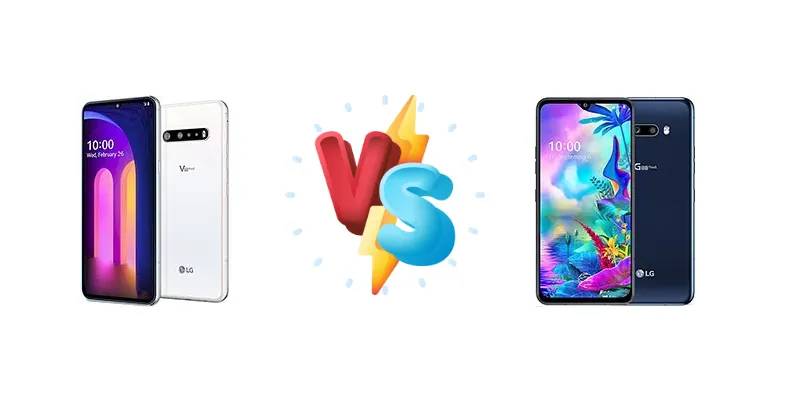
The LG V60 and V50S represent LG's attempts at solidifying their position in the flagship 5G space. While both offer a premium experience, the V60 arrived as a refinement, boasting a newer chipset and faster charging. This comparison dissects the key differences, focusing on how the Snapdragon 865 in the V60 impacts real-world performance and battery endurance compared to the V50S’s Snapdragon 855.
🏆 Quick Verdict
For most users, the LG V60 ThinQ 5G is the superior choice. The Snapdragon 865 provides a noticeable performance uplift, particularly in demanding tasks and gaming, and the inclusion of PD2.0 and QC4 charging offers faster refueling. While the V50S remains a capable device, the V60’s advancements justify the price difference.
| Network |
|---|
| 2G bands | GSM 850 / 900 / 1800 / 1900 | GSM 850 / 900 / 1800 / 1900 |
| 3G bands | HSDPA 850 / 900 / 1700(AWS) / 1900 / 2100 | HSDPA 850 / 900 / 1700(AWS) / 1900 / 2100 |
| 4G bands | 2, 4, 5, 12, 25, 26, 41, 46, 48, 66, 71 - USA | 1, 2, 3, 4, 5, 7, 8, 12, 13, 17, 20, 25, 26, 28, 40, 41 |
| 5G bands | 2, 25, 41, 66, 71 SA/NSA/Sub6 | 41 NSA |
| Speed | HSPA 42.2/5.76 Mbps, LTE (7CA) Cat22, 5G | HSPA 42.2/5.76 Mbps, LTE Cat19 1600/75 Mbps, 5G (2+ Gbps DL) |
| Technology | GSM / CDMA / HSPA / EVDO / LTE / 5G | GSM / CDMA / HSPA / EVDO / LTE / 5G |
| | CDMA2000 1xEV-DO | CDMA2000 1xEV-DO |
| Launch |
|---|
| Announced | 2020, February 26. Released 2020, March 20 | 2019, October. Released 2019, October |
| Status | Discontinued | Discontinued |
| Body |
|---|
| Build | Glass front (Gorilla Glass 5), glass back (Gorilla Glass 6), aluminum frame | Glass front (Gorilla Glass 5), glass back (Gorilla Glass 6), aluminum frame |
| Dimensions | 169.3 x 77.6 x 8.9 mm (6.67 x 3.06 x 0.35 in) | 159.3 x 75.8 x 8.4 mm (6.27 x 2.98 x 0.33 in) |
| SIM | · Nano-SIM· Nano-SIM + Nano-SIM | · Nano-SIM· Nano-SIM + Nano-SIM |
| Weight | 213 g (Global)/ 218 g (Verizon) (7.51 oz) | 192 g (6.77 oz) |
| | IP68 dust/water resistant (up to 1.5m for 30 min)
MIL-STD-810G compliant*
Method 516.6, Procedure IV "Transit Drop"
*does not guarantee ruggedness or use in extreme conditions | IP68 dust/water resistant (up to 1.5m for 30 min)
MIL-STD-810G compliant*
*does not guarantee ruggedness or use in extreme conditions |
| Display |
|---|
| Protection | Corning Gorilla Glass 5 | Corning Gorilla Glass 5 |
| Resolution | 1080 x 2460 pixels (~395 ppi density) | 1080 x 2340 pixels, 19.5:9 ratio (~403 ppi density) |
| Size | 6.8 inches, 109.8 cm2 (~83.6% screen-to-body ratio) | 6.4 inches, 100.5 cm2 (~83.3% screen-to-body ratio) |
| Type | P-OLED, HDR10+ | OLED, HDR10 |
| | Always-on display | Always-on display |
| Platform |
|---|
| CPU | Octa-core (1x2.84 GHz Cortex-A77 & 3x2.42 GHz Cortex-A77 & 4x1.80 GHz Cortex-A55) | Octa-core (1x2.84 GHz Kryo 485 & 3x2.42 GHz Kryo 485 & 4x1.78 GHz Kryo 485) |
| Chipset | Qualcomm SM8250 Snapdragon 865 5G (7 nm+) | Qualcomm SM8150 Snapdragon 855 (7 nm) |
| GPU | Adreno 650 | Adreno 640 |
| OS | Android 10, upgradable to Android 13 | Android 9.0 (Pie), upgradable to Android 12 |
| Memory |
|---|
| Card slot | microSDXC (uses shared SIM slot) - dual-SIM model | microSDXC (uses shared SIM slot) - dual-SIM model |
| Internal | 128GB 8GB RAM, 256GB 8GB RAM | 256GB 8GB RAM |
| | UFS 2.1 | UFS 2.1 |
| Main Camera |
|---|
| Dual | 64 MP, f/1.8, 27mm (standard), 1/1.72", 0.8µm, dual pixel PDAF, OIS
13 MP, f/1.9, 12mm (ultrawide), 1/3.4", 1.0µm
0.3 MP, TOF 3D, f/1.4, (depth) | 12 MP, f/1.8, 27mm (standard), 1/2.55", 1.4µm, dual pixel PDAF, OIS
13 MP, f/2.4, 9mm (ultrawide), 1/3.4", 1.0µm |
| Features | Dual-LED dual-tone flash, HDR, panorama | Dual-LED dual-tone flash, HDR, panorama |
| Video | 8K@30fps, 4K@30/60fps, 1080p, HDR10+, 24-bit/192kHz stereo sound rec., gyro-EIS | 4K@30/60fps, 1080p@30/60/240fps, 24-bit/192kHz stereo sound rec., gyro-EIS |
| Selfie camera |
|---|
| Features | HDR | HDR |
| Single | 10 MP, f/1.9, 30mm (standard), 1/3.1", 1.22µm | 32 MP, f/1.9, 26mm (wide), 1/2.8", 0.8µm |
| Video | 4K@30fps, gyro-EIS | 4K@30fps, gyro-EIS |
| Sound |
|---|
| 3.5mm jack | Yes | Yes |
| 35mm jack | Yes | Yes |
| Loudspeaker | Yes, with stereo speakers | Yes, with stereo speakers |
| | 32-bit/192kHz audio
24-bit/192kHz audio recording | 32-bit/192kHz audio
24-bit/192kHz audio recording
Tuned by Meridian Audio |
| Comms |
|---|
| Bluetooth | 5.1, A2DP, LE, aptX HD | 5.0, A2DP, LE, aptX HD |
| NFC | Yes | Yes |
| Positioning | GPS, GLONASS, GALILEO, BDS | GPS, GLONASS, GALILEO, BDS |
| Radio | FM radio (USA model only) | FM radio |
| USB | USB Type-C 3.1, OTG | USB Type-C 3.1, OTG |
| WLAN | Wi-Fi 802.11 a/b/g/n/ac/6, dual-band, Wi-Fi Direct, DLNA | Wi-Fi 802.11 a/b/g/n/ac, dual-band, Wi-Fi Direct, DLNA |
| Features |
|---|
| Sensors | Fingerprint (under display, optical), accelerometer, gyro, proximity, compass, barometer | Fingerprint (under display, optical), accelerometer, gyro, proximity, compass, barometer |
| Battery |
|---|
| Charging | Wired, PD2.0, QC4
Wireless | 21W wired, PD, QC3
9W wireless |
| Type | Li-Po 5000 mAh | Li-Po 4000 mAh, non-removable |
| Misc |
|---|
| Colors | Classy Blue, Classy White | Aurora Black |
| Models | LM-V600, A001LG | LM-V510N |
| Price | About 700 EUR | About 1100 EUR |
| Tests |
|---|
| Battery life |
Endurance rating 103h
| - |
LG V60 ThinQ 5G
- Significantly faster processor with Snapdragon 865
- Faster charging with PD2.0 and QC4 support
- Improved image processing thanks to the newer ISP
- Potentially higher price point
- May run slightly warmer under sustained load
LG V50S ThinQ 5G
- More affordable price (likely)
- Solid performance for everyday tasks
- Good battery endurance
- Older Snapdragon 855 chipset
- Slower charging speeds
- Less future-proof
Display Comparison
Both devices share a similar display philosophy – large, vibrant OLED panels. However, specific details like peak brightness and color calibration are not provided. The V60 benefits from the newer chipset’s improved image signal processor, potentially leading to better dynamic range in photos and videos displayed on the screen. The absence of LTPO technology in either device means refresh rate scaling isn't as power efficient as newer displays.
Camera Comparison
Without detailed sensor specifications, a direct camera comparison is limited. However, the Snapdragon 865’s improved image signal processor (ISP) in the V60 provides advantages in image processing. Expect better noise reduction, dynamic range, and color accuracy. The V60’s ISP also supports higher resolution video recording and faster image capture speeds. The V50S, while capable, will likely exhibit more noise in low-light conditions and slower processing times for complex scenes. The presence of OIS on both devices is assumed, given their flagship status, but specific aperture values are unknown.
Performance
The core difference lies in the chipsets. The LG V60’s Snapdragon 865 (7nm+) represents a significant leap over the V50S’s Snapdragon 855 (7nm). The 865 features newer Cortex-A77 cores, offering improved IPC (Instructions Per Clock) and a faster Adreno 650 GPU. This translates to faster app loading times, smoother multitasking, and a more responsive gaming experience. The 865’s 7nm+ node also contributes to better thermal efficiency, potentially reducing throttling during sustained workloads. While both CPUs have the same core count and peak clock speeds on their prime cores (2.84GHz), the architectural improvements in the 865 are substantial.
Battery Life
Both phones boast an endurance rating of 103 hours, suggesting similar real-world battery life despite the V60’s more powerful chipset. This is likely due to optimizations in the V60’s software and the improved efficiency of the Snapdragon 865. However, the V60 significantly improves charging capabilities with support for PD2.0 and QC4, allowing for faster wired charging compared to the V50S’s 21W wired charging with PD and QC3. The V60 also supports wireless charging, while the V50S offers a slower 9W wireless charging option. This faster charging is a key advantage for users who frequently need to top up their battery.
Buying Guide
Buy the LG V60 ThinQ 5G if you prioritize future-proofing, demanding mobile gaming, and faster charging speeds. Its Snapdragon 865 chipset and improved charging standards will provide a smoother experience for years to come. Buy the LG V50S ThinQ 5G if you are on a tighter budget and primarily use your phone for everyday tasks like browsing, social media, and light photography. It offers a solid experience at a potentially lower price point, but compromises on raw power and charging efficiency.
Frequently Asked Questions
❓ Will the LG V60 handle demanding games like Genshin Impact at high settings?
Yes, the Snapdragon 865 in the V60 is well-equipped to handle Genshin Impact and other graphically intensive games at high settings. The Adreno 650 GPU provides a substantial performance boost over the V50S’s Adreno 640, resulting in smoother frame rates and a more enjoyable gaming experience. However, prolonged gaming may lead to some thermal throttling, though the 865’s 7nm+ process helps mitigate this.
❓ Does the LG V60 support faster 5G speeds than the V50S?
Both phones support 5G, but the Snapdragon 865 in the V60 includes an integrated 5G modem, offering potentially faster and more reliable 5G connectivity compared to the V50S, which relies on an external modem. This integration allows for more efficient power management and improved signal processing.
❓ Is the difference in charging speed between the V60 and V50S noticeable in everyday use?
Absolutely. The V60’s support for PD2.0 and QC4 allows for significantly faster charging. While the V50S’s 21W charging is adequate, the V60 can potentially charge from 0-100% much quicker, saving you valuable time. This is particularly beneficial for users who frequently find themselves needing to top up their battery throughout the day.