
LG V60 ThinQ 5G vs LG G8X ThinQ: A Deep Dive into LG's Flagship Showdown
| Phones Images | |||||
|---|---|---|---|---|---|
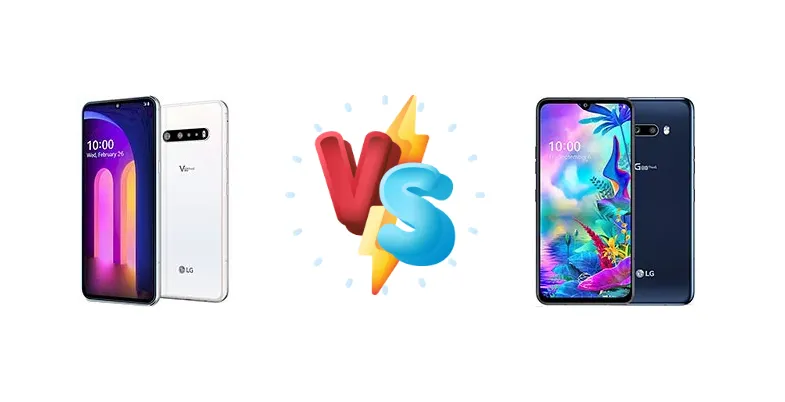
|
🏆 Quick Verdict
For most users, the LG V60 ThinQ 5G is the superior choice. Its Snapdragon 865 chipset delivers a noticeable performance boost over the G8X's Snapdragon 855, translating to smoother multitasking and gaming. While the G8X boasts slightly better battery endurance, the V60's faster charging and overall processing power make it the more compelling option.
| PHONES | ||
|---|---|---|
| Phone Names | LG V60 ThinQ 5G | LG G8X ThinQ |
| Network | ||
|---|---|---|
| 2G bands | GSM 850 / 900 / 1800 / 1900 | GSM 850 / 900 / 1800 / 1900 |
| 3G bands | HSDPA 850 / 900 / 1700(AWS) / 1900 / 2100 | HSDPA 850 / 900 / 1900 / 2100 |
| 4G bands | 2, 4, 5, 12, 25, 26, 41, 46, 48, 66, 71 - USA | 1, 2, 3, 4, 5, 7, 8, 12, 13, 17, 20, 28, 32, 38, 39, 40, 41 |
| 5G bands | 2, 25, 41, 66, 71 SA/NSA/Sub6 | - |
| Speed | HSPA 42.2/5.76 Mbps, LTE (7CA) Cat22, 5G | HSPA 42.2/5.76 Mbps, LTE Cat20 1960/75 Mbps |
| Technology | GSM / CDMA / HSPA / EVDO / LTE / 5G | GSM / CDMA / HSPA / EVDO / LTE |
| CDMA2000 1xEV-DO | 1, 2, 3, 4, 5, 7, 12, 14, 20, 29, 30, 38, 39, 40, 41, 46, 66 - USA | |
| Launch | ||
|---|---|---|
| Announced | 2020, February 26. Released 2020, March 20 | 2019, September 06. Released 2019, November 01 |
| Status | Discontinued | Discontinued |
| Body | ||
|---|---|---|
| Build | Glass front (Gorilla Glass 5), glass back (Gorilla Glass 6), aluminum frame | Glass front (Gorilla Glass 6), glass back (Gorilla Glass 5), aluminum frame |
| Dimensions | 169.3 x 77.6 x 8.9 mm (6.67 x 3.06 x 0.35 in) | 159.3 x 75.8 x 8.4 mm (6.27 x 2.98 x 0.33 in) |
| SIM | · Nano-SIM· Nano-SIM + Nano-SIM | · Nano-SIM· Nano-SIM + Nano-SIM |
| Weight | 213 g (Global)/ 218 g (Verizon) (7.51 oz) | 192 g (6.77 oz) |
| IP68 dust/water resistant (up to 1.5m for 30 min) MIL-STD-810G compliant* Method 516.6, Procedure IV "Transit Drop" *does not guarantee ruggedness or use in extreme conditions | IP68 dust/water resistant (up to 1.5m for 30 min) MIL-STD-810G compliant* *does not guarantee ruggedness or use in extreme conditions | |
| Display | ||
|---|---|---|
| Protection | Corning Gorilla Glass 5 | Corning Gorilla Glass 6 |
| Resolution | 1080 x 2460 pixels (~395 ppi density) | 1080 x 2340 pixels, 19.5:9 ratio (~403 ppi density) |
| Size | 6.8 inches, 109.8 cm2 (~83.6% screen-to-body ratio) | 6.4 inches, 100.5 cm2 (~83.3% screen-to-body ratio) |
| Type | P-OLED, HDR10+ | OLED, HDR10 |
| Always-on display | Always-on display | |
| Platform | ||
|---|---|---|
| CPU | Octa-core (1x2.84 GHz Cortex-A77 & 3x2.42 GHz Cortex-A77 & 4x1.80 GHz Cortex-A55) | Octa-core (1x2.84 GHz Kryo 485 & 3x2.42 GHz Kryo 485 & 4x1.78 GHz Kryo 485) |
| Chipset | Qualcomm SM8250 Snapdragon 865 5G (7 nm+) | Qualcomm SM8150 Snapdragon 855 (7 nm) |
| GPU | Adreno 650 | Adreno 640 |
| OS | Android 10, upgradable to Android 13 | Android 9.0 (Pie), upgradable to Android 12 |
| Memory | ||
|---|---|---|
| Card slot | microSDXC (uses shared SIM slot) - dual-SIM model | microSDXC (uses shared SIM slot) - dual-SIM model |
| Internal | 128GB 8GB RAM, 256GB 8GB RAM | 128GB 6GB RAM |
| UFS 2.1 | UFS 2.1 | |
| Main Camera | ||
|---|---|---|
| Dual | 64 MP, f/1.8, 27mm (standard), 1/1.72", 0.8µm, dual pixel PDAF, OIS 13 MP, f/1.9, 12mm (ultrawide), 1/3.4", 1.0µm 0.3 MP, TOF 3D, f/1.4, (depth) | 12 MP, f/1.8, 27mm (wide), 1/2.55", 1.4µm, dual pixel PDAF, OIS 13 MP, f/2.4, 9mm (ultrawide), 1.0µm |
| Features | Dual-LED dual-tone flash, HDR, panorama | Dual-LED dual-tone flash, HDR, panorama |
| Single | - | 3.15 MP, AF |
| Video | 8K@30fps, 4K@30/60fps, 1080p, HDR10+, 24-bit/192kHz stereo sound rec., gyro-EIS | 4K@30/60fps, 1080p@30/60/240fps, 24-bit/192kHz stereo sound rec., gyro-EIS |
| Selfie camera | ||
|---|---|---|
| Features | HDR | HDR |
| Single | 10 MP, f/1.9, 30mm (standard), 1/3.1", 1.22µm | 32 MP, f/1.9, 26mm (wide), 1/2.8", 0.8µm |
| Video | 4K@30fps, gyro-EIS | 4K@30fps, gyro-EIS |
| Sound | ||
|---|---|---|
| 3.5mm jack | Yes | Yes |
| 35mm jack | Yes | Yes |
| Loudspeaker | Yes, with stereo speakers | Yes, with stereo speakers |
| 32-bit/192kHz audio 24-bit/192kHz audio recording | 32-bit/192kHz audio 24-bit/192kHz audio recording Tuned by Meridian Audio | |
| Comms | ||
|---|---|---|
| Bluetooth | 5.1, A2DP, LE, aptX HD | 5.0, A2DP, LE, aptX HD |
| NFC | Yes | Yes |
| Positioning | GPS, GLONASS, GALILEO, BDS | GPS, GLONASS, GALILEO, BDS |
| Radio | FM radio (USA model only) | FM radio |
| USB | USB Type-C 3.1, OTG | USB Type-C 3.1, OTG |
| WLAN | Wi-Fi 802.11 a/b/g/n/ac/6, dual-band, Wi-Fi Direct, DLNA | Wi-Fi 802.11 a/b/g/n/ac, dual-band, Wi-Fi Direct, DLNA |
| Features | ||
|---|---|---|
| Browser | - | HTML, Adobe Flash |
| Sensors | Fingerprint (under display, optical), accelerometer, gyro, proximity, compass, barometer | Fingerprint (under display, optical), accelerometer, gyro, proximity, compass, barometer |
| Battery | ||
|---|---|---|
| Charging | Wired, PD2.0, QC4 Wireless | 21W wired, PD, QC3 9W wireless |
| Talk time | - | Up to 12 h (multimedia) |
| Type | Li-Po 5000 mAh | Li-Po 4000 mAh, non-removable |
| Misc | ||
|---|---|---|
| Colors | Classy Blue, Classy White | New Aurora Black |
| Models | LM-V600, A001LG | LMG850EMW, LM-G850, 901LG, LM-G850N |
| Price | About 700 EUR | About 560 EUR |
| SAR | - | 1.12 W/kg (body) |
| SAR EU | - | 0.90 W/kg (head) |
| Tests | ||
|---|---|---|
| Audio quality | - | Noise -93.2dB / Crosstalk -93.4dB |
| Battery life | Endurance rating 103h | Endurance rating 111h |
| Camera | - | Photo / Video |
| Display | - | Contrast ratio: Infinite (nominal) |
| Loudspeaker | - | -24.9 LUFS (Very good) |
| Performance | - | AnTuTu: 339726 (v7), 411980 (v8) GeekBench: 11251 (v4.4), 2870 (v5.1) GFXBench: 38fps (ES 3.1 onscreen) |
LG V60 ThinQ 5G
- Significantly faster Snapdragon 865 processor
- 5G connectivity for faster data speeds
- Faster charging with PD2.0 and QC4
- Potentially better image processing
- Slightly lower battery endurance rating
- Display specifications less detailed
LG G8X ThinQ
- Excellent battery life (111h endurance)
- Brighter display (603 nits)
- Dual-screen accessory compatibility
- More affordable price point
- Older Snapdragon 855 processor
- Slower charging speeds (21W wired, 9W wireless)
Display Comparison
The LG G8X ThinQ holds a slight edge in measured display quality, achieving 603 nits of peak brightness. While the V60's brightness isn't specified, the G8X's higher output ensures better visibility in direct sunlight. Both displays boast an 'Infinite' contrast ratio, typical of OLED panels. However, the V60's display technology isn't detailed, leaving questions about potential features like variable refresh rate (VRR) which the G8X lacks. The G8X's focus on display quality is further highlighted by its dual-screen capability, a feature absent on the V60.
Camera Comparison
Both phones offer 'Photo / Video' capabilities, but detailed camera specifications are limited. Without sensor size or aperture information, a direct comparison is difficult. However, the V60's more powerful processor likely enables more sophisticated image processing algorithms, potentially leading to better dynamic range and low-light performance. The inclusion of 5G connectivity on the V60 could also facilitate faster cloud-based image processing and sharing. The G8X's camera system is likely competent, but the V60's processing power gives it a potential edge.
Performance
The core difference lies in the chipsets: the LG V60 utilizes the Qualcomm Snapdragon 865 5G (7nm+), while the G8X features the Snapdragon 855 (7nm). The 865 represents a significant architectural upgrade, with its Cortex-A77 cores offering improved performance and efficiency compared to the Kryo 485 cores in the 855. The V60's CPU configuration (1x2.84 GHz Cortex-A77, 3x2.42 GHz Cortex-A77, 4x1.80 GHz Cortex-A55) provides a clear advantage in multi-core tasks. The 865 also benefits from an improved GPU, resulting in higher frame rates in graphically intensive games. While both phones likely utilize LPDDR4X RAM, the V60's superior chipset will minimize bottlenecks and deliver a smoother overall experience.
Battery Life
The LG G8X ThinQ boasts an endurance rating of 111 hours, slightly exceeding the V60's 103 hours. This suggests the G8X is more efficient in managing power consumption. However, the V60 compensates with faster charging capabilities, supporting PD2.0 and QC4 standards, alongside wireless charging. The G8X offers 21W wired charging with PD and QC3, and 9W wireless charging. The V60's faster charging speeds will significantly reduce downtime, making it more convenient for users who frequently need to top up their battery. The difference in endurance is relatively small, and the V60's charging advantage is a significant benefit.
Buying Guide
Buy the LG V60 ThinQ 5G if you prioritize raw performance for demanding tasks like gaming, video editing, or running multiple apps simultaneously. Its 5G connectivity also future-proofs it for faster network speeds. Buy the LG G8X ThinQ if you value exceptional battery life and are intrigued by the dual-screen accessory, offering a unique productivity and entertainment experience, and are less concerned with having the absolute fastest processor.