
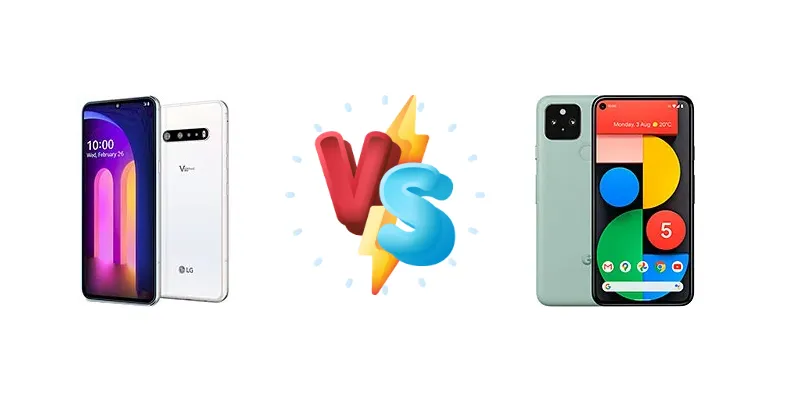
LG V60 ThinQ 5G vs Google Pixel 5: A Head-to-Head Comparison of 5G Power and Smarts
| Phones Images | |||||
|---|---|---|---|---|---|
|
🏆 Quick Verdict
For users prioritizing raw performance and extended battery life, the LG V60 ThinQ 5G is the clear winner. Its Snapdragon 865 offers a significant performance advantage, and its 103-hour endurance rating surpasses the Pixel 5's 95 hours. However, the Pixel 5's superior camera processing and clean software experience make it a compelling choice for photography enthusiasts and those valuing simplicity.
| PHONES | ||
|---|---|---|
| Phone Names | LG V60 ThinQ 5G | Google Pixel 5 |
| Network | ||
|---|---|---|
| 2G bands | GSM 850 / 900 / 1800 / 1900 | GSM 850 / 900 / 1800 / 1900 |
| 3G bands | HSDPA 850 / 900 / 1700(AWS) / 1900 / 2100 | HSDPA 850 / 900 / 1700(AWS) / 1900 / 2100 |
| 4G bands | 2, 4, 5, 12, 25, 26, 41, 46, 48, 66, 71 - USA | 1, 2, 3, 4, 5, 7, 8, 12, 13, 14, 17, 18, 19, 20, 25, 26, 28, 29, 30, 32, 38, 39, 40, 41, 42, 46, 48, 66, 71 |
| 5G bands | 2, 25, 41, 66, 71 SA/NSA/Sub6 | 1, 2, 3, 5, 7, 8, 12, 28, 41, 66, 71, 77, 78, 258, 260, 261 Sub6/mmWave - GD1YQ |
| Speed | HSPA 42.2/5.76 Mbps, LTE (7CA) Cat22, 5G | HSPA, LTE, 5G |
| Technology | GSM / CDMA / HSPA / EVDO / LTE / 5G | GSM / CDMA / HSPA / EVDO / LTE / 5G |
| CDMA2000 1xEV-DO | 1, 2, 3, 5, 7, 8, 12, 28, 41, 66, 71, 77, 78 Sub6 - GTT9Q | |
| Launch | ||
|---|---|---|
| Announced | 2020, February 26. Released 2020, March 20 | 2020, September 30 |
| Status | Discontinued | Available. Released 2020, October 15 |
| Body | ||
|---|---|---|
| Build | Glass front (Gorilla Glass 5), glass back (Gorilla Glass 6), aluminum frame | Glass front (Gorilla Glass 6), aluminum back, aluminum frame |
| Dimensions | 169.3 x 77.6 x 8.9 mm (6.67 x 3.06 x 0.35 in) | 144.7 x 70.4 x 8 mm (5.70 x 2.77 x 0.31 in) |
| SIM | · Nano-SIM· Nano-SIM + Nano-SIM | Nano-SIM + eSIM |
| Weight | 213 g (Global)/ 218 g (Verizon) (7.51 oz) | 151 g (5.33 oz) |
| IP68 dust/water resistant (up to 1.5m for 30 min) MIL-STD-810G compliant* Method 516.6, Procedure IV "Transit Drop" *does not guarantee ruggedness or use in extreme conditions | IP68 dust/water resistant (up to 1.5m for 30 min) | |
| Display | ||
|---|---|---|
| Protection | Corning Gorilla Glass 5 | Corning Gorilla Glass 6 |
| Resolution | 1080 x 2460 pixels (~395 ppi density) | 1080 x 2340 pixels, 19.5:9 ratio (~432 ppi density) |
| Size | 6.8 inches, 109.8 cm2 (~83.6% screen-to-body ratio) | 6.0 inches, 87.6 cm2 (~85.9% screen-to-body ratio) |
| Type | P-OLED, HDR10+ | OLED, 90Hz, HDR10+ |
| Always-on display | Always-on display | |
| Platform | ||
|---|---|---|
| CPU | Octa-core (1x2.84 GHz Cortex-A77 & 3x2.42 GHz Cortex-A77 & 4x1.80 GHz Cortex-A55) | Octa-core (1x2.4 GHz Kryo 475 Prime & 1x2.2 GHz Kryo 475 Gold & 6x1.8 GHz Kryo 475 Silver) |
| Chipset | Qualcomm SM8250 Snapdragon 865 5G (7 nm+) | Qualcomm SM7250 Snapdragon 765G 5G (7 nm) |
| GPU | Adreno 650 | Adreno 620 |
| OS | Android 10, upgradable to Android 13 | Android 11, upgradable to Android 14 |
| Memory | ||
|---|---|---|
| Card slot | microSDXC (uses shared SIM slot) - dual-SIM model | No |
| Internal | 128GB 8GB RAM, 256GB 8GB RAM | 128GB 8GB RAM |
| UFS 2.1 | UFS 2.1 | |
| Main Camera | ||
|---|---|---|
| Dual | 64 MP, f/1.8, 27mm (standard), 1/1.72", 0.8µm, dual pixel PDAF, OIS 13 MP, f/1.9, 12mm (ultrawide), 1/3.4", 1.0µm 0.3 MP, TOF 3D, f/1.4, (depth) | 12.2 MP, f/1.7, 27mm (wide), 1/2.55", 1.4µm, dual pixel PDAF, OIS 16 MP, f/2.2, 117˚ (ultrawide), 1.0µm |
| Features | Dual-LED dual-tone flash, HDR, panorama | LED flash, Pixel Shift, Auto-HDR, panorama |
| Video | 8K@30fps, 4K@30/60fps, 1080p, HDR10+, 24-bit/192kHz stereo sound rec., gyro-EIS | 4K@30/60fps, 1080p@30/60/120/240fps; gyro-EIS |
| Selfie camera | ||
|---|---|---|
| Features | HDR | HDR |
| Single | 10 MP, f/1.9, 30mm (standard), 1/3.1", 1.22µm | 8 MP, f/2.0, 24mm (wide), 1/4.0", 1.12µm |
| Video | 4K@30fps, gyro-EIS | 1080p@30fps |
| Sound | ||
|---|---|---|
| 3.5mm jack | Yes | No |
| 35mm jack | Yes | No |
| Loudspeaker | Yes, with stereo speakers | Yes, with stereo speakers |
| 32-bit/192kHz audio 24-bit/192kHz audio recording | - | |
| Comms | ||
|---|---|---|
| Bluetooth | 5.1, A2DP, LE, aptX HD | 5.0, A2DP, LE, aptX HD |
| NFC | Yes | Yes |
| Positioning | GPS, GLONASS, GALILEO, BDS | GPS, GLONASS, GALILEO, QZSS, BDS |
| Radio | FM radio (USA model only) | No |
| USB | USB Type-C 3.1, OTG | USB Type-C 3.1 |
| WLAN | Wi-Fi 802.11 a/b/g/n/ac/6, dual-band, Wi-Fi Direct, DLNA | Wi-Fi 802.11 a/b/g/n/ac, dual-band, Wi-Fi Direct |
| Features | ||
|---|---|---|
| Sensors | Fingerprint (under display, optical), accelerometer, gyro, proximity, compass, barometer | Fingerprint (rear-mounted), accelerometer, gyro, proximity, compass, barometer |
| Battery | ||
|---|---|---|
| Charging | Wired, PD2.0, QC4 Wireless | 18W wired, PD2.0 12W wireless 5W reverse wired |
| Type | Li-Po 5000 mAh | Li-Po 4080 mAh |
| Misc | ||
|---|---|---|
| Colors | Classy Blue, Classy White | Just Black, Sorta Sage |
| Models | LM-V600, A001LG | GD1YQ, GTT9Q, G5NZ6 |
| Price | About 700 EUR | € 181.31 / $ 272.44 / £ 136.00 |
| Pricing | ||
|---|---|---|
| 128GB 8GB RAM | - | $ 194.84 |
| RENEWED | - | $ 253.00 |
| Tests | ||
|---|---|---|
| Battery life | Endurance rating 103h | Endurance rating 95h |
| Display | - | Contrast ratio: Infinite (nominal) |
LG V60 ThinQ 5G
- Superior processing power with Snapdragon 865
- Longer battery life (103h endurance)
- Faster charging support (PD2.0, QC4)
- Potential for more versatile camera hardware (spec dependent)
- Likely larger and heavier form factor
- LG’s software support is no longer guaranteed
Google Pixel 5
- Excellent camera image processing
- Clean and streamlined Android experience
- More compact and manageable size
- Reverse wireless charging
- Less powerful Snapdragon 765G chipset
- Shorter battery life (95h endurance)
- Slower charging speeds (18W)
Display Comparison
The Pixel 5 boasts a measured peak brightness of 699 nits, a respectable figure, but the LG V60’s display specifications are not provided, suggesting it may not reach the same level of brightness. Both displays feature an 'infinite' (nominal) contrast ratio, typical of OLED panels. The Pixel 5’s size is more manageable, while the V60, being a larger phone overall, likely offers a more immersive viewing experience. Without detailed color accuracy data for the V60, it’s difficult to assess which display is more color-accurate, but Google’s Pixel line is generally known for its accurate color reproduction.
Camera Comparison
While both phones are capable, their approaches differ. The Pixel 5 is renowned for its computational photography prowess, leveraging Google’s image processing algorithms to produce stunning images, even in challenging lighting conditions. The LG V60’s camera specifications are not detailed enough to make a direct comparison, but its flagship status suggests a higher-resolution sensor and potentially more versatile lens options. However, sensor size and aperture are critical; without those details, the Pixel 5’s software advantage is likely to be more impactful for the average user. The Pixel 5’s focus on software optimization likely delivers more consistent results across various shooting scenarios.
Performance
The core difference lies in the chipsets. The LG V60’s Snapdragon 865 (7nm+) is a flagship processor, featuring an octa-core configuration with a prime Cortex-A77 core clocked at 2.84 GHz. This contrasts with the Pixel 5’s Snapdragon 765G (7nm), which utilizes Kryo 475 cores peaking at 2.4 GHz. The 865’s superior clock speeds and more powerful architecture translate to significantly faster processing speeds, particularly in graphically intensive applications. While the 765G is efficient, the 865’s performance headroom is substantial. The V60’s likely use of LPDDR5 RAM (based on the chipset) further enhances memory bandwidth compared to the Pixel 5’s 8GB of RAM. This difference will be most noticeable during multitasking and demanding gaming sessions.
Battery Life
The LG V60 ThinQ 5G boasts an endurance rating of 103 hours, a clear advantage over the Pixel 5’s 95 hours. This translates to longer usage between charges, despite the Pixel 5’s efficient chipset. The V60 supports both PD2.0 and QC4 wired charging, offering faster charging speeds than the Pixel 5’s 18W PD2.0. The V60 also supports wireless charging, while the Pixel 5 adds the convenience of 5W reverse wired charging, allowing it to top up accessories. The combination of larger endurance and faster charging gives the V60 a significant edge in battery performance.
Buying Guide
Buy the LG V60 ThinQ 5G if you need uncompromising performance for demanding tasks like gaming or video editing, and value a larger battery for all-day use. Buy the Google Pixel 5 if you prefer a streamlined Android experience, exceptional camera image processing, and a more compact form factor, even if it means sacrificing some raw processing power.