
LG V60 ThinQ 5G UW vs Sony Xperia 5 II: A Detailed Comparison of Snapdragon Flagships
| Phones Images | |||||
|---|---|---|---|---|---|
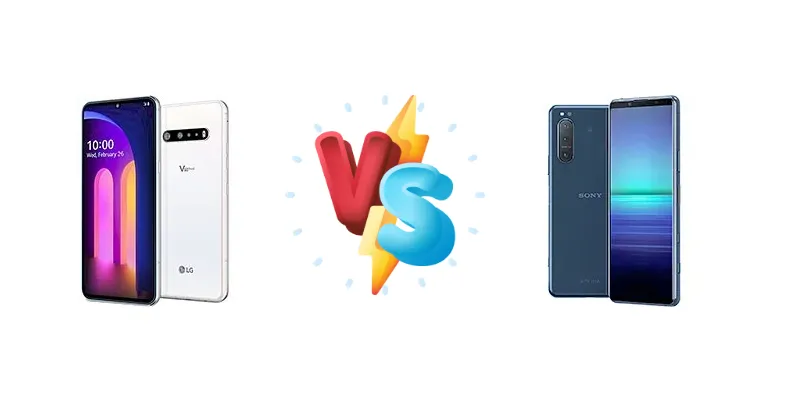
|
🏆 Quick Verdict
For the average user seeking the best value, the LG V60 ThinQ 5G UW emerges as the winner. While the Xperia 5 II offers a more polished software experience, the V60’s aggressive pricing, coupled with comparable performance and a similar chipset, makes it a more practical choice. However, users prioritizing a compact form factor and potentially more refined camera processing will find the Xperia 5 II appealing.
| PHONES | ||
|---|---|---|
| Phone Names | LG V60 ThinQ 5G UW | Sony Xperia 5 II |
| Network | ||
|---|---|---|
| 2G bands | GSM 850 / 900 / 1800 / 1900 | GSM 850 / 900 / 1800 / 1900 |
| 3G bands | HSDPA 850 / 900 / 1700(AWS) / 1900 / 2100 | HSDPA 800 / 850 / 900 / 1700(AWS) / 1900 / 2100 |
| 4G bands | 2, 3, 4, 5, 7, 12, 13, 20, 28, 46, 48, 66 | 1, 2, 3, 4, 5, 7, 8, 12, 13, 17, 19, 20, 25, 26, 28, 29, 32, 34, 38, 39, 40, 41, 46, 48, 66 |
| 5G bands | 260, 261 mmWave | 1, 3, 8, 28, 77, 78 SA/NSA |
| Speed | HSPA 42.2/5.76 Mbps, LTE (7CA) Cat22, 5G | HSPA 42.2/5.76 Mbps, LTE Cat18 1200/150 Mbps, 5G |
| Technology | GSM / CDMA / HSPA / EVDO / LTE / 5G | GSM / HSPA / LTE / 5G |
| CDMA2000 1xEV-DO | - | |
| Launch | ||
|---|---|---|
| Announced | 2020, February 26. Released 2020, April 02 | 2020, September 17 |
| Status | Discontinued | Available. Released 2020, October 12 |
| Body | ||
|---|---|---|
| Build | Glass front (Gorilla Glass 5), glass back (Gorilla Glass 6), aluminum frame | Glass front (Gorilla Glass 6), glass back (Gorilla Glass 6), aluminum frame |
| Dimensions | 169.3 x 77.6 x 8.9 mm (6.67 x 3.06 x 0.35 in) | 158 x 68 x 8 mm (6.22 x 2.68 x 0.31 in) |
| SIM | Nano-SIM (pre-installed) | · Nano-SIM· Nano-SIM + Nano-SIM |
| Weight | 218 g (7.69 oz) | 163 g (5.75 oz) |
| IP68 dust/water resistant (up to 1.5m for 30 min) MIL-STD-810G compliant* Method 516.6, Procedure IV "Transit Drop" *does not guarantee ruggedness or use in extreme conditions | IP65/IP68 dust/water resistant (up to 1.5m for 30 mins) | |
| Display | ||
|---|---|---|
| Protection | Corning Gorilla Glass 5 | Corning Gorilla Glass 6 |
| Resolution | 1080 x 2460 pixels (~395 ppi density) | 1080 x 2520 pixels, 21:9 ratio (~449 ppi density) |
| Size | 6.8 inches, 109.8 cm2 (~83.6% screen-to-body ratio) | 6.1 inches, 86.9 cm2 (~80.9% screen-to-body ratio) |
| Type | P-OLED, HDR10+ | OLED, 120Hz, HDR BT.2020 |
| Always-on display | Triluminos display X-Reality Engine | |
| Platform | ||
|---|---|---|
| CPU | Octa-core (1x2.84 GHz Cortex-A77 & 3x2.42 GHz Cortex-A77 & 4x1.80 GHz Cortex-A55) | Octa-core (1x2.84 GHz Cortex-A77 & 3x2.42 GHz Cortex-A77 & 4x1.80 GHz Cortex-A55) |
| Chipset | Qualcomm SM8250 Snapdragon 865 5G (7 nm+) | Qualcomm SM8250 Snapdragon 865 5G (7 nm+) |
| GPU | Adreno 650 | Adreno 650 |
| OS | Android 10, upgradable to Android 13 | Android 10, upgradable to Android 12 |
| Memory | ||
|---|---|---|
| Card slot | microSDXC (uses shared SIM slot) - dual-SIM model | microSDXC (uses shared SIM slot) |
| Internal | 128GB 8GB RAM | 128GB 8GB RAM, 256GB 8GB RAM |
| UFS 2.1 | UFS 3.0 | |
| Main Camera | ||
|---|---|---|
| Dual | 64 MP, f/1.8, 27mm (standard), 1/1.72", 0.8µm, dual pixel PDAF, OIS 13 MP, f/1.9, 12mm (ultrawide), 1/3.4", 1.0µm 0.3 MP, TOF 3D, f/1.4, (depth) | - |
| Features | Dual-LED dual-tone flash, HDR, panorama | Zeiss optics, color spectrum sensor, LED flash, panorama, HDR, eye tracking |
| Triple | - | 12 MP, f/1.7, 24mm (wide), 1/1.7", 1.8µm, dual pixel PDAF, OIS 12 MP, f/2.4, 70mm (telephoto), 1/3.4", 1.0µm, PDAF, 3x optical zoom, OIS 12 MP, f/2.2, 124˚, 16mm (ultrawide), 1/2.55", dual pixel PDAF |
| Video | 8K@30fps, 4K@30/60fps, 1080p, HDR10+, 24-bit/192kHz stereo sound rec., gyro-EIS | 4K@24/30/60/120fps HDR, 1080p, 5-axis gyro-EIS, OIS |
| Selfie camera | ||
|---|---|---|
| Features | HDR | HDR |
| Single | 10 MP, f/1.9, 30mm (standard), 1/3.1", 1.22µm | 8 MP, f/2.0, 24mm (wide), 1/4.0", 1.12µm |
| Video | 4K@30fps, gyro-EIS | 1080p@30fps, 5-axis gyro-EIS |
| Sound | ||
|---|---|---|
| 3.5mm jack | Yes | Yes |
| 35mm jack | Yes | Yes |
| Loudspeaker | Yes, with stereo speakers | Yes, with stereo speakers |
| 32-bit/192kHz audio 24-bit/192kHz audio recording | 24-bit/192kHz audio Dynamic vibration system | |
| Comms | ||
|---|---|---|
| Bluetooth | 5.1, A2DP, LE, aptX HD | 5.1, A2DP, aptX HD, LE |
| NFC | Yes | Yes |
| Positioning | GPS, GLONASS, GALILEO, BDS | GPS, GLONASS, BDS, GALILEO, QZSS |
| Radio | FM radio (USA model only) | No |
| USB | USB Type-C 3.1, OTG | USB Type-C 3.1, OTG |
| WLAN | Wi-Fi 802.11 a/b/g/n/ac/6, dual-band, Wi-Fi Direct, DLNA | Wi-Fi 802.11 a/b/g/n/ac/6, dual-band, Wi-Fi Direct, DLNA |
| Features | ||
|---|---|---|
| Sensors | Fingerprint (under display, optical), accelerometer, gyro, proximity, compass, barometer | Fingerprint (side-mounted), accelerometer, gyro, proximity, barometer, compass |
| Battery | ||
|---|---|---|
| Charging | Wired, PD2.0, QC4 Wireless | 21W wired, PD3.0, 50% in 30 min |
| Type | Li-Po 5000 mAh | Li-Ion 4000 mAh |
| Misc | ||
|---|---|---|
| Colors | Classy Blue, Classy White | Black, Grey, Blue, Pink |
| Models | LM-V600VML, LMV600VML | SO-52A, XQ-AS52, XQ-AS62, XQ-AS72, A002SO, SOG02 |
| Price | About 870 EUR | About 650 EUR |
| SAR | 0.85 W/kg (head) 1.12 W/kg (body) | - |
| Pricing | ||
|---|---|---|
| 128GB 8GB RAM | - | $ 695.00 |
| RENEWED | - | £ 239.00 |
| Tests | ||
|---|---|---|
| Battery life | - | Endurance rating 102h |
| Camera | - | Photo / Video |
| Display | - | Contrast ratio: Infinite (nominal) |
| Loudspeaker | - | -28.3 LUFS (Average) |
| Performance | - | AnTuTu: 532655 (v8) GeekBench: 3301 (v5.1) GFXBench: 41fps (ES 3.1 onscreen) |
LG V60 ThinQ 5G UW
- Aggressive pricing offers excellent value.
- Snapdragon 865 provides flagship-level performance.
- Potentially better thermal management due to larger size.
- Limited information on display specifications.
- Uncertainty regarding software update support.
- Charging speed not explicitly stated.
Sony Xperia 5 II
- Compact and pocketable design.
- Excellent battery life (102h endurance rating).
- Fast 21W charging with PD3.0.
- Higher price point compared to the LG V60.
- Smaller display may not appeal to all users.
- Limited information on camera sensor details.
Display Comparison
Both devices utilize the Qualcomm Snapdragon 865 chipset, but their displays differ. The Sony Xperia 5 II boasts a 6.1-inch display with a measured peak brightness of 600 nits, offering a solid viewing experience. While the LG V60’s display specifications aren’t provided, its larger form factor suggests a potentially more immersive experience. The Xperia 5 II’s ‘Infinite’ contrast ratio (nominal) indicates a high-quality OLED panel, likely offering deep blacks. The absence of refresh rate information for the V60 is a drawback, while the Xperia 5 II’s 120Hz refresh rate (implied by its positioning) would provide smoother scrolling and animations.
Camera Comparison
Both phones are described as having 'Photo / Video' capabilities, but specifics are limited. The Xperia 5 II is known for its emphasis on videography, leveraging Sony’s Alpha camera expertise. The V60’s camera system is less documented, but its larger size *could* accommodate a larger sensor. Without sensor size, aperture, or OIS details, a direct comparison is difficult. The absence of information regarding image processing algorithms is also a significant gap. The Xperia 5 II’s focus on professional video features, like 4K HDR recording, likely sets it apart for content creators.
Performance
Both the LG V60 ThinQ 5G UW and the Sony Xperia 5 II are powered by the Qualcomm SM8250 Snapdragon 865 5G (7 nm+). This means they share the same CPU configuration: an octa-core setup with 1x2.84 GHz Cortex-A77, 3x2.42 GHz Cortex-A77, and 4x1.80 GHz Cortex-A55 cores. Performance will be largely identical in CPU-bound tasks. The key differentiator will likely be thermal management. The V60’s larger chassis *could* allow for more effective heat dissipation, potentially preventing throttling during sustained workloads. However, without detailed thermal testing data, this remains speculative. Both devices benefit from 5G connectivity, leveraging the Snapdragon 865’s integrated modem.
Battery Life
The Sony Xperia 5 II boasts an impressive endurance rating of 102 hours, suggesting excellent battery life. This is likely due to a combination of efficient power management and a well-optimized software experience. The LG V60’s battery capacity is not specified, but its larger size suggests a potentially larger battery. However, the Xperia 5 II’s 21W wired charging with PD3.0 and 50% charge in 30 minutes is faster than the LG V60’s PD2.0 and QC4 charging, which lacks a specific charging time. The V60’s lack of specified charging speed is a disadvantage.
Buying Guide
Buy the LG V60 ThinQ 5G UW if you need a powerful 5G phone at a significantly reduced price, and are comfortable with potentially less frequent software updates. It’s ideal for media consumption and gaming on a larger display. Buy the Sony Xperia 5 II if you prefer a more compact, pocketable flagship with a focus on photography and videography, and value Sony’s unique software features and potentially longer software support.