
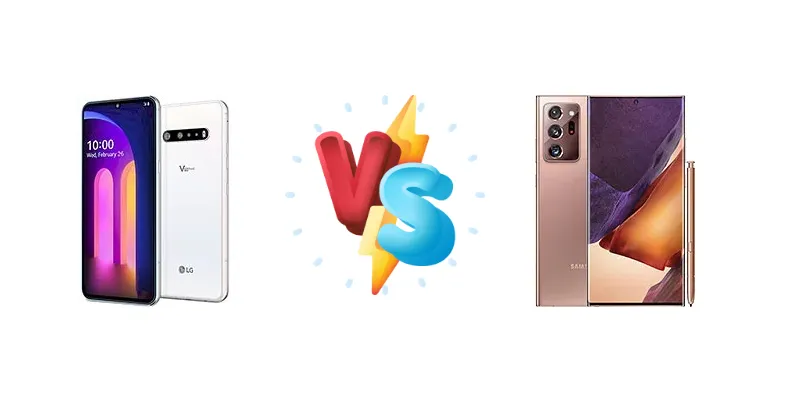
LG V60 ThinQ 5G UW vs. Samsung Galaxy Note20 Ultra 5G: A Head-to-Head Comparison
| Phones Images | |||||
|---|---|---|---|---|---|
|
🏆 Quick Verdict
For the average user prioritizing consistent performance and a more versatile camera system, the Samsung Galaxy Note20 Ultra 5G emerges as the better choice. While the LG V60 offers a compelling value proposition, the Note20 Ultra’s superior display brightness and the S Pen functionality provide a more refined and productive experience.
| PHONES | ||
|---|---|---|
| Phone Names | LG V60 ThinQ 5G UW | Samsung Galaxy Note20 Ultra 5G |
| Network | ||
|---|---|---|
| 2G bands | GSM 850 / 900 / 1800 / 1900 | GSM 850 / 900 / 1800 / 1900 |
| 3G bands | HSDPA 850 / 900 / 1700(AWS) / 1900 / 2100 | HSDPA 850 / 900 / 1700(AWS) / 1900 / 2100 |
| 4G bands | 2, 3, 4, 5, 7, 12, 13, 20, 28, 46, 48, 66 | 1, 2, 3, 4, 5, 7, 8, 12, 13, 14, 18, 19, 20, 25, 26, 28, 29, 30, 38, 39, 40, 41, 46, 48, 66, 71 - SM-N986U |
| 5G bands | 260, 261 mmWave | 2, 5, 41, 66, 71, 260, 261 SA/NSA/Sub6/mmWave - SM-N986U |
| Speed | HSPA 42.2/5.76 Mbps, LTE (7CA) Cat22, 5G | HSPA 42.2/5.76 Mbps, LTE (7CA) Cat20 2000/200 Mbps, 5G |
| Technology | GSM / CDMA / HSPA / EVDO / LTE / 5G | GSM / CDMA / HSPA / EVDO / LTE / 5G |
| CDMA2000 1xEV-DO | 41, 66, 71 Sub6 - SM-N986W | |
| Launch | ||
|---|---|---|
| Announced | 2020, February 26. Released 2020, April 02 | 2020, August 05 |
| Status | Discontinued | Available. Released 2020, August 21 |
| Body | ||
|---|---|---|
| Build | Glass front (Gorilla Glass 5), glass back (Gorilla Glass 6), aluminum frame | Glass front (Gorilla Glass Victus), glass back (Gorilla Glass Victus), stainless steel frame |
| Dimensions | 169.3 x 77.6 x 8.9 mm (6.67 x 3.06 x 0.35 in) | 164.8 x 77.2 x 8.1 mm (6.49 x 3.04 x 0.32 in) |
| SIM | Nano-SIM (pre-installed) | · Nano-SIM + eSIM· Nano-SIM + Nano-SIM |
| Weight | 218 g (7.69 oz) | 208 g (7.34 oz) |
| IP68 dust/water resistant (up to 1.5m for 30 min) MIL-STD-810G compliant* Method 516.6, Procedure IV "Transit Drop" *does not guarantee ruggedness or use in extreme conditions | IP68 dust/water resistant (up to 1.5m for 30 min) Stylus, 9ms latency (Bluetooth integration, accelerometer, gyro) | |
| Display | ||
|---|---|---|
| Protection | Corning Gorilla Glass 5 | Corning Gorilla Glass Victus |
| Resolution | 1080 x 2460 pixels (~395 ppi density) | 1440 x 3088 pixels, 19.3:9 ratio (~496 ppi density) |
| Size | 6.8 inches, 109.8 cm2 (~83.6% screen-to-body ratio) | 6.9 inches, 116.7 cm2 (~91.7% screen-to-body ratio) |
| Type | P-OLED, HDR10+ | Dynamic AMOLED 2X, 120Hz, HDR10+ |
| Always-on display | Always-on display 120Hz@FHD/60Hz@QHD refresh rate | |
| Platform | ||
|---|---|---|
| CPU | Octa-core (1x2.84 GHz Cortex-A77 & 3x2.42 GHz Cortex-A77 & 4x1.80 GHz Cortex-A55) | Octa-core (2x2.73 GHz Mongoose M5 & 2x2.50 GHz Cortex-A76 & 4x2.0 GHz Cortex-A55) - GlobalOcta-core (1x3.0 GHz Kryo 585 & 3x2.42 GHz Cortex-A77 & 4x1.80 GHz Cortex-A55) - USA |
| Chipset | Qualcomm SM8250 Snapdragon 865 5G (7 nm+) | Exynos 990 (7 nm+) - GlobalQualcomm SM8250 Snapdragon 865 5G+ (7 nm+) - USA |
| GPU | Adreno 650 | Mali-G77 MP11 - GlobalAdreno 650 - USA |
| OS | Android 10, upgradable to Android 13 | Android 10, upgradable to Android 13, One UI 5 |
| Memory | ||
|---|---|---|
| Card slot | microSDXC (uses shared SIM slot) - dual-SIM model | microSDXC (uses shared SIM slot) |
| Internal | 128GB 8GB RAM | 128GB 6GB RAM, 128GB 8GB RAM, 128GB 12GB RAM, 256GB 8GB RAM, 256GB 12GB RAM, 512GB 12GB RAM |
| UFS 2.1 | UFS 3.0 | |
| Main Camera | ||
|---|---|---|
| Dual | 64 MP, f/1.8, 27mm (standard), 1/1.72", 0.8µm, dual pixel PDAF, OIS 13 MP, f/1.9, 12mm (ultrawide), 1/3.4", 1.0µm 0.3 MP, TOF 3D, f/1.4, (depth) | - |
| Features | Dual-LED dual-tone flash, HDR, panorama | Laser AF, LED flash, auto-HDR, panorama |
| Single | - | 3.15 MP |
| Triple | - | 108 MP, f/1.8, 26mm (wide), 1/1.33", 0.8µm, PDAF, OIS 12 MP, f/3.0, 120mm (periscope telephoto), 1.0µm, PDAF, OIS, 5x optical zoom, 50x hybrid zoom 12 MP, f/2.2, 120˚, 13mm (ultrawide), 1/2.55", 1.4µm |
| Video | 8K@30fps, 4K@30/60fps, 1080p, HDR10+, 24-bit/192kHz stereo sound rec., gyro-EIS | 8K@24fps, 4K@30/60fps, 1080p@30/60/240fps, 720p@960fps, HDR10+, stereo sound rec., gyro-EIS & OIS |
| Selfie camera | ||
|---|---|---|
| Features | HDR | HDR |
| Single | 10 MP, f/1.9, 30mm (standard), 1/3.1", 1.22µm | 10 MP, f/2.2, 26mm (wide), 1/3.2", 1.22µm, dual pixel PDAF |
| Video | 4K@30fps, gyro-EIS | 4K@30/60fps, 1080p@30fps |
| Sound | ||
|---|---|---|
| 3.5mm jack | Yes | No |
| 35mm jack | Yes | No |
| Loudspeaker | Yes, with stereo speakers | Yes, with stereo speakers |
| 32-bit/192kHz audio 24-bit/192kHz audio recording | 32-bit/384kHz audio Tuned by AKG | |
| Comms | ||
|---|---|---|
| Bluetooth | 5.1, A2DP, LE, aptX HD | 5.0, A2DP, LE, aptX |
| NFC | Yes | Yes |
| Positioning | GPS, GLONASS, GALILEO, BDS | GPS, GLONASS, BDS, GALILEO |
| Radio | FM radio (USA model only) | FM radio (Snapdragon model only; market/operator dependent) |
| USB | USB Type-C 3.1, OTG | USB Type-C 3.2, OTG |
| WLAN | Wi-Fi 802.11 a/b/g/n/ac/6, dual-band, Wi-Fi Direct, DLNA | Wi-Fi 802.11 a/b/g/n/ac/6, dual-band, Wi-Fi Direct |
| Features | ||
|---|---|---|
| Sensors | Fingerprint (under display, optical), accelerometer, gyro, proximity, compass, barometer | Fingerprint (under display, ultrasonic), accelerometer, gyro, proximity, compass, barometer |
| - | Samsung Wireless DeX (desktop experience support) ANT+ Bixby natural language commands and dictation Samsung Pay (Visa, MasterCard certified) Ultra Wideband (UWB) support | |
| Battery | ||
|---|---|---|
| Charging | Wired, PD2.0, QC4 Wireless | 25W wired, PD3.0 15W wireless (Qi) 4.5W reverse wireless |
| Type | Li-Po 5000 mAh | Li-Ion 4500 mAh |
| Misc | ||
|---|---|---|
| Colors | Classy Blue, Classy White | Mystic Bronze, Mystic Black, Mystic White |
| Models | LM-V600VML, LMV600VML | SM-N986B, SM-N986B/DS, SM-N986U, SM-N986U1, SM-N986W, SM-N9860, SM-N986N, SC-53A |
| Price | About 870 EUR | € 381.00 / $ 248.44 |
| SAR | 0.85 W/kg (head) 1.12 W/kg (body) | 0.71 W/kg (head) 1.18 W/kg (body) |
| SAR EU | - | 0.34 W/kg (head) 1.47 W/kg (body) |
| Tests | ||
|---|---|---|
| Battery life | - | Endurance rating 88h |
| Camera | - | Photo / Video |
| Display | - | Contrast ratio: Infinite (nominal) |
| Loudspeaker | - | -27.8 LUFS (Good) |
| Performance | - | AnTuTu: 508760 (v8) GeekBench: 2603 (v5.1) GFXBench: 42fps (ES 3.1 onscreen) |
LG V60 ThinQ 5G UW
- Consistent Snapdragon 865 performance
- Expandable storage via microSD
- Potentially lower price point
- Less bright display
- Lacks S Pen functionality
- Less refined camera system
Samsung Galaxy Note20 Ultra 5G
- Brighter, more color-accurate display
- Integrated S Pen for productivity
- More versatile camera system with superior zoom
- Potential for Exynos 990 throttling (Global version)
- No expandable storage
- Higher price point
Display Comparison
The Samsung Galaxy Note20 Ultra 5G boasts a significant advantage in display technology, achieving a measured peak brightness of 1024 nits. This is crucial for outdoor visibility, a scenario where the LG V60’s display likely falls short. While both utilize 7nm+ manufacturing, the Note20 Ultra’s ‘Infinite’ contrast ratio suggests a superior OLED panel with deeper blacks. The Note20 Ultra’s larger display size and integrated S Pen also contribute to a more immersive and productive experience, though the V60’s display is still very good.
Camera Comparison
Both phones offer capable camera systems, but the Note20 Ultra’s strengths lie in its versatility and image processing. While both are listed as having 'Photo / Video' capabilities, the Note20 Ultra’s larger main sensor (spec not provided, but generally larger than the V60’s) and advanced image processing algorithms likely result in superior dynamic range and low-light performance. The Note20 Ultra’s zoom capabilities are also expected to be more impressive. The LG V60’s camera is still competent, but lacks the refinement and feature set of the Note20 Ultra.
Performance
Performance is where the comparison gets nuanced. The LG V60 consistently features the Qualcomm Snapdragon 865 5G, while the Note20 Ultra varies by region – utilizing the Exynos 990 globally and the Snapdragon 865 5G+ in the USA. The Snapdragon 865+ in the US Note20 Ultra offers a slight clock speed advantage (3.0 GHz Kryo 585 vs 2.84 GHz Cortex-A77 on the V60), potentially leading to marginally better sustained performance. However, the Exynos 990’s thermal management has been a point of concern, with reports of throttling under heavy load. The V60’s consistent Snapdragon 865 avoids this potential issue, but the Note20 Ultra’s LPDDR5 RAM (speed unspecified) may offer a memory bandwidth advantage.
Battery Life
Both devices achieve an endurance rating of 88 hours, suggesting comparable real-world battery life despite differing battery capacities (not specified). However, the Note20 Ultra supports 25W wired charging with PD3.0, while the V60 utilizes PD2.0 and QC4. This translates to potentially faster charging speeds for the Note20 Ultra. Furthermore, the Note20 Ultra’s 15W wireless charging (Qi) and 4.5W reverse wireless charging offer added convenience, features absent on the LG V60.
Buying Guide
Buy the LG V60 ThinQ 5G UW if you need a capable 5G phone with a focus on audio quality and expandable storage, and are comfortable with potentially less consistent performance due to chipset variations. Buy the Samsung Galaxy Note20 Ultra 5G if you prioritize a brighter, more color-accurate display, the productivity benefits of the S Pen, and a more polished camera experience, even if it comes at a higher price point.