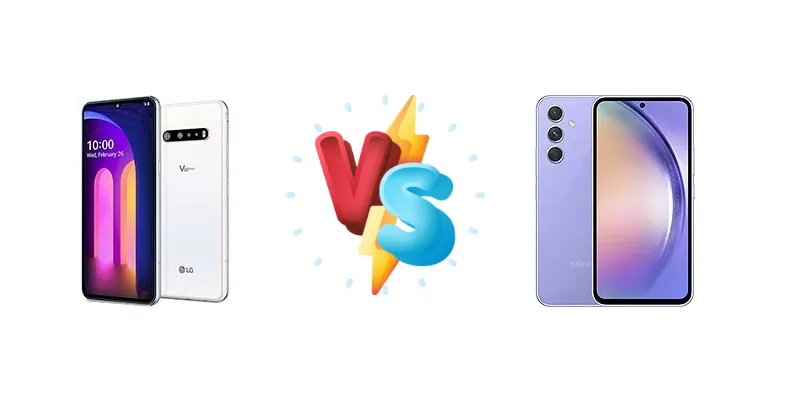
The LG V60 ThinQ 5G UW, though an older flagship, remains a compelling option due to its powerful Snapdragon 865 chipset. Now, it faces off against the newer Samsung Galaxy A54, a popular mid-range contender. This comparison dissects their key differences, helping you determine which device delivers the best value in today's market.
🏆 Quick Verdict
For users prioritizing raw performance and future-proofing, the LG V60 ThinQ 5G UW is the better choice, despite its age. However, the Samsung Galaxy A54 offers a more modern experience with excellent battery life and a brighter display, making it ideal for everyday users.
| Network |
|---|
| 2G bands | GSM 850 / 900 / 1800 / 1900 | GSM 850 / 900 / 1800 / 1900 |
| 3G bands | HSDPA 850 / 900 / 1700(AWS) / 1900 / 2100 | HSDPA 850 / 900 / 1700(AWS) / 1900 / 2100 |
| 4G bands | 2, 3, 4, 5, 7, 12, 13, 20, 28, 46, 48, 66 | 1, 2, 3, 4, 5, 7, 8, 12, 17, 20, 26, 28, 32, 38, 40, 41, 66 - International |
| 5G bands | 260, 261 mmWave | 1, 3, 7, 8, 20, 28, 38, 40, 41, 77, 78 SA/NSA/Sub6 - International |
| Speed | HSPA 42.2/5.76 Mbps, LTE (7CA) Cat22, 5G | HSPA, LTE, 5G |
| Technology | GSM / CDMA / HSPA / EVDO / LTE / 5G | GSM / HSPA / LTE / 5G |
| | CDMA2000 1xEV-DO | 25, 41, 66, 71 SA/NSA/Sub6/mmWave - USA |
| Launch |
|---|
| Announced | 2020, February 26. Released 2020, April 02 | 2023, March 15 |
| Status | Discontinued | Available. Released 2023, March 24 |
| Body |
|---|
| Build | Glass front (Gorilla Glass 5), glass back (Gorilla Glass 6), aluminum frame | Glass front (Gorilla Glass 5), glass back (Gorilla Glass 5), plastic frame |
| Dimensions | 169.3 x 77.6 x 8.9 mm (6.67 x 3.06 x 0.35 in) | 158.2 x 76.7 x 8.2 mm (6.23 x 3.02 x 0.32 in) |
| SIM | Nano-SIM (pre-installed) | · Nano-SIM + eSIM· Nano-SIM + Nano-SIM |
| Weight | 218 g (7.69 oz) | 202 g (7.13 oz) |
| | IP68 dust/water resistant (up to 1.5m for 30 min)
MIL-STD-810G compliant*
Method 516.6, Procedure IV "Transit Drop"
*does not guarantee ruggedness or use in extreme conditions | IP67 dust/water resistant (up to 1m for 30 min) |
| Display |
|---|
| Protection | Corning Gorilla Glass 5 | Corning Gorilla Glass 5 |
| Resolution | 1080 x 2460 pixels (~395 ppi density) | 1080 x 2340 pixels, 19.5:9 ratio (~403 ppi density) |
| Size | 6.8 inches, 109.8 cm2 (~83.6% screen-to-body ratio) | 6.4 inches, 100.5 cm2 (~82.9% screen-to-body ratio) |
| Type | P-OLED, HDR10+ | Super AMOLED, 120Hz, HDR10+, 1000 nits (HBM) |
| | Always-on display | - |
| Platform |
|---|
| CPU | Octa-core (1x2.84 GHz Cortex-A77 & 3x2.42 GHz Cortex-A77 & 4x1.80 GHz Cortex-A55) | Octa-core (4x2.4 GHz Cortex-A78 & 4x2.0 GHz Cortex-A55) |
| Chipset | Qualcomm SM8250 Snapdragon 865 5G (7 nm+) | Exynos 1380 (5 nm) |
| GPU | Adreno 650 | Mali-G68 MP5 |
| OS | Android 10, upgradable to Android 13 | Android 13, up to 4 major Android upgrades, One UI 7 |
| Memory |
|---|
| Card slot | microSDXC (uses shared SIM slot) - dual-SIM model | microSDXC (uses shared SIM slot) |
| Internal | 128GB 8GB RAM | 128GB 4GB RAM, 128GB 6GB RAM, 128GB 8GB RAM, 256GB 6GB RAM, 256GB 8GB RAM |
| | UFS 2.1 | - |
| Main Camera |
|---|
| Dual | 64 MP, f/1.8, 27mm (standard), 1/1.72", 0.8µm, dual pixel PDAF, OIS
13 MP, f/1.9, 12mm (ultrawide), 1/3.4", 1.0µm
0.3 MP, TOF 3D, f/1.4, (depth) | - |
| Features | Dual-LED dual-tone flash, HDR, panorama | LED flash, panorama, HDR |
| Single | - | 32 MP, f/2.2, 26mm (wide), 1/2.8", 0.8µm |
| Triple | - | 50 MP, f/1.8, 23mm (wide), 1/1.56", 1.0µm, PDAF, OIS
12 MP, f/2.2, 13mm, 123˚ (ultrawide), 1/3.X", 1.12µm
5 MP (macro) |
| Video | 8K@30fps, 4K@30/60fps, 1080p, HDR10+, 24-bit/192kHz stereo sound rec., gyro-EIS | 4K@30fps, 1080p@30/60fps, 720p@480fps, gyro-EIS |
| Selfie camera |
|---|
| Features | HDR | - |
| Single | 10 MP, f/1.9, 30mm (standard), 1/3.1", 1.22µm | 32 MP, f/2.2, 26mm (wide), 1/2.8", 0.8µm |
| Video | 4K@30fps, gyro-EIS | 4K@30fps, 1080p@30/60fps |
| Sound |
|---|
| 3.5mm jack | Yes | No |
| 35mm jack | Yes | No |
| Loudspeaker | Yes, with stereo speakers | Yes, with stereo speakers |
| | 32-bit/192kHz audio
24-bit/192kHz audio recording | - |
| Comms |
|---|
| Bluetooth | 5.1, A2DP, LE, aptX HD | 5.3, A2DP, LE |
| NFC | Yes | Yes (market/region dependent) |
| Positioning | GPS, GLONASS, GALILEO, BDS | GPS, GLONASS, GALILEO, BDS |
| Radio | FM radio (USA model only) | No |
| USB | USB Type-C 3.1, OTG | USB Type-C 2.0, OTG |
| WLAN | Wi-Fi 802.11 a/b/g/n/ac/6, dual-band, Wi-Fi Direct, DLNA | Wi-Fi 802.11 a/b/g/n/ac/6, dual-band, Wi-Fi Direct |
| Features |
|---|
| Sensors | Fingerprint (under display, optical), accelerometer, gyro, proximity, compass, barometer | Fingerprint (under display, optical), accelerometer, gyro, compass, barometer (USA only) |
| | - | Virtual proximity sensing |
| Battery |
|---|
| Charging | Wired, PD2.0, QC4
Wireless | 25W wired |
| Type | Li-Po 5000 mAh | 5000 mAh |
| Misc |
|---|
| Colors | Classy Blue, Classy White | Lime, Graphite, Violet, White |
| Models | LM-V600VML, LMV600VML | SM-A546V, SM-A546U, SM-A546U1, SM-A546B, SM-A546B/DS, SM-A546E, SM-A546E/DS, SM-A5460, SM-A546M, SM-A546M/DS, SM-A546W |
| Price | About 870 EUR | € 210.00 / $ 119.11 / £ 169.95 / ₹ 28,999 |
| SAR | 0.85 W/kg (head) 1.12 W/kg (body) | 0.81 W/kg (head) 0.67 W/kg (body) |
| SAR EU | - | 0.69 W/kg (head) 1.34 W/kg (body) |
| Tests |
|---|
| Battery life | - |
Endurance rating 119h
|
| Camera | - |
Photo / Video |
| Display | - |
Contrast ratio: Infinite (nominal) |
| Loudspeaker | - |
-26.6 LUFS (Good)
|
| Performance | - |
AnTuTu: 506678 (v9)
GeekBench: 2703 (v5.1), 2797 (v6)
GFXBench: 25fps (ES 3.1 onscreen) |
LG V60 ThinQ 5G UW
- Superior processing power with Snapdragon 865
- Potentially faster charging with PD2.0/QC4 support
- 5G UW support for faster network speeds
- Likely shorter battery life
- Older device with potentially limited software updates
- Display brightness likely lower than A54
Samsung Galaxy A54
- Excellent battery life and endurance
- Brighter display for outdoor visibility
- More modern software and guaranteed updates
- Less powerful processor compared to Snapdragon 865
- Slower 25W charging
- May struggle with demanding games at maximum settings
Display Comparison
The Samsung Galaxy A54 boasts a significantly brighter display, reaching 980 nits, compared to the LG V60’s unspecified peak brightness (likely lower). While the LG V60’s panel technology isn’t detailed, the A54’s ‘Infinite’ contrast ratio suggests a VA panel, offering deeper blacks. The A54’s brightness is a clear advantage for outdoor visibility. The LG V60’s display, while likely still good, is showing its age against newer panels.
Camera Comparison
Both devices offer photo and video capabilities, but detailed sensor information for the LG V60 is missing. The Galaxy A54 likely benefits from Samsung’s advanced image processing algorithms. Without specific sensor sizes or apertures for the LG V60, it’s difficult to make a direct comparison. The A54’s camera system is optimized for social media sharing and everyday photography, while the LG V60, if equipped with a high-end sensor, could offer more flexibility for advanced users. The inclusion of OIS on the A54 is a plus for stable video recording.
Performance
The LG V60’s Snapdragon 865, built on a 7nm+ process, represents a significant performance leap over the Samsung Galaxy A54’s Exynos 1380 (5nm). The 865’s Cortex-A77 cores, clocked at up to 2.84 GHz, outperform the A54’s Cortex-A78 cores at 2.4 GHz. While the Exynos 1380 benefits from a more efficient 5nm node, the Snapdragon 865’s raw processing power and Adreno 650 GPU will deliver a smoother experience in graphically intensive applications. However, the 5nm process of the Exynos 1380 should result in better thermal efficiency, potentially reducing throttling during sustained loads.
Battery Life
The Samsung Galaxy A54 demonstrates impressive battery endurance, achieving an endurance rating of 119 hours and 11:15 hours of active use. The LG V60’s battery capacity and performance are not specified, but its more power-hungry Snapdragon 865 likely results in shorter battery life. The A54’s 25W wired charging is slower than the LG V60’s support for PD2.0 and QC4, suggesting potentially faster charging speeds on the older device, though this depends on the charger used. The A54’s efficiency is a key advantage for all-day use.
Buying Guide
Buy the LG V60 ThinQ 5G UW if you need uncompromising processing power for demanding tasks like gaming or video editing, and appreciate the potential for faster 5G speeds. Buy the Samsung Galaxy A54 if you prefer a longer-lasting battery, a vibrant display for media consumption, and a more streamlined software experience with guaranteed updates.
Frequently Asked Questions
❓ Does the Exynos 1380 in the Galaxy A54 overheat during prolonged gaming sessions?
The Exynos 1380’s 5nm process is designed for improved thermal efficiency. While it won’t match the raw cooling capacity of a flagship, it’s unlikely to overheat significantly during typical gaming sessions. Expect some throttling after extended play, but it should remain manageable.
❓ Is the LG V60's 5G UW support still relevant, and will it work on all 5G networks?
The LG V60’s 5G UW (Ultra Wideband) support is beneficial on compatible mmWave networks, offering significantly faster speeds. However, mmWave coverage is limited. It will also work on sub-6GHz 5G networks, but the UW feature is only useful where mmWave is deployed.
❓ How does the Snapdragon 865's performance hold up in 2024 compared to newer chipsets?
While the Snapdragon 865 is no longer the top-of-the-line chipset, it remains a very capable performer in 2024. It can still handle most modern apps and games smoothly, though it may not reach the same frame rates as devices with newer processors like the Snapdragon 8 Gen 2 or 8 Gen 3.