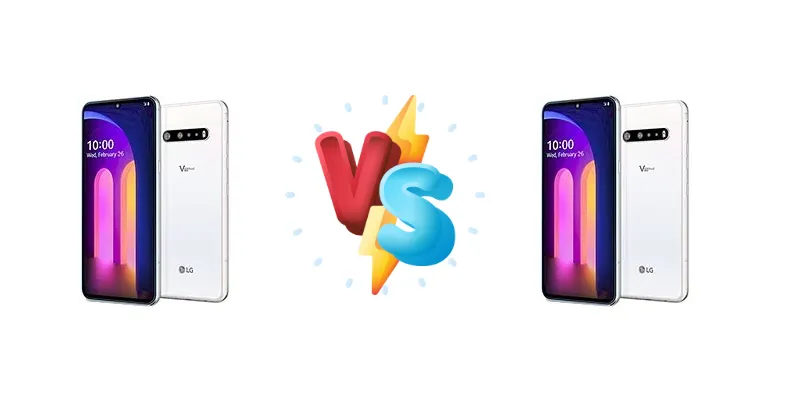
The LG V60 ThinQ 5G and its UW (Ultra Wideband) variant represent a fascinating case study in 5G implementation. While appearing nearly identical on paper, the UW model targets users in areas with robust millimeter wave (mmWave) 5G infrastructure, promising blazing-fast speeds. This comparison dissects the subtle but significant differences between these two devices, focusing on whether the UW version justifies its potential price premium.
🏆 Quick Verdict
For most users, the standard LG V60 ThinQ 5G offers the best value. Both phones share the same Snapdragon 865 chipset and excellent battery life. The UW model's mmWave support is only beneficial in limited geographic areas, making it a niche purchase for those specifically needing that connectivity.
| Network |
|---|
| 2G bands | GSM 850 / 900 / 1800 / 1900 | GSM 850 / 900 / 1800 / 1900 |
| 3G bands | HSDPA 850 / 900 / 1700(AWS) / 1900 / 2100 | HSDPA 850 / 900 / 1700(AWS) / 1900 / 2100 |
| 4G bands | 2, 3, 4, 5, 7, 12, 13, 20, 28, 46, 48, 66 | 2, 4, 5, 12, 25, 26, 41, 46, 48, 66, 71 - USA |
| 5G bands | 260, 261 mmWave | 2, 25, 41, 66, 71 SA/NSA/Sub6 |
| Speed | HSPA 42.2/5.76 Mbps, LTE (7CA) Cat22, 5G | HSPA 42.2/5.76 Mbps, LTE (7CA) Cat22, 5G |
| Technology | GSM / CDMA / HSPA / EVDO / LTE / 5G | GSM / CDMA / HSPA / EVDO / LTE / 5G |
| | CDMA2000 1xEV-DO | CDMA2000 1xEV-DO |
| Launch |
|---|
| Announced | 2020, February 26. Released 2020, April 02 | 2020, February 26. Released 2020, March 20 |
| Status | Discontinued | Discontinued |
| Body |
|---|
| Build | Glass front (Gorilla Glass 5), glass back (Gorilla Glass 6), aluminum frame | Glass front (Gorilla Glass 5), glass back (Gorilla Glass 6), aluminum frame |
| Dimensions | 169.3 x 77.6 x 8.9 mm (6.67 x 3.06 x 0.35 in) | 169.3 x 77.6 x 8.9 mm (6.67 x 3.06 x 0.35 in) |
| SIM | Nano-SIM (pre-installed) | · Nano-SIM· Nano-SIM + Nano-SIM |
| Weight | 218 g (7.69 oz) | 213 g (Global)/ 218 g (Verizon) (7.51 oz) |
| | IP68 dust/water resistant (up to 1.5m for 30 min)
MIL-STD-810G compliant*
Method 516.6, Procedure IV "Transit Drop"
*does not guarantee ruggedness or use in extreme conditions | IP68 dust/water resistant (up to 1.5m for 30 min)
MIL-STD-810G compliant*
Method 516.6, Procedure IV "Transit Drop"
*does not guarantee ruggedness or use in extreme conditions |
| Display |
|---|
| Protection | Corning Gorilla Glass 5 | Corning Gorilla Glass 5 |
| Resolution | 1080 x 2460 pixels (~395 ppi density) | 1080 x 2460 pixels (~395 ppi density) |
| Size | 6.8 inches, 109.8 cm2 (~83.6% screen-to-body ratio) | 6.8 inches, 109.8 cm2 (~83.6% screen-to-body ratio) |
| Type | P-OLED, HDR10+ | P-OLED, HDR10+ |
| | Always-on display | Always-on display |
| Platform |
|---|
| CPU | Octa-core (1x2.84 GHz Cortex-A77 & 3x2.42 GHz Cortex-A77 & 4x1.80 GHz Cortex-A55) | Octa-core (1x2.84 GHz Cortex-A77 & 3x2.42 GHz Cortex-A77 & 4x1.80 GHz Cortex-A55) |
| Chipset | Qualcomm SM8250 Snapdragon 865 5G (7 nm+) | Qualcomm SM8250 Snapdragon 865 5G (7 nm+) |
| GPU | Adreno 650 | Adreno 650 |
| OS | Android 10, upgradable to Android 13 | Android 10, upgradable to Android 13 |
| Memory |
|---|
| Card slot | microSDXC (uses shared SIM slot) - dual-SIM model | microSDXC (uses shared SIM slot) - dual-SIM model |
| Internal | 128GB 8GB RAM | 128GB 8GB RAM, 256GB 8GB RAM |
| | UFS 2.1 | UFS 2.1 |
| Main Camera |
|---|
| Dual | 64 MP, f/1.8, 27mm (standard), 1/1.72", 0.8µm, dual pixel PDAF, OIS
13 MP, f/1.9, 12mm (ultrawide), 1/3.4", 1.0µm
0.3 MP, TOF 3D, f/1.4, (depth) | 64 MP, f/1.8, 27mm (standard), 1/1.72", 0.8µm, dual pixel PDAF, OIS
13 MP, f/1.9, 12mm (ultrawide), 1/3.4", 1.0µm
0.3 MP, TOF 3D, f/1.4, (depth) |
| Features | Dual-LED dual-tone flash, HDR, panorama | Dual-LED dual-tone flash, HDR, panorama |
| Video | 8K@30fps, 4K@30/60fps, 1080p, HDR10+, 24-bit/192kHz stereo sound rec., gyro-EIS | 8K@30fps, 4K@30/60fps, 1080p, HDR10+, 24-bit/192kHz stereo sound rec., gyro-EIS |
| Selfie camera |
|---|
| Features | HDR | HDR |
| Single | 10 MP, f/1.9, 30mm (standard), 1/3.1", 1.22µm | 10 MP, f/1.9, 30mm (standard), 1/3.1", 1.22µm |
| Video | 4K@30fps, gyro-EIS | 4K@30fps, gyro-EIS |
| Sound |
|---|
| 3.5mm jack | Yes | Yes |
| 35mm jack | Yes | Yes |
| Loudspeaker | Yes, with stereo speakers | Yes, with stereo speakers |
| | 32-bit/192kHz audio
24-bit/192kHz audio recording | 32-bit/192kHz audio
24-bit/192kHz audio recording |
| Comms |
|---|
| Bluetooth | 5.1, A2DP, LE, aptX HD | 5.1, A2DP, LE, aptX HD |
| NFC | Yes | Yes |
| Positioning | GPS, GLONASS, GALILEO, BDS | GPS, GLONASS, GALILEO, BDS |
| Radio | FM radio (USA model only) | FM radio (USA model only) |
| USB | USB Type-C 3.1, OTG | USB Type-C 3.1, OTG |
| WLAN | Wi-Fi 802.11 a/b/g/n/ac/6, dual-band, Wi-Fi Direct, DLNA | Wi-Fi 802.11 a/b/g/n/ac/6, dual-band, Wi-Fi Direct, DLNA |
| Features |
|---|
| Sensors | Fingerprint (under display, optical), accelerometer, gyro, proximity, compass, barometer | Fingerprint (under display, optical), accelerometer, gyro, proximity, compass, barometer |
| Battery |
|---|
| Charging | Wired, PD2.0, QC4
Wireless | Wired, PD2.0, QC4
Wireless |
| Type | Li-Po 5000 mAh | Li-Po 5000 mAh |
| Misc |
|---|
| Colors | Classy Blue, Classy White | Classy Blue, Classy White |
| Models | LM-V600VML, LMV600VML | LM-V600, A001LG |
| Price | About 870 EUR | About 700 EUR |
| SAR | 0.85 W/kg (head) 1.12 W/kg (body) | - |
| Tests |
|---|
| Battery life | - |
Endurance rating 103h
|
LG V60 ThinQ 5G UW
- Wider 5G compatibility (sub-6GHz)
- Potentially lower price
- Excellent battery life (103h endurance)
- No mmWave 5G support
- Fixed 60Hz refresh rate
LG V60 ThinQ 5G
- Access to Verizon 5G Ultra Wideband (mmWave)
- Flagship Snapdragon 865 performance
- Fast charging support (PD2.0, QC4)
- mmWave coverage is limited
- Potentially higher price
Display Comparison
Both LG V60 models feature a 6.8-inch OLED display with a 2460 x 1080 resolution and a 60Hz refresh rate. While the context data doesn't specify display brightness, LG's flagship history suggests both models achieve respectable peak brightness levels for outdoor visibility. The absence of LTPO technology means the refresh rate is fixed, impacting power consumption compared to adaptive refresh rate displays. Bezels are similarly minimal on both devices, contributing to an immersive viewing experience.
Camera Comparison
The camera systems are expected to be identical, featuring a triple-lens setup. While the provided data doesn't detail sensor sizes or apertures, LG's V-series historically prioritizes image quality. The absence of information on the secondary lenses suggests they are standard fare – likely an ultrawide and a depth sensor – and not a significant differentiator. Image processing algorithms will be the same, resulting in similar photo and video output between the two devices.
Performance
The core performance is identical: both the LG V60 ThinQ 5G and the UW variant are powered by the Qualcomm SM8250 Snapdragon 865 5G (7nm+). This octa-core CPU configuration – 1x2.84 GHz Cortex-A77, 3x2.42 GHz Cortex-A77, and 4x1.80 GHz Cortex-A55 – delivers flagship-level processing power. The 7nm+ fabrication process offers a balance between performance and efficiency. The key difference lies in the modem; the UW model includes a modem specifically tuned for mmWave frequencies, while the standard model focuses on sub-6GHz 5G. This doesn't impact CPU or GPU performance, but it dictates 5G network compatibility.
Battery Life
Both the LG V60 ThinQ 5G and the UW model share an endurance rating of 103 hours, indicating comparable battery life. The context data doesn't specify the battery capacity in mAh, but this rating suggests a substantial battery capable of lasting a full day of moderate to heavy use. Both support Wired, PD2.0, and QC4 charging, as well as wireless charging, offering convenient charging options. The power draw of the mmWave modem in the UW model *could* slightly reduce battery life when actively connected to a mmWave network, but this impact is likely minimal under typical usage scenarios.
Buying Guide
Buy the LG V60 ThinQ 5G UW if you live in or frequently travel to areas with extensive Verizon 5G Ultra Wideband coverage and demand the absolute fastest mobile data speeds. Buy the LG V60 ThinQ 5G if you prioritize value, broader 5G compatibility (sub-6GHz), and don't require the peak speeds offered by mmWave technology. Both are excellent choices for power users seeking a flagship experience.
Frequently Asked Questions
❓ Does the LG V60 ThinQ 5G UW actually get significantly faster speeds than the standard 5G model?
Yes, *if* you are within range of a Verizon 5G Ultra Wideband (mmWave) tower. mmWave offers multi-gigabit speeds, far exceeding sub-6GHz 5G. However, mmWave has limited range and struggles to penetrate buildings, so speeds will revert to sub-6GHz when out of range.
❓ Will the mmWave connectivity of the LG V60 ThinQ 5G UW drain the battery faster?
Potentially, but not dramatically. The mmWave modem consumes more power when actively connected to a mmWave network. However, the LG V60's large battery and efficient Snapdragon 865 chipset should mitigate this impact, especially if you aren't constantly connected to mmWave.
❓ Is the LG V60 ThinQ 5G UW compatible with all 5G carriers?
No. The LG V60 ThinQ 5G UW is primarily optimized for Verizon's 5G Ultra Wideband network. While it will connect to sub-6GHz 5G networks, it may not support all bands or features offered by other carriers.