
LG V60 ThinQ 5G UW vs. LG V50 ThinQ 5G: A Deep Dive Comparison
| Phones Images | |||||
|---|---|---|---|---|---|
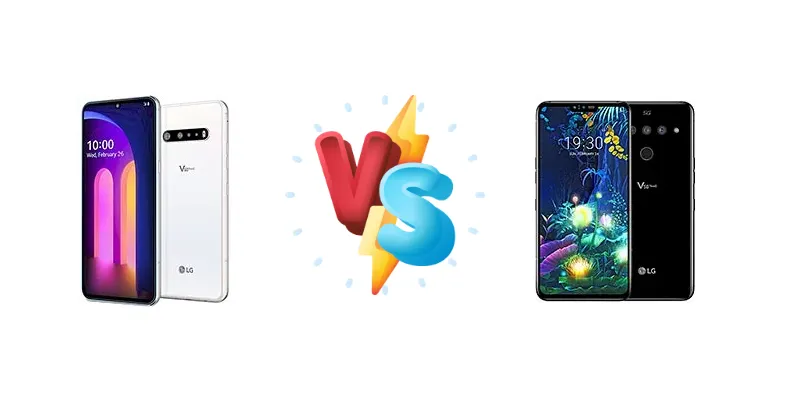
|
🏆 Quick Verdict
For most users, the LG V60 ThinQ 5G UW is the superior choice. The Snapdragon 865 provides a noticeable performance uplift over the Snapdragon 855 in the V50, translating to smoother multitasking and gaming. While both phones offer identical battery endurance ratings, the V60’s faster charging speeds and newer connectivity standards make it the more future-proof option.
| PHONES | ||
|---|---|---|
| Phone Names | LG V60 ThinQ 5G UW | LG V50 ThinQ 5G |
| Network | ||
|---|---|---|
| 2G bands | GSM 850 / 900 / 1800 / 1900 | GSM 850 / 900 / 1800 / 1900 |
| 3G bands | HSDPA 850 / 900 / 1700(AWS) / 1900 / 2100 | HSDPA 850 / 900 / 1700(AWS) / 1900 / 2100 - USA |
| 4G bands | 2, 3, 4, 5, 7, 12, 13, 20, 28, 46, 48, 66 | 1, 2, 3, 4, 5, 7, 8, 12, 13, 17, 20, 25, 26, 28, 40, 41, 46, 66, 71 - USA |
| 5G bands | 260, 261 mmWave | 41, 260, 261 NSA |
| Speed | HSPA 42.2/5.76 Mbps, LTE (7CA) Cat22, 5G | HSPA 42.2/5.76 Mbps, LTE (6CA) Cat18 1200/75 Mbps, 5G (2+ Gbps DL) |
| Technology | GSM / CDMA / HSPA / EVDO / LTE / 5G | GSM / CDMA / HSPA / EVDO / LTE / 5G |
| CDMA2000 1xEV-DO | CDMA2000 1xEV-DO | |
| Launch | ||
|---|---|---|
| Announced | 2020, February 26. Released 2020, April 02 | 2019, February 24. Released 2019, April 19 |
| Status | Discontinued | Discontinued |
| Body | ||
|---|---|---|
| Build | Glass front (Gorilla Glass 5), glass back (Gorilla Glass 6), aluminum frame | Glass front (Gorilla Glass 5), glass back (Gorilla Glass 6), aluminum frame |
| Dimensions | 169.3 x 77.6 x 8.9 mm (6.67 x 3.06 x 0.35 in) | 159.2 x 76.1 x 8.3 mm (6.27 x 3.00 x 0.33 in) |
| SIM | Nano-SIM (pre-installed) | · Nano-SIM· Nano-SIM + Nano-SIM |
| Weight | 218 g (7.69 oz) | 183 g (6.46 oz) |
| IP68 dust/water resistant (up to 1.5m for 30 min) MIL-STD-810G compliant* Method 516.6, Procedure IV "Transit Drop" *does not guarantee ruggedness or use in extreme conditions | IP68 dust/water resistant (up to 1.5m for 30 min) MIL-STD-810G compliant* *does not guarantee ruggedness or use in extreme conditions | |
| Display | ||
|---|---|---|
| Protection | Corning Gorilla Glass 5 | Corning Gorilla Glass 5 |
| Resolution | 1080 x 2460 pixels (~395 ppi density) | 1440 x 3120 pixels, 19.5:9 ratio (~538 ppi density) |
| Size | 6.8 inches, 109.8 cm2 (~83.6% screen-to-body ratio) | 6.4 inches, 100.2 cm2 (~82.7% screen-to-body ratio) |
| Type | P-OLED, HDR10+ | P-OLED, HDR10 |
| Always-on display | Always-on display | |
| Platform | ||
|---|---|---|
| CPU | Octa-core (1x2.84 GHz Cortex-A77 & 3x2.42 GHz Cortex-A77 & 4x1.80 GHz Cortex-A55) | Octa-core (1x2.84 GHz Kryo 485 & 3x2.42 GHz Kryo 485 & 4x1.78 GHz Kryo 485) |
| Chipset | Qualcomm SM8250 Snapdragon 865 5G (7 nm+) | Qualcomm SM8150 Snapdragon 855 (7 nm) |
| GPU | Adreno 650 | Adreno 640 |
| OS | Android 10, upgradable to Android 13 | Android 9.0 (Pie), upgradable to Android 11 |
| Memory | ||
|---|---|---|
| Card slot | microSDXC (uses shared SIM slot) - dual-SIM model | microSDXC (dedicated slot) |
| Internal | 128GB 8GB RAM | 128GB 6GB RAM |
| UFS 2.1 | UFS 2.1 | |
| Main Camera | ||
|---|---|---|
| Dual | 64 MP, f/1.8, 27mm (standard), 1/1.72", 0.8µm, dual pixel PDAF, OIS 13 MP, f/1.9, 12mm (ultrawide), 1/3.4", 1.0µm 0.3 MP, TOF 3D, f/1.4, (depth) | - |
| Features | Dual-LED dual-tone flash, HDR, panorama | LED flash, HDR, panorama |
| Triple | - | 12 MP, 27mm (wide), f/1.5, 1/2.55", 1.4µm, dual pixel PDAF, 3-axis OIS 12 MP, 52mm (telephoto), f/2.4, 1/3.4", 1.0µm, 2x optical zoom, PDAF, OIS 16 MP, 16mm (ultrawide), f/1.9, 1/3.1", 1.0µm, no AF |
| Video | 8K@30fps, 4K@30/60fps, 1080p, HDR10+, 24-bit/192kHz stereo sound rec., gyro-EIS | 4K@30/60fps, 1080p@30/60/240fps, 24-bit/192kHz stereo sound rec., HDR10 video, gyro-EIS |
| Selfie camera | ||
|---|---|---|
| Dual | - | 8 MP, f/1.9, 26mm (wide), 1/4.0", 1.12µm 5 MP, 21mm (wide), f/2.2, 1/5.0", 1.12µm |
| Features | HDR | HDR |
| Single | 10 MP, f/1.9, 30mm (standard), 1/3.1", 1.22µm | - |
| Video | 4K@30fps, gyro-EIS | 1080p@60fps |
| Sound | ||
|---|---|---|
| 3.5mm jack | Yes | Yes |
| 35mm jack | Yes | Yes |
| Loudspeaker | Yes, with stereo speakers | Yes, with stereo speakers |
| 32-bit/192kHz audio 24-bit/192kHz audio recording | 32-bit/192kHz audio 24-bit/192kHz audio recording Tuned with Meridian Audio | |
| Comms | ||
|---|---|---|
| Bluetooth | 5.1, A2DP, LE, aptX HD | 5.0, A2DP, LE, aptX HD |
| NFC | Yes | Yes |
| Positioning | GPS, GLONASS, GALILEO, BDS | GPS, GLONASS, GALILEO |
| Radio | FM radio (USA model only) | FM radio |
| USB | USB Type-C 3.1, OTG | USB Type-C 3.1 |
| WLAN | Wi-Fi 802.11 a/b/g/n/ac/6, dual-band, Wi-Fi Direct, DLNA | Wi-Fi 802.11 a/b/g/n/ac, dual-band, Wi-Fi Direct, DLNA |
| Features | ||
|---|---|---|
| Sensors | Fingerprint (under display, optical), accelerometer, gyro, proximity, compass, barometer | Fingerprint (rear-mounted), accelerometer, gyro, proximity, compass, barometer |
| Battery | ||
|---|---|---|
| Charging | Wired, PD2.0, QC4 Wireless | 18W wired, PD2.0, QC3, 50% in 36 min 10W wireless (Qi) |
| Type | Li-Po 5000 mAh | Li-Po 4000 mAh, non-removable |
| Misc | ||
|---|---|---|
| Colors | Classy Blue, Classy White | New Aurora Black |
| Models | LM-V600VML, LMV600VML | LM-V500, LM-V500N, LM-V500EM, LM-V500XM, LM-V450PM, LM-V450 |
| Price | About 870 EUR | About 550 EUR |
| SAR | 0.85 W/kg (head) 1.12 W/kg (body) | - |
| Tests | ||
|---|---|---|
| Audio quality | - | Noise -92.5dB / Crosstalk -92.6dB |
| Battery life | - | Endurance rating 96h |
| Camera | - | Photo / Video |
| Display | - | Contrast ratio: 194000:1 (nominal) |
| Loudspeaker | - | -25.2 LUFS (Very good) |
| Performance | - | AnTuTu: 343758 (v7), 421934 (v8) GeekBench: 10928 (v4.4), 2672 (v5.1) GFXBench: 22fps (ES 3.1 onscreen) |
LG V60 ThinQ 5G UW
- Significantly faster processor (Snapdragon 865)
- Faster charging speeds (PD2.0, QC4)
- More modern 5G modem
- Potentially improved camera image processing
- Potentially higher price
- No detailed battery capacity information available
LG V50 ThinQ 5G
- Proven 96-hour battery endurance
- High contrast ratio (194000:1)
- Potentially lower purchase price
- Reliable performance for everyday tasks
- Older Snapdragon 855 processor
- Slower charging speeds (18W wired, 10W wireless)
- Less advanced 5G connectivity
Display Comparison
Both the V60 and V50 feature high-quality displays, but specific details beyond the V50’s measured 533 nits peak brightness are limited. The V60 likely benefits from advancements in panel technology during its production cycle, potentially offering improved color accuracy and efficiency. While contrast ratio data is available for the V50 at 194000:1, the V60’s contrast ratio remains unspecified. The V60’s newer processor may also allow for more sophisticated display processing, enhancing visual clarity.
Camera Comparison
Both phones are equipped with photo and video capabilities, but detailed camera specifications are lacking. Without sensor size or aperture information, a direct comparison is difficult. However, the V60’s newer image signal processor (ISP) within the Snapdragon 865 likely delivers improved image processing, resulting in better dynamic range, noise reduction, and overall image quality. The V60’s processor also supports more advanced computational photography features.
Performance
The core difference between these devices lies in their chipsets. The LG V60 utilizes the Qualcomm SM8250 Snapdragon 865 5G (7nm+), a significant upgrade over the V50’s Snapdragon 855 (7nm). The 865 features a newer CPU architecture – Cortex-A77 cores versus the Kryo 485 in the 855 – resulting in improved single-core and multi-core performance. The V60’s CPU configuration (1x2.84 GHz Cortex-A77, 3x2.42 GHz Cortex-A77, 4x1.80 GHz Cortex-A55) offers a more balanced approach than the V50’s (1x2.84 GHz Kryo 485, 3x2.42 GHz Kryo 485, 4x1.78 GHz Kryo 485). The 7nm+ node used in the 865 also provides better thermal efficiency, potentially reducing throttling during sustained workloads. While both support 5G, the 865 offers broader modem compatibility and potentially faster speeds.
Battery Life
Interestingly, both the LG V60 and V50 boast an endurance rating of 96 hours, suggesting similar real-world battery life despite the V60’s more powerful processor. This indicates efficient power management on both devices. However, the V60 significantly improves charging speeds with support for PD2.0 and QC4, while the V50 is limited to 18W wired charging (QC3) and 10W wireless charging. The V60 can achieve a 50% charge faster than the V50, offering greater convenience.
Buying Guide
Buy the LG V60 ThinQ 5G UW if you prioritize performance for demanding applications like gaming or video editing, and want the benefits of faster 5G speeds and more modern charging protocols. Buy the LG V50 ThinQ 5G if you are on a tighter budget and value proven battery life and a potentially lower purchase price, accepting the performance trade-offs of an older chipset.