
LG V50S ThinQ 5G vs. Sony Xperia 5: A Detailed Comparison of 2019 Flagships
| Phones Images | |||||
|---|---|---|---|---|---|
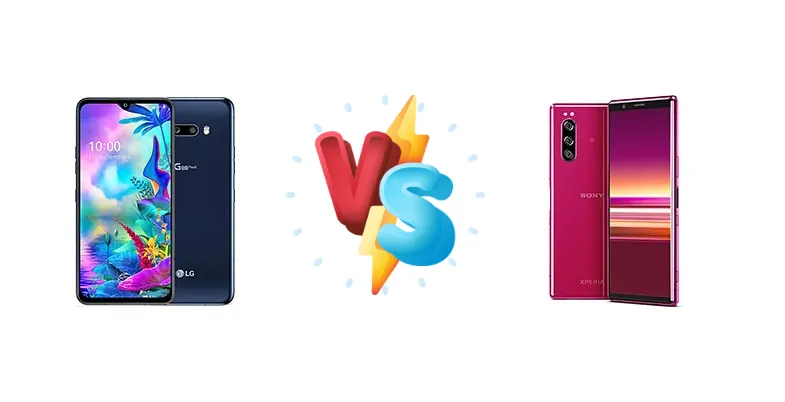
|
🏆 Quick Verdict
For the average user seeking a balance of features and affordability, the Sony Xperia 5 emerges as the stronger choice. While both phones share the same Snapdragon 855 chipset, the Xperia 5’s exceptional 96-hour endurance rating and brighter 630 nit display provide a more refined and practical daily experience.
| PHONES | ||
|---|---|---|
| Phone Names | LG V50S ThinQ 5G | Sony Xperia 5 |
| Network | ||
|---|---|---|
| 2G bands | GSM 850 / 900 / 1800 / 1900 | GSM 850 / 900 / 1800 / 1900 |
| 3G bands | HSDPA 850 / 900 / 1700(AWS) / 1900 / 2100 | HSDPA 800 / 850 / 900 / 1700(AWS) / 1900 / 2100 |
| 4G bands | 1, 2, 3, 4, 5, 7, 8, 12, 13, 17, 20, 25, 26, 28, 40, 41 | 1, 2, 3, 4, 5, 7, 8, 12, 13, 17, 19, 20, 25, 26, 28, 29, 32, 34, 38, 39, 40, 41, 46, 66 |
| 5G bands | 41 NSA | - |
| Speed | HSPA 42.2/5.76 Mbps, LTE Cat19 1600/75 Mbps, 5G (2+ Gbps DL) | HSPA 42.2/5.76 Mbps, LTE Cat19 1600/150 Mbps |
| Technology | GSM / CDMA / HSPA / EVDO / LTE / 5G | GSM / HSPA / LTE |
| CDMA2000 1xEV-DO | - | |
| Launch | ||
|---|---|---|
| Announced | 2019, October. Released 2019, October | 2019, September 05. Released 2019, October 05 |
| Status | Discontinued | Discontinued |
| Body | ||
|---|---|---|
| Build | Glass front (Gorilla Glass 5), glass back (Gorilla Glass 6), aluminum frame | Glass front (Gorilla Glass 6), glass back (Gorilla Glass 6), aluminum frame |
| Dimensions | 159.3 x 75.8 x 8.4 mm (6.27 x 2.98 x 0.33 in) | 158 x 68 x 8.2 mm (6.22 x 2.68 x 0.32 in) |
| SIM | · Nano-SIM· Nano-SIM + Nano-SIM | · Nano-SIM· Nano-SIM + Nano-SIM |
| Weight | 192 g (6.77 oz) | 164 g (5.78 oz) |
| IP68 dust/water resistant (up to 1.5m for 30 min) MIL-STD-810G compliant* *does not guarantee ruggedness or use in extreme conditions | IP65/IP68 dust/water resistant (up to 1.5m for 30 mins) | |
| Display | ||
|---|---|---|
| Protection | Corning Gorilla Glass 5 | Corning Gorilla Glass 6 |
| Resolution | 1080 x 2340 pixels, 19.5:9 ratio (~403 ppi density) | 1080 x 2520 pixels, 21:9 ratio (~449 ppi density) |
| Size | 6.4 inches, 100.5 cm2 (~83.3% screen-to-body ratio) | 6.1 inches, 86.9 cm2 (~80.9% screen-to-body ratio) |
| Type | OLED, HDR10 | OLED, HDR BT.2020 |
| Always-on display | Triluminos display X-Reality Engine | |
| Platform | ||
|---|---|---|
| CPU | Octa-core (1x2.84 GHz Kryo 485 & 3x2.42 GHz Kryo 485 & 4x1.78 GHz Kryo 485) | Octa-core (1x2.84 GHz Kryo 485 & 3x2.42 GHz Kryo 485 & 4x1.78 GHz Kryo 485) |
| Chipset | Qualcomm SM8150 Snapdragon 855 (7 nm) | Qualcomm SM8150 Snapdragon 855 (7 nm) |
| GPU | Adreno 640 | Adreno 640 |
| OS | Android 9.0 (Pie), upgradable to Android 12 | Android 9.0 (Pie), upgradable to Android 11 |
| Memory | ||
|---|---|---|
| Card slot | microSDXC (uses shared SIM slot) - dual-SIM model | microSDXC (uses shared SIM slot) |
| Internal | 256GB 8GB RAM | 128GB 6GB RAM |
| UFS 2.1 | UFS 2.1 | |
| Main Camera | ||
|---|---|---|
| Dual | 12 MP, f/1.8, 27mm (standard), 1/2.55", 1.4µm, dual pixel PDAF, OIS 13 MP, f/2.4, 9mm (ultrawide), 1/3.4", 1.0µm | - |
| Features | Dual-LED dual-tone flash, HDR, panorama | Color spectrum sensor, LED flash, panorama, HDR, eye tracking |
| Triple | - | 12 MP, f/1.6, 26mm (wide), 1/2.55", 1.4µm, predictive dual pixel PDAF, 5-axis OIS 12 MP, f/2.4, 52mm (telephoto), 1/3.4", 1.0µm, predictive PDAF, 2x optical zoom, 5-axis OIS 12 MP, f/2.4, 16mm (ultrawide), 1/3.4", 1.0µm |
| Video | 4K@30/60fps, 1080p@30/60/240fps, 24-bit/192kHz stereo sound rec., gyro-EIS | 4K@24/30fps HDR, 1080p@60fps, 1080p@30fps (5-axis gyro-EIS) |
| Selfie camera | ||
|---|---|---|
| Features | HDR | HDR |
| Single | 32 MP, f/1.9, 26mm (wide), 1/2.8", 0.8µm | 8 MP, f/2.0, 24mm (wide), 1/4.0", 1.12µm |
| Video | 4K@30fps, gyro-EIS | 1080p@30fps (5-axis gyro-EIS) |
| Sound | ||
|---|---|---|
| 3.5mm jack | Yes | No |
| 35mm jack | Yes | No |
| Loudspeaker | Yes, with stereo speakers | Yes, with stereo speakers |
| 32-bit/192kHz audio 24-bit/192kHz audio recording Tuned by Meridian Audio | 24-bit/192kHz audio Dynamic vibration system | |
| Comms | ||
|---|---|---|
| Bluetooth | 5.0, A2DP, LE, aptX HD | 5.0, A2DP, aptX HD, LE |
| NFC | Yes | Yes |
| Positioning | GPS, GLONASS, GALILEO, BDS | GPS, GLONASS, BDS, GALILEO |
| Radio | FM radio | No |
| USB | USB Type-C 3.1, OTG | USB Type-C 3.1, OTG |
| WLAN | Wi-Fi 802.11 a/b/g/n/ac, dual-band, Wi-Fi Direct, DLNA | Wi-Fi 802.11 a/b/g/n/ac, dual-band, Wi-Fi Direct, DLNA |
| Features | ||
|---|---|---|
| Sensors | Fingerprint (under display, optical), accelerometer, gyro, proximity, compass, barometer | Fingerprint (side-mounted), accelerometer, gyro, proximity, barometer, compass |
| Battery | ||
|---|---|---|
| Charging | 21W wired, PD, QC3 9W wireless | 18W wired, PD2.0 |
| Type | Li-Po 4000 mAh, non-removable | Li-Ion 3140 mAh, non-removable |
| Misc | ||
|---|---|---|
| Colors | Aurora Black | Blue, Red, Black, Grey |
| Models | LM-V510N | J8210, J8270, J9210, SOV41, SO-01M |
| Price | About 1100 EUR | About 500 EUR |
| Pricing | ||
|---|---|---|
| 128GB 6GB RAM | - | $ 409.99 |
| RENEWED | - | $ 674.00 |
| Tests | ||
|---|---|---|
| Audio quality | - | Noise -93.0dB / Crosstalk -89.4dB |
| Battery life | - | Endurance rating 96h |
| Display | - | Contrast ratio: Infinite (nominal) |
| Loudspeaker | - | -27.1 LUFS (Good) |
| Performance | - | AnTuTu: 334809 (v7), 416601 (v8) GeekBench: 10941 (v4.4), 2825 (v5.1) GFXBench: 33fps (ES 3.1 onscreen) |
LG V50S ThinQ 5G
- Faster wired charging (21W vs 18W)
- Wireless charging support
- Potentially better thermal management due to larger chassis
- Battery life data unavailable, likely inferior to Xperia 5
- Display brightness likely lower than Xperia 5
- 5G functionality may be limited by network availability
Sony Xperia 5
- Exceptional 96-hour battery life
- Brighter 630 nit display
- Compact and portable form factor
- Slower wired charging (18W)
- No wireless charging support
- May lack some of the LG's software features
Display Comparison
The Sony Xperia 5 boasts a significantly brighter display, reaching a measured 630 nits, compared to an unspecified brightness for the LG V50S. This difference is crucial for outdoor visibility. Both devices share an 'infinite' (nominal) contrast ratio, typical of OLED panels, but the Xperia 5’s higher peak brightness translates to a more vibrant and punchy image. The Xperia 5’s aspect ratio of 21:9 also caters to a more cinematic viewing experience, while the V50S likely adheres to a more standard 19.5:9 ratio. The lack of detailed display specs for the V50S makes a precise comparison difficult, but the Xperia 5 clearly holds an advantage in brightness.
Camera Comparison
Detailed camera specifications for both devices are limited. However, the focus should be on image processing and sensor quality rather than relying on auxiliary lenses. While both likely feature multi-camera setups, the core performance hinges on the main sensor. Without knowing the sensor sizes or apertures, it’s difficult to declare a clear winner. Sony’s image processing is generally known for its natural color reproduction, while LG’s tends towards more saturated tones. The absence of detailed camera specs necessitates a reliance on real-world image comparisons, which are beyond the scope of this data-driven analysis.
Performance
Both the LG V50S ThinQ 5G and the Sony Xperia 5 are powered by the Qualcomm SM8150 Snapdragon 855 (7 nm) chipset, featuring an identical octa-core CPU configuration (1x2.84 GHz Kryo 485, 3x2.42 GHz Kryo 485, and 4x1.78 GHz Kryo 485). This means raw processing power will be nearly indistinguishable between the two. However, thermal management could differ due to variations in internal design and cooling solutions. The V50S’s larger size *potentially* allows for a more robust cooling system, but without specific thermal testing data, it’s impossible to definitively say which phone will exhibit less throttling under sustained load. Both devices benefit from the Snapdragon 855’s integrated 5G modem, though the V50S’s marketing heavily emphasized this feature.
Battery Life
The Sony Xperia 5’s standout feature is its exceptional battery life, achieving an endurance rating of 96 hours. This is a significant advantage over the LG V50S, for which battery life data is unavailable. While the V50S supports faster 21W wired charging (with PD and QC3) compared to the Xperia 5’s 18W wired charging (PD2.0), the Xperia 5’s superior endurance mitigates the need for frequent charging. The V50S also offers 9W wireless charging, a feature absent on the Xperia 5. However, the slower wireless charging speed is unlikely to offset the Xperia 5’s overall battery life advantage. The Xperia 5’s efficiency clearly wins out here.
Buying Guide
Buy the LG V50S ThinQ 5G if you absolutely require 5G connectivity and prioritize a larger screen for media consumption, understanding that battery life will be a compromise. Buy the Sony Xperia 5 if you value portability, exceptional battery life, and a brighter, more visible display, making it ideal for users on the go or those sensitive to screen glare.