
LG V50S ThinQ 5G vs Sony Xperia 1 II: A Detailed Comparison of Flagship Performance
| Phones Images | |||||
|---|---|---|---|---|---|
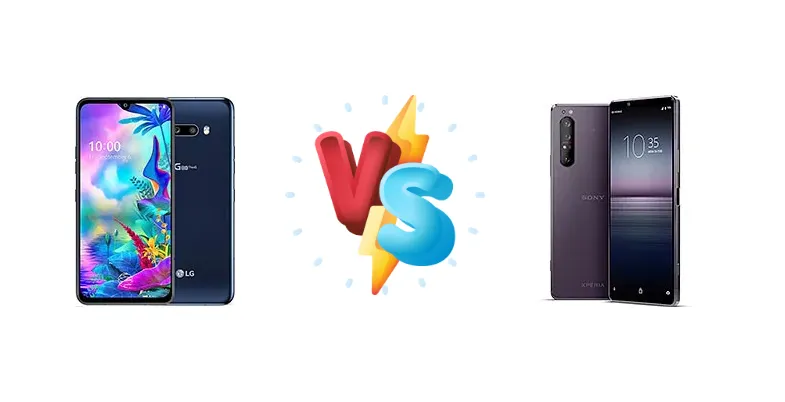
|
🏆 Quick Verdict
For the average user in 2024, the Sony Xperia 1 II emerges as the superior choice. While both phones offer 21W wired charging and similar wireless speeds, the Xperia 1 II’s Snapdragon 865 provides a noticeable performance uplift and benefits from a more refined software experience, justifying its higher initial price point even today.
| PHONES | ||
|---|---|---|
| Phone Names | LG V50S ThinQ 5G | Sony Xperia 1 II |
| Network | ||
|---|---|---|
| 2G bands | GSM 850 / 900 / 1800 / 1900 | GSM 850 / 900 / 1800 / 1900 |
| 3G bands | HSDPA 850 / 900 / 1700(AWS) / 1900 / 2100 | HSDPA 800 / 850 / 900 / 1700(AWS) / 1900 / 2100 |
| 4G bands | 1, 2, 3, 4, 5, 7, 8, 12, 13, 17, 20, 25, 26, 28, 40, 41 | 1, 2, 3, 4, 5, 7, 8, 12, 13, 17, 19, 20, 25, 26, 28, 29, 32, 34, 38, 39, 40, 41, 46, 66 |
| 5G bands | 41 NSA | 1, 3, 28, 77, 78 NSA/Sub6 |
| Speed | HSPA 42.2/5.76 Mbps, LTE Cat19 1600/75 Mbps, 5G (2+ Gbps DL) | HSPA 42.2/5.76 Mbps, LTE (6CA) Cat19 1600/150 Mbps, 5G (2+ Gbps DL) |
| Technology | GSM / CDMA / HSPA / EVDO / LTE / 5G | GSM / HSPA / LTE / 5G |
| CDMA2000 1xEV-DO | - | |
| Launch | ||
|---|---|---|
| Announced | 2019, October. Released 2019, October | 2020, February 24 |
| Status | Discontinued | Available. Released 2020, May 22 |
| Body | ||
|---|---|---|
| Build | Glass front (Gorilla Glass 5), glass back (Gorilla Glass 6), aluminum frame | Glass front (Gorilla Glass 6), glass back (Gorilla Glass 6), aluminum frame |
| Dimensions | 159.3 x 75.8 x 8.4 mm (6.27 x 2.98 x 0.33 in) | 165.1 x 71.1 x 7.6 mm (6.5 x 2.80 x 0.30 in) |
| SIM | · Nano-SIM· Nano-SIM + Nano-SIM | Nano-SIM + Nano-SIM |
| Weight | 192 g (6.77 oz) | 181.4 g (6.38 oz) |
| IP68 dust/water resistant (up to 1.5m for 30 min) MIL-STD-810G compliant* *does not guarantee ruggedness or use in extreme conditions | IP65/IP68 dust/water resistant (up to 1.5m for 30 mins) | |
| Display | ||
|---|---|---|
| Protection | Corning Gorilla Glass 5 | Corning Gorilla Glass 6 |
| Resolution | 1080 x 2340 pixels, 19.5:9 ratio (~403 ppi density) | 1644 x 3840 pixels, 21:9 ratio (~643 ppi density) |
| Size | 6.4 inches, 100.5 cm2 (~83.3% screen-to-body ratio) | 6.5 inches, 98.6 cm2 (~84.0% screen-to-body ratio) |
| Type | OLED, HDR10 | OLED, 1B colors, HDR BT.2020 |
| Always-on display | Runs at 1096 x 2560 pixels except for select use cases | |
| Platform | ||
|---|---|---|
| CPU | Octa-core (1x2.84 GHz Kryo 485 & 3x2.42 GHz Kryo 485 & 4x1.78 GHz Kryo 485) | Octa-core (1x2.84 GHz Cortex-A77 & 3x2.42 GHz Cortex-A77 & 4x1.80 GHz Cortex-A55) |
| Chipset | Qualcomm SM8150 Snapdragon 855 (7 nm) | Qualcomm SM8250 Snapdragon 865 5G (7 nm+) |
| GPU | Adreno 640 | Adreno 650 |
| OS | Android 9.0 (Pie), upgradable to Android 12 | Android 10, upgradable to Android 12 |
| Memory | ||
|---|---|---|
| Card slot | microSDXC (uses shared SIM slot) - dual-SIM model | microSDXC (uses shared SIM slot) |
| Internal | 256GB 8GB RAM | 256GB 8GB RAM, 256GB 12GB RAM |
| UFS 2.1 | UFS 3.0 | |
| Main Camera | ||
|---|---|---|
| Dual | 12 MP, f/1.8, 27mm (standard), 1/2.55", 1.4µm, dual pixel PDAF, OIS 13 MP, f/2.4, 9mm (ultrawide), 1/3.4", 1.0µm | - |
| Features | Dual-LED dual-tone flash, HDR, panorama | Zeiss optics, color spectrum sensor, LED flash, panorama, HDR, eye tracking |
| Triple | - | 12 MP, f/1.7, 24mm (wide), 1/1.7", 1.8µm, dual pixel PDAF, OIS 12 MP, f/2.4, 70mm (telephoto), 1/3.4", 1.0µm, PDAF, 3x optical zoom, OIS 12 MP, f/2.2, 124˚, 16mm (ultrawide), 1/2.55", dual pixel PDAF 0.3 MP, TOF 3D, (depth) |
| Video | 4K@30/60fps, 1080p@30/60/240fps, 24-bit/192kHz stereo sound rec., gyro-EIS | 4K@24/25/30/60/120fps HDR, 1080p@30/60/120fps; 5-axis gyro-EIS, OIS |
| Selfie camera | ||
|---|---|---|
| Features | HDR | HDR |
| Single | 32 MP, f/1.9, 26mm (wide), 1/2.8", 0.8µm | 8 MP, f/2.0, 24mm (wide), 1/4.0", 1.12µm |
| Video | 4K@30fps, gyro-EIS | 1080p@30fps (5-axis gyro-EIS) |
| Sound | ||
|---|---|---|
| 3.5mm jack | Yes | Yes |
| 35mm jack | Yes | Yes |
| Loudspeaker | Yes, with stereo speakers | Yes, with stereo speakers |
| 32-bit/192kHz audio 24-bit/192kHz audio recording Tuned by Meridian Audio | 24-bit/192kHz audio Dynamic vibration system | |
| Comms | ||
|---|---|---|
| Bluetooth | 5.0, A2DP, LE, aptX HD | 5.1, A2DP, aptX HD, LE |
| NFC | Yes | Yes |
| Positioning | GPS, GLONASS, GALILEO, BDS | GPS, GLONASS, BDS, GALILEO |
| Radio | FM radio | No |
| USB | USB Type-C 3.1, OTG | USB Type-C 3.1, OTG |
| WLAN | Wi-Fi 802.11 a/b/g/n/ac, dual-band, Wi-Fi Direct, DLNA | Wi-Fi 802.11 a/b/g/n/ac/6, dual-band, Wi-Fi Direct, DLNA |
| Features | ||
|---|---|---|
| Sensors | Fingerprint (under display, optical), accelerometer, gyro, proximity, compass, barometer | Fingerprint (side-mounted), accelerometer, gyro, proximity, barometer, compass |
| Battery | ||
|---|---|---|
| Charging | 21W wired, PD, QC3 9W wireless | 21W wired, PD 11W wireless |
| Type | Li-Po 4000 mAh, non-removable | Li-Po 4000 mAh |
| Misc | ||
|---|---|---|
| Colors | Aurora Black | Black, Purple, Mirror Lake Green |
| Models | LM-V510N | XQ-AT51, XQ-AT52, SOG01, XQ-AT42 |
| Price | About 1100 EUR | About 700 EUR |
| Tests | ||
|---|---|---|
| Battery life | - | Endurance rating 83h |
| Camera | - | Photo / Video |
| Display | - | Contrast ratio: Infinite (nominal) |
| Loudspeaker | - | -27.3 LUFS (Good) |
| Performance | - | AnTuTu: 534701 (v8) GeekBench: 3295 (v5.1) GFXBench: 39fps (ES 3.1 onscreen) |
LG V50S ThinQ 5G
- More affordable price point in 2024
- Faster wireless charging (9W vs 11W)
- Supports Quick Charge 3.0
- Older Snapdragon 855 chipset
- Likely inferior display quality
- Less refined camera processing
Sony Xperia 1 II
- More powerful Snapdragon 865 chipset
- Brighter and potentially more accurate display
- Superior camera image processing
- Higher initial cost
- Slower wireless charging (11W)
- May be harder to find new
Display Comparison
The Sony Xperia 1 II boasts a brighter display, reaching 611 nits measured, compared to an unspecified brightness for the LG V50S. While both feature an 'infinite' contrast ratio (typical for OLED panels), the Xperia 1 II’s display is likely to offer better visibility in direct sunlight. The Xperia 1 II’s focus on content creation and consumption is further supported by its color accuracy, though specific color gamut coverage isn’t provided. The V50S’s display quality, while adequate, likely doesn’t match the Xperia 1 II’s premium offering.
Camera Comparison
Both devices are described as having 'Photo / Video' capabilities, lacking specific details. However, the Xperia 1 II’s camera system is known for its emphasis on manual controls and professional-grade features, catering to photography enthusiasts. While sensor sizes and apertures are unknown for both, the Xperia 1 II’s image processing algorithms are generally considered more refined, offering better dynamic range and color accuracy. The LG V50S likely relies on more aggressive image processing to compensate for its older sensor technology.
Performance
The core difference lies in the chipsets: the LG V50S utilizes the Qualcomm Snapdragon 855 (7nm), while the Sony Xperia 1 II features the Snapdragon 865 5G (7nm+). The 865 represents a significant architectural improvement, employing Cortex-A77 cores in its prime cluster versus the Kryo 485 cores in the 855. This translates to faster processing speeds and improved efficiency. Both share an octa-core configuration with a 1x2.84 GHz prime core and 3x2.42 GHz performance cores, but the 865’s newer architecture and 7nm+ process node provide a clear advantage. The Xperia 1 II’s 5G modem is integrated into the chipset, offering potentially better power efficiency compared to external modems often paired with the 855.
Battery Life
Both phones share an endurance rating of 83 hours, suggesting comparable real-world battery life despite the Xperia 1 II’s more powerful processor. The LG V50S supports 21W wired charging with Power Delivery (PD) and Quick Charge 3.0 (QC3), alongside 9W wireless charging. The Xperia 1 II also supports 21W wired charging with PD, but offers only 11W wireless charging. The similar endurance rating suggests the Xperia 1 II’s more efficient chipset offsets its increased power draw, while the V50S offers slightly faster wireless charging.
Buying Guide
Buy the LG V50S ThinQ 5G if you need a functional 5G smartphone on a tight budget and prioritize affordability over cutting-edge performance. It’s a viable option for basic tasks and moderate usage. Buy the Sony Xperia 1 II if you prioritize a superior multimedia experience, demand smoother performance for demanding applications, and value a more polished software experience, even if it means a higher investment.