
LG V50S ThinQ 5G vs OnePlus 7 Pro 5G: A Detailed Comparison of Snapdragon 855 Powerhouses
| Phones Images | |||||
|---|---|---|---|---|---|
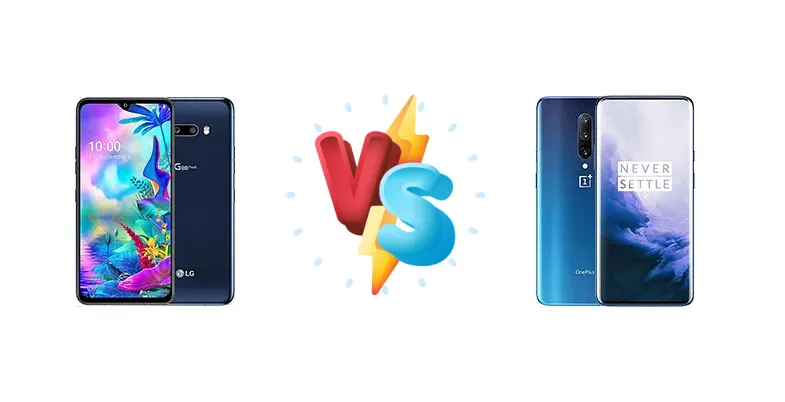
|
🏆 Quick Verdict
For the average user prioritizing speed and convenience, the OnePlus 7 Pro 5G emerges as the winner. Its 30W wired charging significantly outperforms the LG V50S's 21W, translating to less downtime. While both share the same chipset, the OnePlus 7 Pro’s software optimization and faster charging provide a more compelling daily experience.
| PHONES | ||
|---|---|---|
| Phone Names | LG V50S ThinQ 5G | OnePlus 7 Pro 5G |
| Network | ||
|---|---|---|
| 2G bands | GSM 850 / 900 / 1800 / 1900 | GSM 850 / 900 / 1800 / 1900 |
| 3G bands | HSDPA 850 / 900 / 1700(AWS) / 1900 / 2100 | HSDPA 800 / 850 / 900 / 1700(AWS) / 1800 / 1900 / 2100 |
| 4G bands | 1, 2, 3, 4, 5, 7, 8, 12, 13, 17, 20, 25, 26, 28, 40, 41 | 1, 2, 3, 4, 5, 7, 8, 12, 13, 17, 18, 19, 20, 25, 26, 28, 29, 32, 34, 38, 39, 40, 41, 66 |
| 5G bands | 41 NSA | 41 NSA/Sub6/mmWave |
| Speed | HSPA 42.2/5.76 Mbps, LTE Cat19 1600/75 Mbps, 5G (2+ Gbps DL) | HSPA 42.2/5.76 Mbps, LTE (5CA) Cat18 1200/150 Mbps, 5G (2+ Gbps DL) |
| Technology | GSM / CDMA / HSPA / EVDO / LTE / 5G | GSM / HSPA / LTE / 5G |
| CDMA2000 1xEV-DO | - | |
| Launch | ||
|---|---|---|
| Announced | 2019, October. Released 2019, October | 2019, May 14. Released 2019, September 06 |
| Status | Discontinued | Discontinued |
| Body | ||
|---|---|---|
| Build | Glass front (Gorilla Glass 5), glass back (Gorilla Glass 6), aluminum frame | Glass front (Gorilla Glass 5), glass back (Gorilla Glass 5), aluminum frame |
| Dimensions | 159.3 x 75.8 x 8.4 mm (6.27 x 2.98 x 0.33 in) | 162.6 x 75.9 x 8.8 mm (6.40 x 2.99 x 0.35 in) |
| SIM | · Nano-SIM· Nano-SIM + Nano-SIM | Nano-SIM + Nano-SIM |
| Weight | 192 g (6.77 oz) | 206 g (7.27 oz) |
| IP68 dust/water resistant (up to 1.5m for 30 min) MIL-STD-810G compliant* *does not guarantee ruggedness or use in extreme conditions | - | |
| Display | ||
|---|---|---|
| Protection | Corning Gorilla Glass 5 | Corning Gorilla Glass 5 |
| Resolution | 1080 x 2340 pixels, 19.5:9 ratio (~403 ppi density) | 1440 x 3120 pixels, 19.5:9 ratio (~515 ppi density) |
| Size | 6.4 inches, 100.5 cm2 (~83.3% screen-to-body ratio) | 6.67 inches, 109.2 cm2 (~88.5% screen-to-body ratio) |
| Type | OLED, HDR10 | Fluid AMOLED, 90Hz, HDR10+ |
| Always-on display | - | |
| Platform | ||
|---|---|---|
| CPU | Octa-core (1x2.84 GHz Kryo 485 & 3x2.42 GHz Kryo 485 & 4x1.78 GHz Kryo 485) | Octa-core (1x2.84 GHz Kryo 485 & 3x2.42 GHz Kryo 485 & 4x1.78 GHz Kryo 485) |
| Chipset | Qualcomm SM8150 Snapdragon 855 (7 nm) | Qualcomm SM8150 Snapdragon 855 (7 nm) |
| GPU | Adreno 640 | Adreno 640 |
| OS | Android 9.0 (Pie), upgradable to Android 12 | Android 9.0 (Pie), upgradable to Android 10, OxygenOS 10.0.4 |
| Memory | ||
|---|---|---|
| Card slot | microSDXC (uses shared SIM slot) - dual-SIM model | No |
| Internal | 256GB 8GB RAM | 128GB 6GB RAM, 256GB 8GB RAM, 256GB 12GB RAM |
| UFS 2.1 | UFS 3.0 | |
| Main Camera | ||
|---|---|---|
| Dual | 12 MP, f/1.8, 27mm (standard), 1/2.55", 1.4µm, dual pixel PDAF, OIS 13 MP, f/2.4, 9mm (ultrawide), 1/3.4", 1.0µm | - |
| Features | Dual-LED dual-tone flash, HDR, panorama | Laser AF, Dual-LED dual-tone flash, panorama, HDR |
| Triple | - | 48 MP, f/1.6, (wide), 1/2.0", 0.8µm, PDAF, OIS 8 MP, f/2.4, 78mm (telephoto), 3x zoom, PDAF, OIS 16 MP, f/2.2, 13mm (ultrawide) |
| Video | 4K@30/60fps, 1080p@30/60/240fps, 24-bit/192kHz stereo sound rec., gyro-EIS | 4K@30/60fps, 1080p@30/60/240fps, 720p@480fps, Auto HDR, gyro-EIS, no video rec. with ultrawide camera |
| Selfie camera | ||
|---|---|---|
| Features | HDR | HDR |
| Single | 32 MP, f/1.9, 26mm (wide), 1/2.8", 0.8µm | Motorized pop-up 16 MP, f/2.0, 25mm (wide), 1/3.06", 1.0µm |
| Video | 4K@30fps, gyro-EIS | 1080p@30fps, gyro-EIS |
| Sound | ||
|---|---|---|
| 3.5mm jack | Yes | No |
| 35mm jack | Yes | No |
| Loudspeaker | Yes, with stereo speakers | Yes, with stereo speakers |
| 32-bit/192kHz audio 24-bit/192kHz audio recording Tuned by Meridian Audio | - | |
| Comms | ||
|---|---|---|
| Bluetooth | 5.0, A2DP, LE, aptX HD | 5.0, A2DP, LE, aptX HD |
| NFC | Yes | Yes |
| Positioning | GPS, GLONASS, GALILEO, BDS | GPS (L1+L5), GLONASS (G1), BDS (B1), GALILEO (E1+E5a) |
| Radio | FM radio | No |
| USB | USB Type-C 3.1, OTG | USB Type-C 3.1, OTG |
| WLAN | Wi-Fi 802.11 a/b/g/n/ac, dual-band, Wi-Fi Direct, DLNA | Wi-Fi 802.11 a/b/g/n/ac, dual-band, Wi-Fi Direct, DLNA |
| Features | ||
|---|---|---|
| Sensors | Fingerprint (under display, optical), accelerometer, gyro, proximity, compass, barometer | Fingerprint (under display, optical), accelerometer, gyro, proximity, compass |
| Battery | ||
|---|---|---|
| Charging | 21W wired, PD, QC3 9W wireless | 30W wired |
| Type | Li-Po 4000 mAh, non-removable | Li-Po 4000 mAh, non-removable |
| Misc | ||
|---|---|---|
| Colors | Aurora Black | Mirror Grey, Almond, Nebula Blue |
| Models | LM-V510N | GM1925 |
| Price | About 1100 EUR | About 800 EUR |
LG V50S ThinQ 5G
- Expandable storage via microSD card.
- Wireless charging support.
- Feature-rich software with customization options.
- Slower 21W wired charging.
- Potentially more software bloat.
- Less optimized software experience compared to OnePlus.
OnePlus 7 Pro 5G
- 30W fast wired charging for rapid replenishment.
- Clean and optimized OxygenOS software.
- Near bezel-less display for immersive viewing.
- No expandable storage.
- No wireless charging support.
- Less feature-rich software compared to LG.
Display Comparison
Both devices feature excellent displays, though specific details beyond resolution aren't provided. The lack of information on panel technology (OLED vs LCD) or refresh rates prevents a detailed comparison. However, given the market positioning, both likely utilize OLED panels. The OnePlus 7 Pro’s nearly bezel-less design, a hallmark of the device, likely offers a more immersive viewing experience. Color accuracy and peak brightness are unknown, but both would have been competitive for their time.
Camera Comparison
Without detailed camera specifications, a comprehensive comparison is limited. Both devices likely feature multi-camera setups, but sensor sizes, lens apertures, and image processing algorithms are unknown. The LG V50S’s brand history suggests a focus on versatile camera features, while OnePlus typically prioritizes natural-looking images. The absence of information on optical image stabilization (OIS) is a significant gap. The presence of a 2MP macro camera on either device is unlikely to significantly impact image quality, serving primarily as a marketing feature.
Performance
Both the LG V50S ThinQ 5G and the OnePlus 7 Pro 5G are equipped with the Qualcomm SM8150 Snapdragon 855 (7 nm) chipset, featuring an identical octa-core CPU configuration. This means raw processing power will be nearly indistinguishable between the two. However, OnePlus is renowned for its software optimization, potentially leading to slightly better sustained performance and reduced thermal throttling under heavy loads. The RAM configuration is not specified, but both likely utilize LPDDR4X RAM, common for the Snapdragon 855 era. The real-world performance difference will likely be minimal for most tasks.
Battery Life
The LG V50S ThinQ 5G supports 21W wired charging with Power Delivery (PD) and Quick Charge 3 (QC3) alongside 9W wireless charging. The OnePlus 7 Pro 5G, however, boasts a significantly faster 30W wired charging capability. This difference is substantial; the OnePlus 7 Pro will achieve a full charge considerably faster than the LG V50S. While battery capacity isn’t specified, the faster charging of the OnePlus 7 Pro effectively mitigates any potential disadvantage from a slightly smaller battery size, offering more uptime in a shorter charging window.
Buying Guide
Buy the LG V50S ThinQ 5G if you need expandable storage via microSD, value wireless charging capabilities, and prefer a more feature-rich, albeit sometimes bloated, software experience. Buy the OnePlus 7 Pro 5G if you prioritize a clean, fast software experience, incredibly rapid wired charging, and a smoother overall user interface. The OnePlus 7 Pro is the better choice for power users and gamers who demand minimal interruptions.