
LG V50S ThinQ 5G vs LG Velvet 5G: Which LG Flagship Reigns Supreme?
| Phones Images | |||||
|---|---|---|---|---|---|
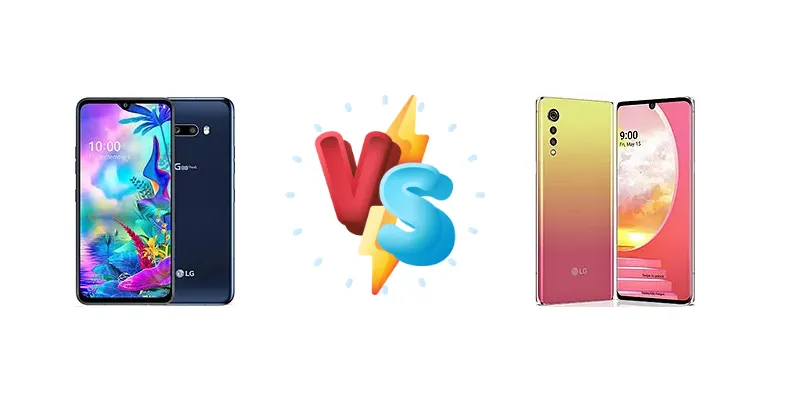
|
🏆 Quick Verdict
For users prioritizing raw processing power and sustained performance, the LG V50S ThinQ 5G is the clear winner. Its Snapdragon 855 chipset delivers a noticeable advantage in demanding tasks. However, the LG Velvet 5G offers a compelling alternative with a more modern design and comparable battery life, making it ideal for everyday users.
| PHONES | ||
|---|---|---|
| Phone Names | LG V50S ThinQ 5G | LG Velvet 5G |
| Network | ||
|---|---|---|
| 2G bands | GSM 850 / 900 / 1800 / 1900 | GSM 850 / 900 / 1800 / 1900 |
| 3G bands | HSDPA 850 / 900 / 1700(AWS) / 1900 / 2100 | HSDPA 850 / 900 / 1900 / 2100 |
| 4G bands | 1, 2, 3, 4, 5, 7, 8, 12, 13, 17, 20, 25, 26, 28, 40, 41 | 1, 2, 3, 4, 5, 7, 8, 12, 17, 20, 28, 32, 38, 39, 40, 41 |
| 5G bands | 41 NSA | 1, 3, 28, 78 SA/NSA |
| Speed | HSPA 42.2/5.76 Mbps, LTE Cat19 1600/75 Mbps, 5G (2+ Gbps DL) | HSPA 42.2/5.76 Mbps, LTE (5CA) Cat16 1000/75 Mbps, 5G 2Gbps |
| Technology | GSM / CDMA / HSPA / EVDO / LTE / 5G | GSM / HSPA / LTE / 5G |
| CDMA2000 1xEV-DO | - | |
| Launch | ||
|---|---|---|
| Announced | 2019, October. Released 2019, October | 2020, May 07. Released 2020, May 15 |
| Status | Discontinued | Discontinued |
| Body | ||
|---|---|---|
| Build | Glass front (Gorilla Glass 5), glass back (Gorilla Glass 6), aluminum frame | Glass front, glass back, aluminum frame |
| Dimensions | 159.3 x 75.8 x 8.4 mm (6.27 x 2.98 x 0.33 in) | 167.2 x 74.1 x 7.9 mm (6.58 x 2.92 x 0.31 in) |
| SIM | · Nano-SIM· Nano-SIM + Nano-SIM | Nano-SIM + Nano-SIM |
| Weight | 192 g (6.77 oz) | 180 g (6.35 oz) |
| IP68 dust/water resistant (up to 1.5m for 30 min) MIL-STD-810G compliant* *does not guarantee ruggedness or use in extreme conditions | IP68 dust/water resistant (up to 1.5m for 30 mins) MIL-STD-810G compliant* *does not guarantee ruggedness or use in extreme conditions | |
| Display | ||
|---|---|---|
| Protection | Corning Gorilla Glass 5 | - |
| Resolution | 1080 x 2340 pixels, 19.5:9 ratio (~403 ppi density) | 1080 x 2460 pixels (~395 ppi density) |
| Size | 6.4 inches, 100.5 cm2 (~83.3% screen-to-body ratio) | 6.8 inches, 109.8 cm2 (~88.6% screen-to-body ratio) |
| Type | OLED, HDR10 | P-OLED |
| Always-on display | - | |
| Platform | ||
|---|---|---|
| CPU | Octa-core (1x2.84 GHz Kryo 485 & 3x2.42 GHz Kryo 485 & 4x1.78 GHz Kryo 485) | Octa-core (1x2.4 GHz Kryo 475 Prime & 1x2.2 GHz Kryo 475 Gold & 6x1.8 GHz Kryo 475 Silver) |
| Chipset | Qualcomm SM8150 Snapdragon 855 (7 nm) | Qualcomm SM7250 Snapdragon 765G 5G (7 nm) |
| GPU | Adreno 640 | Adreno 620 |
| OS | Android 9.0 (Pie), upgradable to Android 12 | Android 10, upgradable to Android 13, LG UX |
| Memory | ||
|---|---|---|
| Card slot | microSDXC (uses shared SIM slot) - dual-SIM model | microSDXC (uses shared SIM slot) |
| Internal | 256GB 8GB RAM | 128GB 6GB RAM, 128GB 8GB RAM |
| UFS 2.1 | UFS 2.1 | |
| Main Camera | ||
|---|---|---|
| Dual | 12 MP, f/1.8, 27mm (standard), 1/2.55", 1.4µm, dual pixel PDAF, OIS 13 MP, f/2.4, 9mm (ultrawide), 1/3.4", 1.0µm | - |
| Features | Dual-LED dual-tone flash, HDR, panorama | LED flash, panorama, HDR |
| Triple | - | 48 MP, f/1.8, 26mm (wide), 1/2.0", 0.8µm, PDAF 8 MP, f/2.2, 120˚, 15mm (ultrawide), 1/4.0", 1.12µm Auxiliary lens |
| Video | 4K@30/60fps, 1080p@30/60/240fps, 24-bit/192kHz stereo sound rec., gyro-EIS | 4K@30fps, 1080p@30/60fps, gyro-EIS |
| Selfie camera | ||
|---|---|---|
| Features | HDR | HDR |
| Single | 32 MP, f/1.9, 26mm (wide), 1/2.8", 0.8µm | 16 MP, f/1.9, 29mm (standard), 1/3.06, 1.0µm |
| Video | 4K@30fps, gyro-EIS | 1080p@30fps |
| Sound | ||
|---|---|---|
| 3.5mm jack | Yes | Yes |
| 35mm jack | Yes | Yes |
| Loudspeaker | Yes, with stereo speakers | Yes, with stereo speakers |
| 32-bit/192kHz audio 24-bit/192kHz audio recording Tuned by Meridian Audio | - | |
| Comms | ||
|---|---|---|
| Bluetooth | 5.0, A2DP, LE, aptX HD | 5.1, A2DP, LE, aptX HD |
| NFC | Yes | Yes |
| Positioning | GPS, GLONASS, GALILEO, BDS | GPS (L1+L5), GLONASS, BDS, GALILEO, QZSS |
| Radio | FM radio | FM radio (market/region dependent) |
| USB | USB Type-C 3.1, OTG | USB Type-C, OTG |
| WLAN | Wi-Fi 802.11 a/b/g/n/ac, dual-band, Wi-Fi Direct, DLNA | Wi-Fi 802.11 a/b/g/n/ac, dual-band, Wi-Fi Direct, DLNA |
| Features | ||
|---|---|---|
| Sensors | Fingerprint (under display, optical), accelerometer, gyro, proximity, compass, barometer | Fingerprint (under display, optical), accelerometer, gyro, proximity, compass, barometer |
| Battery | ||
|---|---|---|
| Charging | 21W wired, PD, QC3 9W wireless | 25W wired, PD3.0, QC4 9W wireless |
| Type | Li-Po 4000 mAh, non-removable | Li-Po 4300 mAh |
| Misc | ||
|---|---|---|
| Colors | Aurora Black | Aurora White, Aurora Green, Aurora Gray, Illusion Sunset, Red, Pink |
| Models | LM-V510N | LM-G900N, LM-G900EM, LM-G900, LM-G900TM |
| Price | About 1100 EUR | About 470 EUR |
| SAR | - | 0.23 W/kg (head) 1.02 W/kg (body) |
| Tests | ||
|---|---|---|
| Battery life | - | Endurance rating 79h |
| Camera | - | Photo / Video |
| Display | - | Contrast ratio: Infinite (nominal) |
| Loudspeaker | - | -23.5 LUFS (Very good) |
| Performance | - | AnTuTu: 297372 (v8) GeekBench: 1905 (v5.1) GFXBench: 16fps (ES 3.1 onscreen) |
LG V50S ThinQ 5G
- Superior processing power with Snapdragon 855
- Potentially better graphics performance for gaming
- Likely faster RAM for smoother multitasking
- Older design with potentially larger bezels
- Slower wired charging (21W vs 25W)
LG Velvet 5G
- More modern and refined design
- Faster wired charging (25W)
- Comparable battery life to the V50S
- Less powerful Snapdragon 765G chipset
- Potentially lower graphics performance for demanding games
Display Comparison
The LG Velvet 5G boasts a measured peak brightness of 617 nits, offering a vibrant viewing experience, while the V50S’s display specs are not provided. However, given its flagship positioning, it likely offers comparable brightness. Both devices feature an 'Infinite' contrast ratio, suggesting excellent black levels. The Velvet’s design language, with its 'Waterfall' display and minimal bezels, represents a more modern aesthetic than the V50S, which likely has more pronounced bezels. Without color accuracy data for either, it's difficult to definitively say which offers superior color reproduction.
Camera Comparison
Both phones are listed as having Photo/Video capabilities, but detailed camera specs are lacking. Without sensor size, aperture, or OIS information, a direct comparison is difficult. However, flagship devices like the V50S typically feature larger sensors and more advanced image processing algorithms. The Velvet’s camera system likely focuses on software enhancements and AI scene detection to compensate for a potentially less powerful hardware setup. The absence of detail makes it impossible to assess low-light performance or video quality differences.
Performance
The core difference lies in the chipsets. The LG V50S ThinQ 5G utilizes the Qualcomm Snapdragon 855 (7nm), featuring an octa-core CPU with a prime Kryo 485 core clocked at 2.84 GHz. This is a significant step up in processing power compared to the LG Velvet 5G’s Snapdragon 765G (7nm) with its 2.4 GHz Kryo 475 Prime core. The 855’s Adreno 640 GPU provides superior graphics performance, crucial for gaming. While the 765G is no slouch, the 855 will exhibit less throttling under sustained load. The V50S’s likely faster RAM (though not specified) further contributes to its performance advantage.
Battery Life
Both the LG V50S ThinQ 5G and the LG Velvet 5G achieve an endurance rating of 79 hours, indicating similar real-world battery life despite the V50S’s more powerful processor. The Velvet offers slightly faster wired charging at 25W (PD3.0, QC4) compared to the V50S’s 21W (PD, QC3). This translates to a quicker 0-100% charge time for the Velvet. Both support 9W wireless charging, which is relatively slow by today’s standards.
Buying Guide
Buy the LG V50S ThinQ 5G if you need a phone capable of handling intensive gaming, video editing, or other demanding applications. Its Snapdragon 855 provides a performance edge that the Velvet simply can't match. Buy the LG Velvet 5G if you prefer a sleek, modern design, a comfortable in-hand feel, and a balanced feature set for everyday use. The Velvet’s 617 nits of brightness and efficient chipset make it a strong contender for media consumption and general productivity.