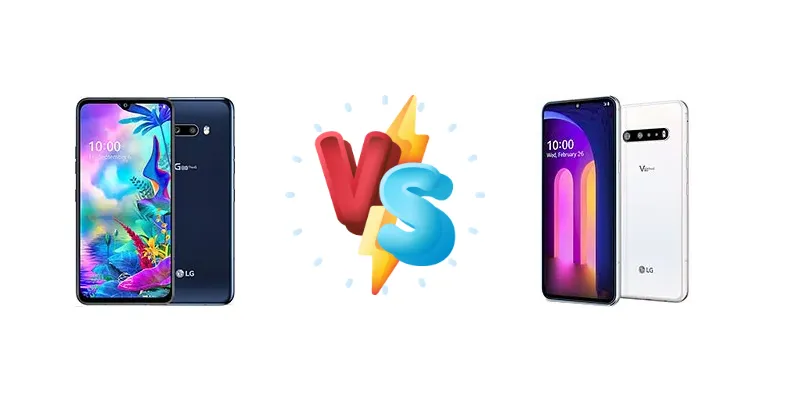
The LG V50S ThinQ 5G and V60 ThinQ 5G represent LG's attempts to establish themselves in the 5G flagship space. While both offer 5G connectivity and a premium experience, the V60 arrived as a refinement, boasting a newer chipset and subtle improvements. This comparison dissects the key differences to determine which device delivers the best value in today's market.
🏆 Quick Verdict
For most users, the LG V60 ThinQ 5G is the superior choice. The Snapdragon 865 provides a noticeable performance uplift and improved efficiency, while maintaining comparable battery life to the V50S. Though the V50S may be available at a lower price, the V60’s future-proofing and smoother experience justify the investment.
| Network |
|---|
| 2G bands | GSM 850 / 900 / 1800 / 1900 | GSM 850 / 900 / 1800 / 1900 |
| 3G bands | HSDPA 850 / 900 / 1700(AWS) / 1900 / 2100 | HSDPA 850 / 900 / 1700(AWS) / 1900 / 2100 |
| 4G bands | 1, 2, 3, 4, 5, 7, 8, 12, 13, 17, 20, 25, 26, 28, 40, 41 | 2, 4, 5, 12, 25, 26, 41, 46, 48, 66, 71 - USA |
| 5G bands | 41 NSA | 2, 25, 41, 66, 71 SA/NSA/Sub6 |
| Speed | HSPA 42.2/5.76 Mbps, LTE Cat19 1600/75 Mbps, 5G (2+ Gbps DL) | HSPA 42.2/5.76 Mbps, LTE (7CA) Cat22, 5G |
| Technology | GSM / CDMA / HSPA / EVDO / LTE / 5G | GSM / CDMA / HSPA / EVDO / LTE / 5G |
| | CDMA2000 1xEV-DO | CDMA2000 1xEV-DO |
| Launch |
|---|
| Announced | 2019, October. Released 2019, October | 2020, February 26. Released 2020, March 20 |
| Status | Discontinued | Discontinued |
| Body |
|---|
| Build | Glass front (Gorilla Glass 5), glass back (Gorilla Glass 6), aluminum frame | Glass front (Gorilla Glass 5), glass back (Gorilla Glass 6), aluminum frame |
| Dimensions | 159.3 x 75.8 x 8.4 mm (6.27 x 2.98 x 0.33 in) | 169.3 x 77.6 x 8.9 mm (6.67 x 3.06 x 0.35 in) |
| SIM | · Nano-SIM· Nano-SIM + Nano-SIM | · Nano-SIM· Nano-SIM + Nano-SIM |
| Weight | 192 g (6.77 oz) | 213 g (Global)/ 218 g (Verizon) (7.51 oz) |
| | IP68 dust/water resistant (up to 1.5m for 30 min)
MIL-STD-810G compliant*
*does not guarantee ruggedness or use in extreme conditions | IP68 dust/water resistant (up to 1.5m for 30 min)
MIL-STD-810G compliant*
Method 516.6, Procedure IV "Transit Drop"
*does not guarantee ruggedness or use in extreme conditions |
| Display |
|---|
| Protection | Corning Gorilla Glass 5 | Corning Gorilla Glass 5 |
| Resolution | 1080 x 2340 pixels, 19.5:9 ratio (~403 ppi density) | 1080 x 2460 pixels (~395 ppi density) |
| Size | 6.4 inches, 100.5 cm2 (~83.3% screen-to-body ratio) | 6.8 inches, 109.8 cm2 (~83.6% screen-to-body ratio) |
| Type | OLED, HDR10 | P-OLED, HDR10+ |
| | Always-on display | Always-on display |
| Platform |
|---|
| CPU | Octa-core (1x2.84 GHz Kryo 485 & 3x2.42 GHz Kryo 485 & 4x1.78 GHz Kryo 485) | Octa-core (1x2.84 GHz Cortex-A77 & 3x2.42 GHz Cortex-A77 & 4x1.80 GHz Cortex-A55) |
| Chipset | Qualcomm SM8150 Snapdragon 855 (7 nm) | Qualcomm SM8250 Snapdragon 865 5G (7 nm+) |
| GPU | Adreno 640 | Adreno 650 |
| OS | Android 9.0 (Pie), upgradable to Android 12 | Android 10, upgradable to Android 13 |
| Memory |
|---|
| Card slot | microSDXC (uses shared SIM slot) - dual-SIM model | microSDXC (uses shared SIM slot) - dual-SIM model |
| Internal | 256GB 8GB RAM | 128GB 8GB RAM, 256GB 8GB RAM |
| | UFS 2.1 | UFS 2.1 |
| Main Camera |
|---|
| Dual | 12 MP, f/1.8, 27mm (standard), 1/2.55", 1.4µm, dual pixel PDAF, OIS
13 MP, f/2.4, 9mm (ultrawide), 1/3.4", 1.0µm | 64 MP, f/1.8, 27mm (standard), 1/1.72", 0.8µm, dual pixel PDAF, OIS
13 MP, f/1.9, 12mm (ultrawide), 1/3.4", 1.0µm
0.3 MP, TOF 3D, f/1.4, (depth) |
| Features | Dual-LED dual-tone flash, HDR, panorama | Dual-LED dual-tone flash, HDR, panorama |
| Video | 4K@30/60fps, 1080p@30/60/240fps, 24-bit/192kHz stereo sound rec., gyro-EIS | 8K@30fps, 4K@30/60fps, 1080p, HDR10+, 24-bit/192kHz stereo sound rec., gyro-EIS |
| Selfie camera |
|---|
| Features | HDR | HDR |
| Single | 32 MP, f/1.9, 26mm (wide), 1/2.8", 0.8µm | 10 MP, f/1.9, 30mm (standard), 1/3.1", 1.22µm |
| Video | 4K@30fps, gyro-EIS | 4K@30fps, gyro-EIS |
| Sound |
|---|
| 3.5mm jack | Yes | Yes |
| 35mm jack | Yes | Yes |
| Loudspeaker | Yes, with stereo speakers | Yes, with stereo speakers |
| | 32-bit/192kHz audio
24-bit/192kHz audio recording
Tuned by Meridian Audio | 32-bit/192kHz audio
24-bit/192kHz audio recording |
| Comms |
|---|
| Bluetooth | 5.0, A2DP, LE, aptX HD | 5.1, A2DP, LE, aptX HD |
| NFC | Yes | Yes |
| Positioning | GPS, GLONASS, GALILEO, BDS | GPS, GLONASS, GALILEO, BDS |
| Radio | FM radio | FM radio (USA model only) |
| USB | USB Type-C 3.1, OTG | USB Type-C 3.1, OTG |
| WLAN | Wi-Fi 802.11 a/b/g/n/ac, dual-band, Wi-Fi Direct, DLNA | Wi-Fi 802.11 a/b/g/n/ac/6, dual-band, Wi-Fi Direct, DLNA |
| Features |
|---|
| Sensors | Fingerprint (under display, optical), accelerometer, gyro, proximity, compass, barometer | Fingerprint (under display, optical), accelerometer, gyro, proximity, compass, barometer |
| Battery |
|---|
| Charging | 21W wired, PD, QC3
9W wireless | Wired, PD2.0, QC4
Wireless |
| Type | Li-Po 4000 mAh, non-removable | Li-Po 5000 mAh |
| Misc |
|---|
| Colors | Aurora Black | Classy Blue, Classy White |
| Models | LM-V510N | LM-V600, A001LG |
| Price | About 1100 EUR | About 700 EUR |
| Tests |
|---|
| Battery life | - |
Endurance rating 103h
|
LG V50S ThinQ 5G
- Potentially lower price point
- Solid performance for everyday tasks
- Comparable battery life to V60
- Older Snapdragon 855 chipset
- Less efficient CPU architecture
- Slower charging speeds
LG V60 ThinQ 5G
- More powerful Snapdragon 865 chipset
- Improved CPU and GPU performance
- Faster charging with QC4
- Likely higher price
- May not offer a dramatic battery life improvement in typical use
- Potential for slightly more heat under sustained load (though mitigated by 7nm+)
Display Comparison
While both devices likely feature similar OLED panels, specific details like peak brightness and color gamut coverage are absent. However, the V60 benefits from the more advanced Snapdragon 865 ISP, potentially leading to better image processing for display output. The V50S, utilizing the Snapdragon 855, may exhibit slightly less refined color accuracy and dynamic range. Bezels are expected to be comparable, as both phones aimed for a premium aesthetic.
Camera Comparison
Detailed camera specs are unavailable, but the V60’s Snapdragon 865 ISP provides superior image processing capabilities. This translates to better dynamic range, noise reduction, and overall image quality, particularly in challenging lighting conditions. The V60’s ISP also supports faster autofocus and more advanced computational photography features. While both phones likely feature similar main sensor resolutions, the V60’s image processing pipeline will deliver more refined results. The absence of details on sensor sizes prevents a more granular comparison.
Performance
The core difference lies in the chipsets: the V50S sports the Snapdragon 855 (7nm) while the V60 features the Snapdragon 865 5G (7nm+). The 865’s Cortex-A77 cores represent an architectural improvement over the Kryo 485 cores in the 855, offering better single-core performance. The 7nm+ process node also contributes to improved thermal efficiency, potentially reducing throttling during sustained workloads. While both CPUs share a similar clock speed on their prime cores (2.84 GHz), the V60’s architecture and process node give it a clear advantage. The V60 also benefits from faster RAM speeds, likely LPDDR5, further enhancing responsiveness.
Battery Life
Both the V50S and V60 boast an endurance rating of 103 hours, suggesting comparable real-world battery life despite the V60’s more powerful chipset. This is likely due to the 7nm+ process node of the Snapdragon 865 offering improved power efficiency. The V60 supports faster charging with QC4, while the V50S uses QC3. This means the V60 will likely achieve a 0-100% charge faster, offering a convenience advantage. Both support wireless charging, but the V50S’s 9W rate is slower than the V60’s unspecified wireless charging speed.
Buying Guide
Buy the LG V50S ThinQ 5G if you prioritize maximizing value and are comfortable with a slightly older chipset. It’s a solid option for users who don’t demand the absolute latest performance and can find it at a significantly discounted price. Buy the LG V60 ThinQ 5G if you want a smoother, more responsive experience, especially for demanding tasks like gaming or video editing, and appreciate the benefits of the newer Snapdragon 865 platform.
Frequently Asked Questions
❓ Will the Snapdragon 855 in the V50S struggle with demanding games like Genshin Impact?
While the Snapdragon 855 can run Genshin Impact, you may experience more noticeable frame drops and throttling compared to the V60’s Snapdragon 865, especially during extended gaming sessions. The 865’s improved thermal efficiency and GPU architecture provide a smoother, more consistent gaming experience.
❓ Does the V60's faster charging significantly reduce charging time compared to the V50S?
Yes, the V60’s QC4 support will result in faster charging times. While exact figures depend on the charger used, expect a noticeable reduction in the time it takes to reach 100% compared to the V50S’s QC3 implementation. This is particularly beneficial for users who frequently need to quickly top up their battery.
❓ Is the 5G performance noticeably different between the V50S and V60?
The Snapdragon 865 in the V60 has an integrated 5G modem, offering potentially more efficient 5G connectivity compared to the external modem used in the V50S. This can translate to slightly better signal strength and data speeds in certain areas, though real-world differences may vary depending on network conditions.