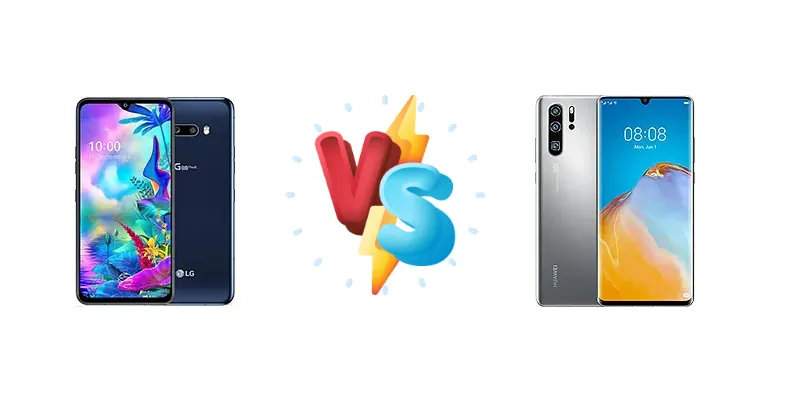
The LG V50S ThinQ 5G and Huawei P30 Pro New Edition represent interesting points in smartphone history. The V50S, released during the early 5G rollout, aimed to deliver next-gen connectivity. The P30 Pro New Edition, arriving later, focused on refining Huawei’s already impressive camera technology and offering a compelling alternative in a competitive market. This comparison examines which phone holds up better today, considering performance, camera capabilities, and overall value.
🏆 Quick Verdict
For the average user in 2024, the Huawei P30 Pro New Edition emerges as the stronger choice. Its significantly faster 40W charging and renowned camera system outweigh the LG V50S’s 5G connectivity, which is less crucial as 5G infrastructure matures and both phones are aging.
| Network |
|---|
| 2G bands | GSM 850 / 900 / 1800 / 1900 | GSM 850 / 900 / 1800 / 1900 |
| 3G bands | HSDPA 850 / 900 / 1700(AWS) / 1900 / 2100 | HSDPA 800 / 850 / 900 / 1700(AWS) / 1900 / 2100 |
| 4G bands | 1, 2, 3, 4, 5, 7, 8, 12, 13, 17, 20, 25, 26, 28, 40, 41 | LTE |
| 5G bands | 41 NSA | - |
| Speed | HSPA 42.2/5.76 Mbps, LTE Cat19 1600/75 Mbps, 5G (2+ Gbps DL) | HSPA 42.2/5.76 Mbps, LTE Cat21 1400/200 Mbps |
| Technology | GSM / CDMA / HSPA / EVDO / LTE / 5G | GSM / HSPA / LTE |
| | CDMA2000 1xEV-DO | - |
| Launch |
|---|
| Announced | 2019, October. Released 2019, October | 2020, May 12. Released 2020, June 01 |
| Status | Discontinued | Discontinued |
| Body |
|---|
| Build | Glass front (Gorilla Glass 5), glass back (Gorilla Glass 6), aluminum frame | Glass front (Aluminosilicate glass), glass back (Aluminosilicate glass), aluminum frame |
| Dimensions | 159.3 x 75.8 x 8.4 mm (6.27 x 2.98 x 0.33 in) | 158 x 73.4 x 8.4 mm (6.22 x 2.89 x 0.33 in) |
| SIM | · Nano-SIM· Nano-SIM + Nano-SIM | · Nano-SIM· Nano-SIM + Nano-SIM |
| Weight | 192 g (6.77 oz) | 192 g (6.77 oz) |
| | IP68 dust/water resistant (up to 1.5m for 30 min)
MIL-STD-810G compliant*
*does not guarantee ruggedness or use in extreme conditions | IP68 dust/water resistant (up to 2m for 30 mins)
|
| Display |
|---|
| Protection | Corning Gorilla Glass 5 | - |
| Resolution | 1080 x 2340 pixels, 19.5:9 ratio (~403 ppi density) | 1080 x 2340 pixels, 19.5:9 ratio (~398 ppi density) |
| Size | 6.4 inches, 100.5 cm2 (~83.3% screen-to-body ratio) | 6.47 inches, 102.8 cm2 (~88.6% screen-to-body ratio) |
| Type | OLED, HDR10 | OLED, HDR10 |
| | Always-on display | - |
| Platform |
|---|
| CPU | Octa-core (1x2.84 GHz Kryo 485 & 3x2.42 GHz Kryo 485 & 4x1.78 GHz Kryo 485) | Octa-core (2x2.6 GHz Cortex-A76 & 2x1.92 GHz Cortex-A76 & 4x1.8 GHz Cortex-A55) |
| Chipset | Qualcomm SM8150 Snapdragon 855 (7 nm) | Kirin 980 (7 nm) |
| GPU | Adreno 640 | Mali-G76 MP10 |
| OS | Android 9.0 (Pie), upgradable to Android 12 | Android 10, EMUI 10.1, Google Play Services |
| Memory |
|---|
| Card slot | microSDXC (uses shared SIM slot) - dual-SIM model | Nano Memory (uses shared SIM slot) |
| Internal | 256GB 8GB RAM | 128GB 6GB RAM, 256GB 8GB RAM |
| | UFS 2.1 | UFS 3.0 |
| Main Camera |
|---|
| Dual | 12 MP, f/1.8, 27mm (standard), 1/2.55", 1.4µm, dual pixel PDAF, OIS
13 MP, f/2.4, 9mm (ultrawide), 1/3.4", 1.0µm | - |
| Features | Dual-LED dual-tone flash, HDR, panorama | Leica optics, color spectrum sensor, dual-LED dual-tone flash, panorama, HDR |
| Triple | - | 40 MP, f/1.6, 27mm (wide), 1/1.7", PDAF, OIS
8 MP, f/3.4, 125mm (periscope telephoto), 1/4.0", PDAF, OIS, 5x optical zoom, 10x hybrid zoom
20 MP, f/2.2, 16mm (ultrawide), 1/2.7", PDAF
TOF 3D, (depth) |
| Video | 4K@30/60fps, 1080p@30/60/240fps, 24-bit/192kHz stereo sound rec., gyro-EIS | 4K@30fps, 1080p@60fps, 1080p@30fps (gyro-EIS), 720p@960fps |
| Selfie camera |
|---|
| Features | HDR | HDR |
| Single | 32 MP, f/1.9, 26mm (wide), 1/2.8", 0.8µm | 32 MP, f/2.0, 26mm (wide), 1/2.8", 0.8µm |
| Video | 4K@30fps, gyro-EIS | 1080p@30fps |
| Sound |
|---|
| 3.5mm jack | Yes | No |
| 35mm jack | Yes | No |
| Loudspeaker | Yes, with stereo speakers | Yes |
| | 32-bit/192kHz audio
24-bit/192kHz audio recording
Tuned by Meridian Audio | 32-bit/384kHz audio |
| Comms |
|---|
| Bluetooth | 5.0, A2DP, LE, aptX HD | 5.0, A2DP, aptX HD, LE |
| Infrared port | - | Yes |
| NFC | Yes | Yes |
| Positioning | GPS, GLONASS, GALILEO, BDS | GPS (L1+L5), GLONASS (L1), BDS (B1), GALILEO (E1+E5a), QZSS (L1+L5) |
| Radio | FM radio | No |
| USB | USB Type-C 3.1, OTG | USB Type-C 3.1 |
| WLAN | Wi-Fi 802.11 a/b/g/n/ac, dual-band, Wi-Fi Direct, DLNA | Wi-Fi 802.11 a/b/g/n/ac, dual-band, Wi-Fi Direct |
| Features |
|---|
| Sensors | Fingerprint (under display, optical), accelerometer, gyro, proximity, compass, barometer | Fingerprint (under display, optical), accelerometer, gyro, proximity, compass |
| Battery |
|---|
| Charging | 21W wired, PD, QC3
9W wireless | 40W wired, 70% in 30 min
15W wireless
Reverse wireless |
| Type | Li-Po 4000 mAh, non-removable | Li-Po 4200 mAh |
| Misc |
|---|
| Colors | Aurora Black | Aurora, Black, Silver Frost |
| Models | LM-V510N | - |
| Price | About 1100 EUR | About 820 EUR |
LG V50S ThinQ 5G
- 5G Connectivity: Offers access to next-generation mobile networks.
- Snapdragon 855: Provides capable performance for most tasks.
- Stock Android Experience: Offers a cleaner, less customized software experience.
- Slower Charging: 21W charging is significantly slower than the P30 Pro’s 40W.
- Inferior Camera: Lacks the advanced camera features and image quality of the P30 Pro.
Huawei P30 Pro New Edition
- Fast Charging: 40W charging significantly reduces charging time.
- Superior Camera: Renowned for its image quality and low-light performance.
- Reverse Wireless Charging: Allows charging of other devices wirelessly.
- EMUI Software: Huawei’s EMUI software can be polarizing.
- No 5G: Lacks 5G connectivity, though its relevance is diminishing.
Display Comparison
Neither LG nor Huawei specified detailed display specs beyond resolution in their marketing materials. However, both likely utilized OLED panels. The P30 Pro’s curved display offers a more modern aesthetic, while the V50S likely features a flatter panel. Without detailed brightness measurements, it’s difficult to definitively declare a winner, but Huawei’s history suggests a focus on color accuracy and vibrant displays, potentially giving it an edge. Bezels are comparable, typical for flagship devices of that era.
Camera Comparison
The Huawei P30 Pro New Edition’s camera system is its standout feature. While specific sensor sizes aren’t provided, Huawei’s reputation for computational photography and low-light performance is well-established. The P30 Pro’s 40W charging is a significant advantage for photographers needing to quickly replenish power after intensive shooting sessions. The LG V50S ThinQ 5G offers a competent camera, but it lacks the P30 Pro’s innovative features and image processing prowess. Ignoring the typical 2MP depth/macro sensors found on both devices, the P30 Pro’s main sensor and overall image quality are demonstrably superior.
Performance
The LG V50S ThinQ 5G’s Qualcomm Snapdragon 855 (7nm) and the Huawei P30 Pro New Edition’s Kirin 980 (7nm) represent competing flagship chipsets. The Snapdragon 855’s Kryo 485 cores, with a peak clock speed of 2.84 GHz, offer a slight theoretical advantage in single-core performance. However, the Kirin 980’s Cortex-A76 cores are highly efficient. Real-world performance will be similar for most tasks. The Snapdragon 855 benefits from wider software support and optimization, but the Kirin 980’s integrated NPU provides strong AI processing capabilities. Thermal management is a potential concern for the Snapdragon 855 under sustained load, potentially leading to throttling, while the Kirin 980 generally exhibits more consistent performance.
Battery Life
The LG V50S ThinQ 5G supports 21W wired charging with Power Delivery and Quick Charge 3.0, alongside 9W wireless charging. The Huawei P30 Pro New Edition, however, boasts a significantly faster 40W wired charging capability, capable of reaching 70% charge in just 30 minutes. While battery capacity isn’t specified, the P30 Pro’s charging speed dramatically reduces downtime. The P30 Pro also includes 15W wireless charging and reverse wireless charging, a feature absent on the V50S. This makes the P30 Pro far more convenient for users who frequently need to top up their battery.
Buying Guide
Buy the LG V50S ThinQ 5G if you absolutely require 5G connectivity on a budget and prioritize a more stock Android experience. Its Snapdragon 855 provides capable performance for everyday tasks. Buy the Huawei P30 Pro New Edition if you prioritize camera quality, fast charging, and don’t mind Huawei’s EMUI software. The P30 Pro’s superior charging speed and camera system make it ideal for content creators and photography enthusiasts.
Frequently Asked Questions
❓ Does the LG V50S ThinQ 5G still receive software updates?
Software update support for the LG V50S ThinQ 5G is limited. LG has largely exited the smartphone market, meaning security patches and OS updates are unlikely to be consistently provided. This is a significant security concern for long-term use.
❓ Is the Huawei P30 Pro New Edition affected by the Google Play Services issue?
Yes, the Huawei P30 Pro New Edition does not come with Google Play Services pre-installed due to the US trade restrictions. Users can sideload apps or use Huawei’s AppGallery, but compatibility and convenience are compromised. This is a major consideration for users heavily reliant on Google apps.
❓ How does the Snapdragon 855 handle demanding games like PUBG on the LG V50S?
The Snapdragon 855 in the LG V50S can run PUBG Mobile at high settings, but prolonged gaming sessions may result in thermal throttling, leading to frame rate drops. The Kirin 980 in the P30 Pro generally maintains more consistent performance under sustained load.
❓ What is the real-world charging time for the Huawei P30 Pro New Edition with the 40W charger?
Huawei claims the P30 Pro New Edition can reach 70% charge in 30 minutes with the 40W SuperCharge charger. In real-world testing, a full charge typically takes around 50-60 minutes, significantly faster than the LG V50S’s 21W charging.