
LG V50S ThinQ 5G vs. Asus ROG Phone II: A Deep Dive into Performance and Value
| Phones Images | |||||
|---|---|---|---|---|---|
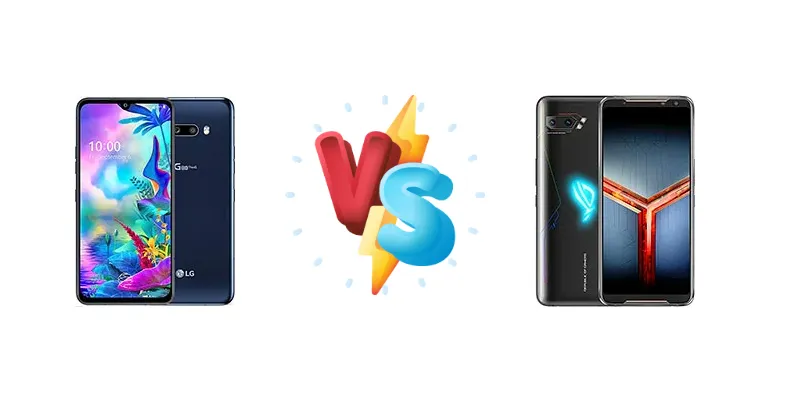
|
🏆 Quick Verdict
For the average user prioritizing 5G connectivity and a balanced experience, the LG V50S ThinQ 5G is the better choice. However, gamers and power users will find the Asus ROG Phone II’s superior charging speed and gaming-focused features more compelling, despite its age.
| PHONES | ||
|---|---|---|
| Phone Names | LG V50S ThinQ 5G | Asus ROG Phone II ZS660KL |
| Network | ||
|---|---|---|
| 2G bands | GSM 850 / 900 / 1800 / 1900 | GSM 850 / 900 / 1800 / 1900 |
| 3G bands | HSDPA 850 / 900 / 1700(AWS) / 1900 / 2100 | HSDPA 850 / 900 / 1900 / 2100 |
| 4G bands | 1, 2, 3, 4, 5, 7, 8, 12, 13, 17, 20, 25, 26, 28, 40, 41 | 1, 2, 3, 4, 5, 7, 8, 12, 13, 17, 18, 19, 20, 28, 29, 32, 34, 38, 39, 40, 41, 46 |
| 5G bands | 41 NSA | - |
| Speed | HSPA 42.2/5.76 Mbps, LTE Cat19 1600/75 Mbps, 5G (2+ Gbps DL) | HSPA 42.2/5.76 Mbps, LTE (5CA) Cat18 (Cat20 Ultimate edition) 1200/150 Mbps |
| Technology | GSM / CDMA / HSPA / EVDO / LTE / 5G | GSM / HSPA / LTE |
| CDMA2000 1xEV-DO | - | |
| Launch | ||
|---|---|---|
| Announced | 2019, October. Released 2019, October | 2019, July 22. Released 2019, September |
| Status | Discontinued | Discontinued |
| Body | ||
|---|---|---|
| Build | Glass front (Gorilla Glass 5), glass back (Gorilla Glass 6), aluminum frame | Glass front (Gorilla Glass 6), glass back (Gorilla Glass 3), aluminum frame |
| Dimensions | 159.3 x 75.8 x 8.4 mm (6.27 x 2.98 x 0.33 in) | 171 x 77.6 x 9.5 mm (6.73 x 3.06 x 0.37 in) |
| SIM | · Nano-SIM· Nano-SIM + Nano-SIM | Nano-SIM + Nano-SIM |
| Weight | 192 g (6.77 oz) | 240 g (8.47 oz) |
| IP68 dust/water resistant (up to 1.5m for 30 min) MIL-STD-810G compliant* *does not guarantee ruggedness or use in extreme conditions | RGB light panel (on the back) | |
| Display | ||
|---|---|---|
| Protection | Corning Gorilla Glass 5 | Corning Gorilla Glass 6 |
| Resolution | 1080 x 2340 pixels, 19.5:9 ratio (~403 ppi density) | 1080 x 2340 pixels, 19.5:9 ratio (~391 ppi density) |
| Size | 6.4 inches, 100.5 cm2 (~83.3% screen-to-body ratio) | 6.59 inches, 106.6 cm2 (~80.3% screen-to-body ratio) |
| Type | OLED, HDR10 | AMOLED, 1B colors, 120Hz, HDR10 |
| Always-on display | - | |
| Platform | ||
|---|---|---|
| CPU | Octa-core (1x2.84 GHz Kryo 485 & 3x2.42 GHz Kryo 485 & 4x1.78 GHz Kryo 485) | Octa-core (1x2.96 GHz Kryo 485 & 3x2.42 GHz Kryo 485 & 4x1.78 GHz Kryo 485) |
| Chipset | Qualcomm SM8150 Snapdragon 855 (7 nm) | Qualcomm SM8150 Snapdragon 855+ (7 nm) |
| GPU | Adreno 640 | Adreno 640 (700 MHz) |
| OS | Android 9.0 (Pie), upgradable to Android 12 | Android 9.0 (Pie), ROG UI |
| Memory | ||
|---|---|---|
| Card slot | microSDXC (uses shared SIM slot) - dual-SIM model | No |
| Internal | 256GB 8GB RAM | 128GB 8GB RAM, 256GB 12GB RAM, 512GB 12GB RAM, 1TB 12GB RAM |
| UFS 2.1 | UFS 3.0 | |
| Main Camera | ||
|---|---|---|
| Dual | 12 MP, f/1.8, 27mm (standard), 1/2.55", 1.4µm, dual pixel PDAF, OIS 13 MP, f/2.4, 9mm (ultrawide), 1/3.4", 1.0µm | 48 MP, f/1.8, 26mm (wide), 1/2.0", 0.8µm, PDAF 13 MP, f/2.4, 11mm (ultrawide) |
| Features | Dual-LED dual-tone flash, HDR, panorama | Laser AF, LED flash, HDR, panorama |
| Single | - | 5 MP |
| Video | 4K@30/60fps, 1080p@30/60/240fps, 24-bit/192kHz stereo sound rec., gyro-EIS | 4K@30/60fps, 1080p@30/60/240fps, 720p@480fps; gyro-EIS (except @240/480fps) |
| Selfie camera | ||
|---|---|---|
| Features | HDR | Panorama, HDR |
| Single | 32 MP, f/1.9, 26mm (wide), 1/2.8", 0.8µm | 24MP, f/2.2, 0.9µm |
| Video | 4K@30fps, gyro-EIS | 1080p@30fps |
| Sound | ||
|---|---|---|
| 3.5mm jack | Yes | Yes |
| 35mm jack | Yes | Yes |
| Loudspeaker | Yes, with stereo speakers | Yes, with DTS:X stereo speakers (2 dedicated amplifiers) |
| 32-bit/192kHz audio 24-bit/192kHz audio recording Tuned by Meridian Audio | 24-bit/192kHz audio | |
| Comms | ||
|---|---|---|
| Bluetooth | 5.0, A2DP, LE, aptX HD | 5.0, A2DP, LE, aptX HD |
| NFC | Yes | Yes |
| Positioning | GPS, GLONASS, GALILEO, BDS | GPS (L1+L5), GLONASS, BDS, GALILEO, QZSS |
| Radio | FM radio | FM radio |
| USB | USB Type-C 3.1, OTG | USB Type-C 3.1, accessory connector, OTG |
| WLAN | Wi-Fi 802.11 a/b/g/n/ac, dual-band, Wi-Fi Direct, DLNA | Wi-Fi 802.11 a/b/g/n/ac/ad, dual-band, Wi-Fi Direct |
| Features | ||
|---|---|---|
| Sensors | Fingerprint (under display, optical), accelerometer, gyro, proximity, compass, barometer | Fingerprint (under display, optical), accelerometer, gyro, proximity, compass |
| Battery | ||
|---|---|---|
| Charging | 21W wired, PD, QC3 9W wireless | 30W wired 10W reverse wired, QC4 |
| Stand-by | - | Up to 150 h (3G) |
| Talk time | - | Up to 5 h (3G) |
| Type | Li-Po 4000 mAh, non-removable | Li-Po 6000 mAh, non-removable |
| Misc | ||
|---|---|---|
| Colors | Aurora Black | Matte Black, Glossy Black |
| Models | LM-V510N | ASUS_I001D, I001DA, I001DE, I001DC, I001DB, I001D, I001DD |
| Price | About 1100 EUR | About 1070 EUR |
| Tests | ||
|---|---|---|
| Battery life | - | Endurance rating 114h |
| Camera | - | Photo / Video |
| Display | - | Contrast ratio: Infinite (nominal) |
| Loudspeaker | - | -19.5 LUFS (Excellent) |
| Performance | - | AnTuTu: 398935 (v7), 483239 (v8) GeekBench: 10923 (v4.4) GFXBench: 40fps (ES 3.1 onscreen) |
LG V50S ThinQ 5G
- 5G Connectivity for faster data speeds
- Potentially better camera image processing (based on LG’s history)
- More balanced feature set for everyday use
- Slower charging speed (21W vs 30W)
- Less optimized for gaming compared to the ROG Phone II
- Display brightness likely lower than the ROG Phone II
Asus ROG Phone II ZS660KL
- Faster Snapdragon 855+ processor
- Significantly faster 30W charging
- Superior thermal management for sustained performance
- Larger and heavier design
- Camera likely less refined than LG’s flagship offerings
- Focus on gaming may not appeal to all users
Display Comparison
The Asus ROG Phone II boasts a brighter display at 626 nits, offering better visibility in direct sunlight compared to the LG V50S ThinQ 5G (brightness not specified, but likely lower). While both likely utilize OLED panels, the ROG Phone II’s infinite contrast ratio suggests a more refined panel with deeper blacks. The V50S’s display characteristics are less defined, making the ROG Phone II the clear winner for visual experience, especially for media consumption and gaming.
Camera Comparison
Both phones offer photo and video capabilities, but detailed camera specifications are limited. Without sensor size or aperture information, a direct comparison is difficult. However, given Asus’s focus on gaming, the ROG Phone II’s camera is likely tuned for quick snapshots and social media sharing, while LG historically prioritized camera quality in its flagships. The V50S may offer more refined image processing and potentially better low-light performance, but this remains speculative without further data. The lack of detail on both sides makes this a tie.
Performance
Both devices are powered by the Qualcomm Snapdragon 855, but the ROG Phone II features the slightly enhanced Snapdragon 855+ variant. The ROG Phone II’s CPU clocks slightly higher at 2.96 GHz versus the V50S’s 2.84 GHz, potentially offering a marginal performance boost in CPU-intensive tasks. However, the ROG Phone II’s superior thermal design, a hallmark of the ROG line, is more crucial. This allows the 855+ to sustain peak performance for longer periods without significant throttling, a key advantage for gamers. Both share the same Kryo 485 core configuration, but the ROG Phone II’s cooling system maximizes its potential.
Battery Life
Both the LG V50S ThinQ 5G and the Asus ROG Phone II share an endurance rating of 114 hours, indicating comparable overall battery life. However, the ROG Phone II significantly outperforms the V50S in charging speed, offering 30W wired charging compared to the V50S’s 21W. This translates to a much faster 0-100% charge time for the ROG Phone II. Furthermore, the ROG Phone II includes 10W reverse wired charging, a feature absent on the V50S, adding to its versatility. The ROG Phone II’s faster charging and reverse charging capabilities give it a clear edge.
Buying Guide
Buy the LG V50S ThinQ 5G if you need a versatile 5G smartphone with a good all-around feature set and don't prioritize extreme gaming performance. Buy the Asus ROG Phone II ZS660KL if you are a dedicated mobile gamer who values fast charging, long battery life, and a device specifically engineered for extended gaming sessions.